

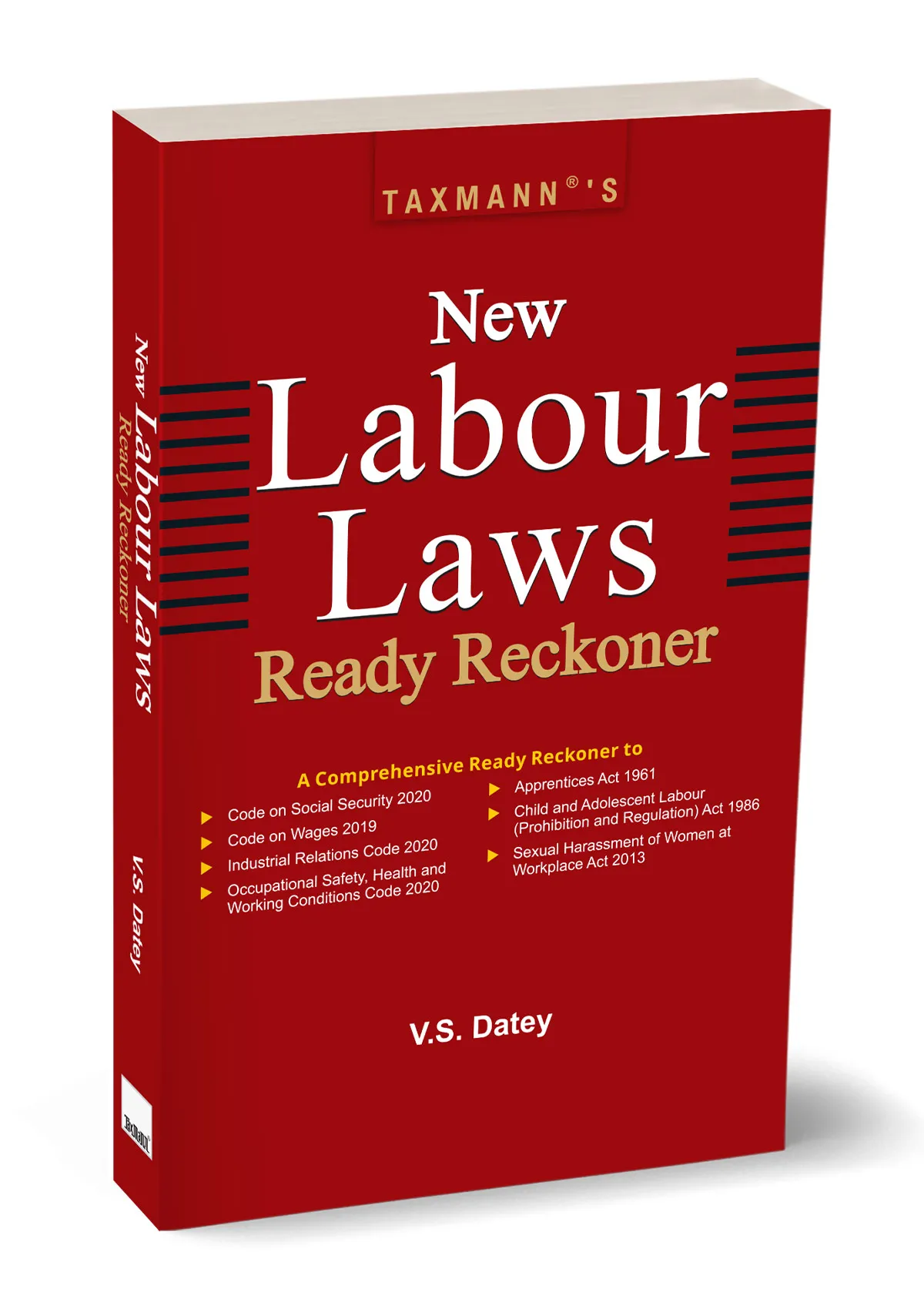
New Labour Laws Ready Reckoner | V S Datey | Edition 2026
Original price was: ₹1,795.00.₹1,345.00Current price is: ₹1,345.00.
New Labour Laws Ready Reckoner | V S Datey | Edition 2026
Description
New Labour Laws Ready Reckoner is a practitioner’s desk reference to the four Labour Codes as they presently operate. The work follows a uniform methodology on every page. A proposition is stated; its statutory source follows immediately, cited to the level of the proviso or Explanation; judicial authority is set alongside it; and where the drafting is deficient, the author records the deficiency.
This evaluative element distinguishes the work from a conventional restatement. The author does not treat the Codes as either settled or soundly drafted. He identifies provisions that appear to express the opposite of the evident legislative intention, requirements that cannot be complied with in practice, and definitions likely to give rise to protracted litigation. The reader is therefore furnished with the legal position, the supporting authority, and an assessment of the attendant risk.
The work proceeds from a single premise, stated at the outset and sustained throughout: the Codes consolidate, but they do not reform. The erstwhile enactments survive within them as substantially self-contained chapters, and the substantive law has, in the main, been carried forward. It follows that the body of precedent developed under the repealed Acts remains live authority, and the work is structured so as to render that authority readily traceable under the new numbering.
The currency of this title is material to its utility. The law altered repeatedly between November 2025 and August 2026: the Codes were brought into force, the Central Rules were notified thereafter, and the three provident fund schemes were superseded in their entirety. The law in this book is updated to 26th August 2026, placing it after each of these developments.
This book is intended for the following audience:
- HR and Industrial Relations Managers responsible for day-to-day compliance
- Payroll and Compensation Teams restructuring remuneration under the revised definition of wages
- Chartered Accountants and Finance Controllers addressing the accounting consequences arising from that definition
- Company Secretaries and In-House Counsel handling registrations, returns, standing orders and disciplinary proceedings
- Advocates Appearing Before Tribunals, Insurance Courts and the High Courts in service matters
- Labour Law Consultants administering multi-State and multi-establishment mandates
- Inspector-cum-Facilitators and Labour Department Officers
- Aggregators and Platform Businesses assessing exposure in respect of gig workers
- Employers’ Associations and Trade Union Office Bearers
- Faculty and Students of labour law and human resource management
The Present Publication is the 2026 Edition, authored by V.S. Datey, with the following noteworthy features:
- [Rules Integrated, Not Appended] The 2026 Central Rules framed under all four Codes are incorporated within the discussion at the point of their application. The statutory entitlement and the procedure by which it is given effect appear in the same paragraph. The Rules are not relegated to an annexure requiring separate reconciliation by the reader
- [Authority Cited to the Proviso] Every proposition concludes with its source. Citation extends to the level of the sub-section, proviso, Explanation, rule or scheme paragraph. A compliance officer may therefore extract a position together with its statutory anchor in a single reading
- [Section-wise Migration Charts from the Repealed Acts] Each Code division opens with tables pairing the new section number with the provision it has replaced. These furnish the practical bridge for re-anchoring existing precedent, compliance manuals, standing orders and letters of appointment without the need to repeat the underlying research
- [Extensive Case Law Carried Forward] The text contains in excess of 1,700 case citations drawn from upwards of one thousand distinct decisions. Reporting spans LLR, AIR, SCC, FJR, FLR, LLJ and Lab IC, with the strength of the Bench noted where material. The authority extends from the 1950s to decisions reported in 2026
- [Critical Assessment of Legislative Drafting] Where a provision is defectively drafted, unworkable or liable to generate litigation, the work states the position and sets out the reasons. The treatment of the common definition of wages affords the clearest illustration. This constitutes a working assessment rather than a neutral restatement
- [Dedicated Chapters on the Three 2026 Schemes] The replacement provident fund, pension and deposit-linked insurance schemes are each accorded a chapter of their own and examined paragraph by paragraph, including the transition from the schemes they have superseded
- [Accounting and Financial Reporting Consequences] The work reproduces the seven FAQs issued in December 2025 concerning the effect of the revised definition of wages upon financial reporting. These address past service cost, actuarial re-measurement, interim reporting, presentation as an exceptional item, and deferred tax
- [Historical Limits Retained Alongside Current Ones] Where a wage ceiling or monetary limit has been revised, the earlier figures and their respective effective dates are preserved. This is of consequence in any proceeding relating to an anterior period, in which the prevailing limit would be inapplicable
- [Rates and Thresholds Traced to Their Notifications] Rates and thresholds are not presented as bare figures. Each is traced to the notification by which it was fixed, together with the exceptions thereto, enabling the reader to verify the position rather than accept it on trust
- [Disciplinary Practice, Notwithstanding Its Omission from the Codes] An entire division addresses misconduct, domestic enquiry, punishment and judicial review. The Codes make no provision in respect of these matters, yet they govern every decision to terminate employment. The division rests almost wholly upon the authority of the Supreme Court and the High Courts
- [Common Definitions Treated in a Single Chapter] Terms common to all four Codes are dealt with in one chapter, with the variations between the Codes identified. This avoids repetition and isolates those instances in which a term does not bear the same meaning throughout
- [Provisions Not Yet in Force Identified] The work identifies the provisions that remain un-notified and the matters reserved for future notification, rather than presenting them as settled law
The coverage of the book is as follows:
- Division One | Labour Legislation Overview
- The rationale for the enactment of the Codes, the constitutional foundation of labour legislation, and the distribution of legislative and administrative authority between the Centre and the States. There follows the chapter on common definitions, addressing establishment, employer, employee, worker, factory, contractor, wages and cognate terms. The treatment of the definition of wages is extended and encompasses its accounting implications
- Division Two | Code on Social Security 2020
- The largest division, comprising sixteen chapters. Social Security Organisations and their administration. Provident fund, pension and deposit-linked insurance, with the three 2026 schemes in dedicated chapters. Employees’ State Insurance, including tests of coverage, benefits, occupational disease and the Insurance Court. Gratuity, from eligibility through computation, forfeiture, compulsory insurance and appeal. Maternity benefit and other provisions concerning women employees, including crèche facilities. Employees’ compensation. Cess and welfare in respect of building and construction workers. Social security for unorganised, gig and platform workers. Administration, recovery, offences and exemption
- Division Three | Code on Wages 2019
- Gender equality and equal remuneration. Minimum wages, including the floor wage and its components. Payment of wages, permissible deductions, fines and recoveries. Bonus, including the computation of surplus and the principles of set-on and set-off. Employer records and returns. Claims, appeals and burden of proof. Administration, inspection, offences and compounding
- Division Four | Industrial Relations Code 2020
- Works committees and grievance redressal. Trade unions, from registration through funds, immunities, negotiating unions and dissolution. Standing orders and notice of change. Conciliation, arbitration, Tribunals and awards. Strikes and lock-outs. Lay-off, retrenchment and closure, with the separate regime of prior permission applicable to larger establishments treated in a chapter of its own. Unfair labour practices and protected workmen
- Division Five | Occupational Safety, Health and Working Conditions Code 2020
- Seventeen chapters addressing registration, the duties of employers and employees, safety committees, health and working conditions, welfare provisions, hours of work and leave, and inspection. Contract labour and inter-State migrant workers receive extended treatment. Separate chapters deal with mines, factories, plantations, dock work, beedi and cigar work, construction and audio-visual workers. The employment of women, including night work, is treated separately
- Division Six | Miscellaneous Social Welfare Legislation
- The Apprentices Act. Child and adolescent labour. The legislation on sexual harassment, covering committees, inquiry, compensation and the duties of the employer. A further chapter takes up seven additional subjects, including senior citizens, the rights of persons with disabilities, street vendors, bonded labour, and the rural employment guarantee framework as recently replaced
- Division Seven | Disciplinary Action and Punishment
- Codes of conduct and the steps preceding formal action. Natural justice, charge sheets and the conduct of domestic enquiry. Specific heads of misconduct, from absence and abandonment to theft and misrepresentation at the time of engagement. Proportionality of punishment. Probationers, resignation, transfer and seniority. Appeal, judicial review, reinstatement and compensation in lieu thereof
Every chapter follows the same internal pattern:
- Numbered Paragraphs — Chapters are divided into paragraphs numbered in the form 11.2, with sub-paragraphs numbered 11.2-2. Every proposition thus carries an address. Cross-references and the index are keyed to these numbers and not to pages
- Two Heading Levels — Sub-paragraph headings are set in bold sans-serif and carry their number, standing out distinctly against the serif body text
- Run-in Catchlines — Within a paragraph, each discrete point opens with a bold italic catchline followed by the rule, so that an extended paragraph presents as a sequence of locatable propositions rather than as continuous prose
- Proposition First, Source Last — The rule opens the sentence and the citation concludes it. Provisos and Explanations are named and italicised within the citation
- Definitions Quoted in Full — Where a defined term is determinative, the definition is reproduced in the language of the Code together with its section reference. Where the Codes differ, both versions are set out
- Case Law in Place — Authority is placed adjacent to the proposition it supports rather than collected at the conclusion of the chapter. Case names are italicised and citations are given in full, with the court identified
- Three Recurring Tables, Ruled and Boxed with Italic Column Headings — The first maps each Code’s chapters to their sections and rules; the second lists the Schedules; the third compares the Code with the enactment it has replaced
- Key Highlights Blocks — The opening chapter of each Code carries a bulleted summary of the changes effected, written with an assessment attached rather than as neutral description
- Notes and Asides — The author’s observations appear as bracketed remarks within the text and as bold Note lines beneath the tables, drawing attention to anomalies and to divergences between Code and Rules
- Uniform Closing Pattern for Each Code — Every division concludes with offences and penalties, followed by miscellaneous provisions, overriding effect and repeal, so that the consequences of non-compliance are invariably located in the same position
- Running Heads — Each page carries the page number, the chapter title and the governing paragraph number, permitting a paragraph to be located without recourse to the contents
- Subject Index — Ten pages, arranged alphabetically and keyed to paragraph numbers, indexing both subjects and defined terms
Additional information
| BINDING | PAPERBACK |
|---|---|
| AUTHOR | VS DATEY |
| EDITION | 2026 |
| ISBN | 9789375617402 |
| PUBLICATION | TAXMANN PUBLICATIONS |
Related products
-
- Sale!
- LABOUR LAWS, DEPARTMENTAL ENQUIRIES, SERVICE LAWS, INDUSTRIAL LAW
Commercial’s New Labour & Industrial Code (along with draft rules) – 3rd Edition 2022
- Original price was: ₹1,095.00.₹825.00Current price is: ₹825.00.
- Add to cart
-
- Sale!
- LABOUR LAWS, DEPARTMENTAL ENQUIRIES, SERVICE LAWS, INDUSTRIAL LAW
Introduction to Labour and Industrial Laws I by Avtar Singh and Harpreet Kaur
- Original price was: ₹1,035.00.₹879.00Current price is: ₹879.00.
- Add to cart
-
- Out of StockSale!
- LABOUR LAWS, DEPARTMENTAL ENQUIRIES, SERVICE LAWS, INDUSTRIAL LAW
Whitesmann’s A to Z of Service Laws by Dr. Pramod Kumar Singh
- Original price was: ₹1,800.00.₹1,350.00Current price is: ₹1,350.00.
- Read more
-

Reviews
There are no reviews yet.