


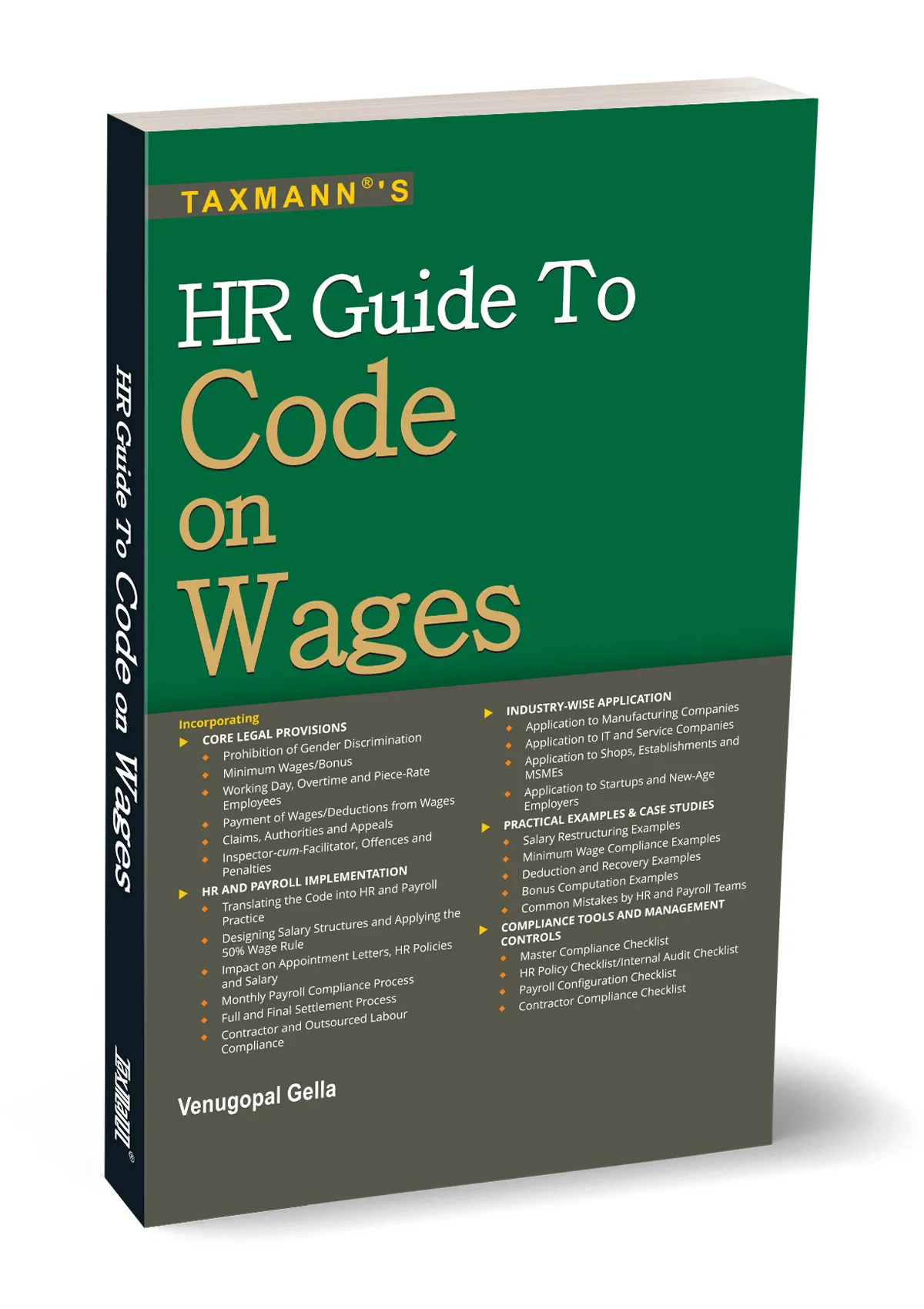
HR Guide to Code on Wages | Venugopal Gella | Edition 2026
Original price was: ₹1,195.00.₹895.00Current price is: ₹895.00.
HR Guide to Code on Wages | Venugopal Gella | Edition 2026
Description
HR Guide to Code on Wages is an implementation handbook on the Code on Wages, 2019, prepared for the professional responsible for operating payroll under the Code rather than for the reader seeking a statutory commentary.
The work’s composition reflects that purpose. It carries no case law and does not reproduce the bare Act. In their place, the reader finds more than 150 worked examples, of which 85 are full numerical computations set out as numbered paragraphs, together with ready formats, model clauses, control tables, registers, checklists, and management dashboards.
Each chapter concludes in an instrument capable of immediate use, whether a control, a format, a register, an exception report or a checklist. The author states the governing test at the outset and repeats it in the book’s closing note: compliance is not achieved when a policy has been drafted, but when compliant payroll can be processed, evidenced, and audited in every wage period. The work is organised backwards from that test.
The book is intended for the following audience:
- HR Heads and HR Business Partners responsible for appointment letters, salary annexures and policy documentation
- Payroll Managers and Payroll Processing Teams, in-house and outsourced
- CFOs and Finance Teams handling wage payments, bonus provisioning, statutory deposits and cost simulation
- Compliance Officers and Labour Law Consultants advising on the four labour codes
- Chartered Accountants and CA Firms handling payroll compliance, statutory audit support and labour law advisory
- Internal Auditors and Risk Teams designing wage and payroll audit programmes
- Managing Directors, Business Heads and Boards or Audit Committees accountable for labour code readiness
- Payroll Software Product Teams, HRMS Implementation Consultants and IT Teams configuring wage rules
- Admin and Procurement Teams responsible for contractor invoice release and principal employer risk
- Employers across manufacturing, IT and ITES, shops and establishments, MSMEs and startups, including multi-State and remote-first organisations
The Present Publication is the 2026 Edition, updated till August 2026. This book is authored by Venugopal Gella, with the following noteworthy features:
- [Grounded in Practitioner Engagement] The author has conducted regular knowledge sessions for HR and payroll professionals over a period of two years. The doubts, implementation gaps, and operational difficulties raised in those sessions form the basis of the examples, documented errors, and checklists in this work. The treatment therefore proceeds from the questions practitioners actually raise rather than from a chapter-wise survey of the statute
- [85 Numbered Numerical Computations] Comprising six salary structure illustrations; four complete restructuring exercises at monthly cost-to-company levels of ₹25,000, ₹50,000, ₹1,00,000 and ₹2,00,000, each presenting the existing structure, the deficiencies identified, the revised structure and the resulting payroll impact; twenty-five minimum wage compliance illustrations; twenty deduction and recovery illustrations; and thirty bonus computation illustrations. Each follows a uniform sequence of facts, computation, issue identified and corrective treatment, with assumptions stated in advance so that the arithmetic may be traced and re-performed on the reader’s own figures
- [Thirty-Four Documented Errors With Quantified Exposure] A dedicated chapter identifies each error by name, quantifies the consequence and prescribes the correction. It concludes with an error matrix, a ten-step corrective action roadmap, a model exception report and a fifteen-point self-assessment scorecard carrying a stated threshold for escalation
- [Ready-to-Use Formats and Templates] Nine annexures of immediately usable material, including a wage slip in eight blocks with nine additional fields for daily-rated, piece-rated and overtime employees; four sample salary structures with monthly and annual figures; a fifteen-row salary annexure template accompanied by a caution note for reproduction beneath it; six deduction authorisation formats; an eleven-column bonus working sheet with a four-year set-on and set-off register; and a contractor compliance certificate incorporating a thirteen-point declaration and an indemnity undertaking
- [Model Clauses in Drafting Language] Policy clauses, standard operating procedure clauses, certifications and declarations are reproduced verbatim at the point in the chapter at which the underlying obligation is discussed, permitting direct incorporation into a policy document or a contractor agreement
- [Contractor Compliance Constructed as a Payment Gate] An eight-step monthly compliance flow with designated owners, supported by worker-wise verification formats for wages, minimum wages, overtime, deductions and social security remittances; a ten-condition invoice release control; a fifteen-point red flag checklist; a 100-point contractor scorecard with four risk bands; a seventeen-folder monthly record structure; and four model agreement clauses
- [Payroll Configuration Set Out as a System Specification] Forty-five paragraphs specifying fifteen configuration modules, a twenty-two-field component master, thirteen employee category codes, sixteen deduction codes, a six-field wage rule engine, a ten-step minimum wage validation sequence, a six-step deduction cap rule, sixteen reports with prescribed frequencies, fifteen go-live test cases, user acceptance testing across eight user groups, eleven data protection controls and a configuration sign-off. The chapter concludes with a payroll system requirement statement suitable for use in software selection or a request for proposal
- [A Complete Internal Audit Programme] Comprising audit objective, scope, a five-step methodology, a pre-audit information request list, four risk levels, a documented sampling approach, eight sets of audit tests each with its own red flags, eight financial exposure formulas, a twelve-field observation format with a worked specimen, a thirteen-section report structure, a corrective action tracker, a management representation and fourteen workpapers
- [Four Industry-Specific Applications] Manufacturing, information technology and services, shops and MSMEs, and startups, each supported by its own risk table, skill mapping, monthly checklist, compliance matrix and dashboard. The startup chapter additionally provides a seven-stage payroll maturity model and a due diligence-ready employment folder for fundraising
- [A Day 0 to Day 90 Management Programme] Ten decisions required of management before commencement, phase-wise actions with designated owners and outputs, fourteen success criteria expressed at 100 per cent, a responsibility matrix across seven functions, a ten-risk implementation register subject to fortnightly review, and separate tracks for small and large employers
- [Thirty Documents Identified for Amendment] Extending from the offer letter to the contractor agreement, each with the amendment required, supported by a policy approval matrix, a ten-stage rollout timeline and an employee communication checklist. Seven clauses commonly found in existing appointment letters are identified as requiring review, with three model redrafts supplied
- [Every Provision Mapped to a Chapter] The statutory index does not summarise the law. Each row identifies the chapter of this handbook in which the provision, rule or Form is dealt with, so that a query arriving in statutory form may be answered from the work in a single step
- [Built on the 2026 Rules and the March 2026 Clarifications] The Central Rules are worked through rule by rule rather than cited in a list, and the clarifications are carried into the arithmetic of the illustrations, so that the reader observes the effect on a wage slip rather than the text of the clarification. Karnataka is adopted as the worked State illustration and is identified as being at draft stage throughout
The coverage of the book is as follows:
- Part 1 | Understanding the Code on Wages (Chapters 1 to 4)
- The mapping exercise that must precede all other work, namely the identification of the entity, the appropriate Government, the covered personnel and the operative definitions. The Part delivers an applicability map, an employee and worker comparison table, a practical definition matrix, and a nine-person classification case study covering a machine operator, a shift supervisor, an HR manager, an apprentice, a management trainee, a full-time consultant and contractor personnel
- Part 2 | Core Legal Provisions (Chapters 5 to 12)
- Eight chapters constructed to a uniform pattern, proceeding from the provision to its payroll consequence, then to worked illustrations, and finally to the instruments. The instruments include an equal remuneration review format and policy clause; a minimum wage review format and a variable dearness allowance tracker; an overtime approval format and policy clause; a payroll calendar and a payment compliance checklist; a deduction control table, a validation flowchart and a deduction approval format; a bonus working format and policy clause; a claim response file with a twelve-step response procedure; a due diligence evidence table; an inspection response format; and a dashboard directed at the prevention of penalties. Each chapter closes with common errors, internal audit questions, a summary and a set of practical questions
- Part 3 | HR and Payroll Implementation (Chapters 13 to 19)
- The principal implementation toolkit. It supplies an eight-column wage component dictionary and an eight-field minimum wage matrix; an eight-step method for testing the salary structure, supported by six worked illustrations; a twelve-area appointment letter map with model redrafts; a dated monthly payroll calendar with eight pre-closure reconciliations, an eleven-line exception report, an eighteen-item compliance file and a ten-metric dashboard; a full and final settlement chapter that fixes the trigger date for nine separation situations, works the day-count against a calendar, and provides a five-stage workflow and a fifteen-record settlement file; a contractor chapter with core and non-core analysis across seven establishment types, twelve invoice hold triggers, twenty agreement clauses and four model clauses; and a payroll software chapter drafted as a configuration specification
- Part 4 | Industry-Wise Application (Chapters 20 to 23)
- Four sector applications. Manufacturing addresses shop-floor activity mapping, skill classification where designation is not determinative, mixed work allocation records, shift and overtime risk situations, piece-rate protection, production incentive policy, and recoveries in respect of canteen, transport, personal protective equipment and damage. Information technology and services addresses cost-to-company mapping, flexible benefit structures, variable pay, work location capture for remote employees, timesheets by employee category, on-call and night shift arrangements, a ten-factor consultant classification test, and recoveries relating to devices, training bonds and bonus clawbacks. Shops and MSMEs addresses part-time proportionality, daily wage records, cash and stock shortage recovery, a five-file compliance model, a twelve-folder monthly structure and a compliance calendar. Startups addresses founder remuneration, the separation of equity instruments from wages, interns, clawbacks, investor due diligence and a payroll maturity model
- Part 5 | Practical Examples and Case Studies (Chapters 24 to 28)
- The illustrative core of the work. Salary restructuring is presented at four cost-to-company levels, supported by four case studies covering cost-neutral and gross-protected approaches, minimum wage exposure and annual incentives, together with a twelve-step process and a model employee communication. Twenty-five minimum wage illustrations span monthly, daily, hourly, part-time, piece-rate, mixed category, temporary, seasonal, migrant, contract, platform, trainee and fixed-term personnel. Twenty deduction illustrations demonstrate how recovery schedules extend where the statutory ceiling operates. Thirty bonus illustrations follow, and the Part concludes with thirty-four documented errors
- Part 6 | Compliance Tools and Management Controls (Chapters 29 to 34)
- The management and assurance layer. It provides a twenty-five-checkpoint master checklist with evidence and owner columns; a red, amber and green rating model; a 100-point weighted scorecard with four interpretive bands; nine topic-wise sub-checklists; a claim readiness checklist mapping seven categories of claim to the evidence each requires; a management certificate; a twelve-item quarterly review agenda; an action plan template; and a one-page board note format. These are followed by the HR policy checklist, the payroll configuration checklist, the contractor compliance checklist, the internal audit programme and the management implementation roadmap
- Part 7 | Annexures
- The documentation pack. It comprises a statutory index mapping each provision, rule and Form to the chapter in which it is dealt with; a comparison of the earlier laws with the Code presented in seven tables, including twenty-six compliance areas and a thirteen-item transition checklist; a classification table covering more than eighty salary and benefit components across six columns, supported by a nine-group risk matrix and fifteen payroll master fields; four salary structure formats; a wage slip; six deduction authorisation formats; a bonus working pack; a contractor compliance certificate; and a twenty-seven-area implementation checklist with designated owners and named evidence, accompanied by 30, 60 and 90-day checklists, a fifteen-metric monthly dashboard and a management sign-off format
Each chapter follows a uniform internal architecture, allowing the work to serve as a reference text on first reading and as a working paper thereafter.
- Opening Apparatus — A numbered chapter head followed by an orienting paragraph. Several chapters open instead with the questions HR and payroll teams commonly raise, which are then answered in sequence
- Statutory Anchor — Chapters dealing with legal provisions carry a Statutory References table before the discussion commences, setting out the governing provisions, the corresponding rules and the prescribed Forms
- Paragraph Numbering — Content is divided into decimal-numbered paragraphs, each carrying a bold running head, so that an individual issue may be cited and retrieved without reading the surrounding text. Many paragraph heads are framed as the question itself, with the result that the detailed contents operate as an index of practical problems
- Navigation — Each page carries the Part or Chapter name together with the paragraph number appearing on that page, enabling direct reference from the detailed contents and from the statutory index
- Tabular Treatment — Comparison tables, classification matrices, decision tables, control matrices, ownership matrices, compliance calendars and dashboards are employed wherever an issue involves more than two variables. Numerical positions are invariably presented in tabular form rather than in prose, and most tables carry a risk, purpose or relevance column
- Illustrations — Presented in a fixed sequence of facts, computation, issue identified and corrective treatment, with assumptions stated in advance
- Placement of Formats — Clauses, formats, certifications and templates appear within the chapter at the point at which the obligation is discussed, rather than being collected at the end of the work
- System Specifications — Where a control properly resides in software rather than in a document, the chapter specifies the master fields, the pay codes and the validation rule
- Closing Apparatus — Common Errors, Internal Audit Questions, a dashboard with stated targets, an implementation checklist and a Chapter Takeaway. Chapters in Parts 1 and 2 additionally carry a boxed Summary and a numbered set of Practical Questions
- Part Openers — Each Part opens with an editorial note explaining its function and the sequence in which its chapters should be read
- Annexure Divisions — Annexures are divided into lettered sections, each constituting a standalone format or checklist capable of direct incorporation into an organisation’s documentation
Additional information
| BINDING | PAPERBACK |
|---|---|
| AUTHOR | CA Venugopal Gella |
| EDITION | 2026 |
| ISBN | 9788167011916 |
| PUBLICATION | TAXMANN PUBLICATIONS |
Related products
-
- Out of StockSale!
- LABOUR LAWS, DEPARTMENTAL ENQUIRIES, SERVICE LAWS, INDUSTRIAL LAW
B.C. Publication’s Law on Disciplinary Proceedings by Kumar Jyoti Singh
- Original price was: ₹795.00.₹635.00Current price is: ₹635.00.
- Read more
-
-
- Sale!
- LABOUR LAWS, DEPARTMENTAL ENQUIRIES, SERVICE LAWS, INDUSTRIAL LAW
The Law of Services and Dismissals by Doabia & Doabia
- Original price was: ₹14,195.00.₹11,356.00Current price is: ₹11,356.00.
- Add to cart
-
- Out of StockSale!
- LABOUR LAWS, DEPARTMENTAL ENQUIRIES, SERVICE LAWS, INDUSTRIAL LAW
Commentaries on Employees’ Provident Funds and Miscellaneous Provisions Act, 1952 by V.K. Kharbanda – Edition 2022
- Original price was: ₹1,800.00.₹1,440.00Current price is: ₹1,440.00.
- Read more
-


Reviews
There are no reviews yet.