

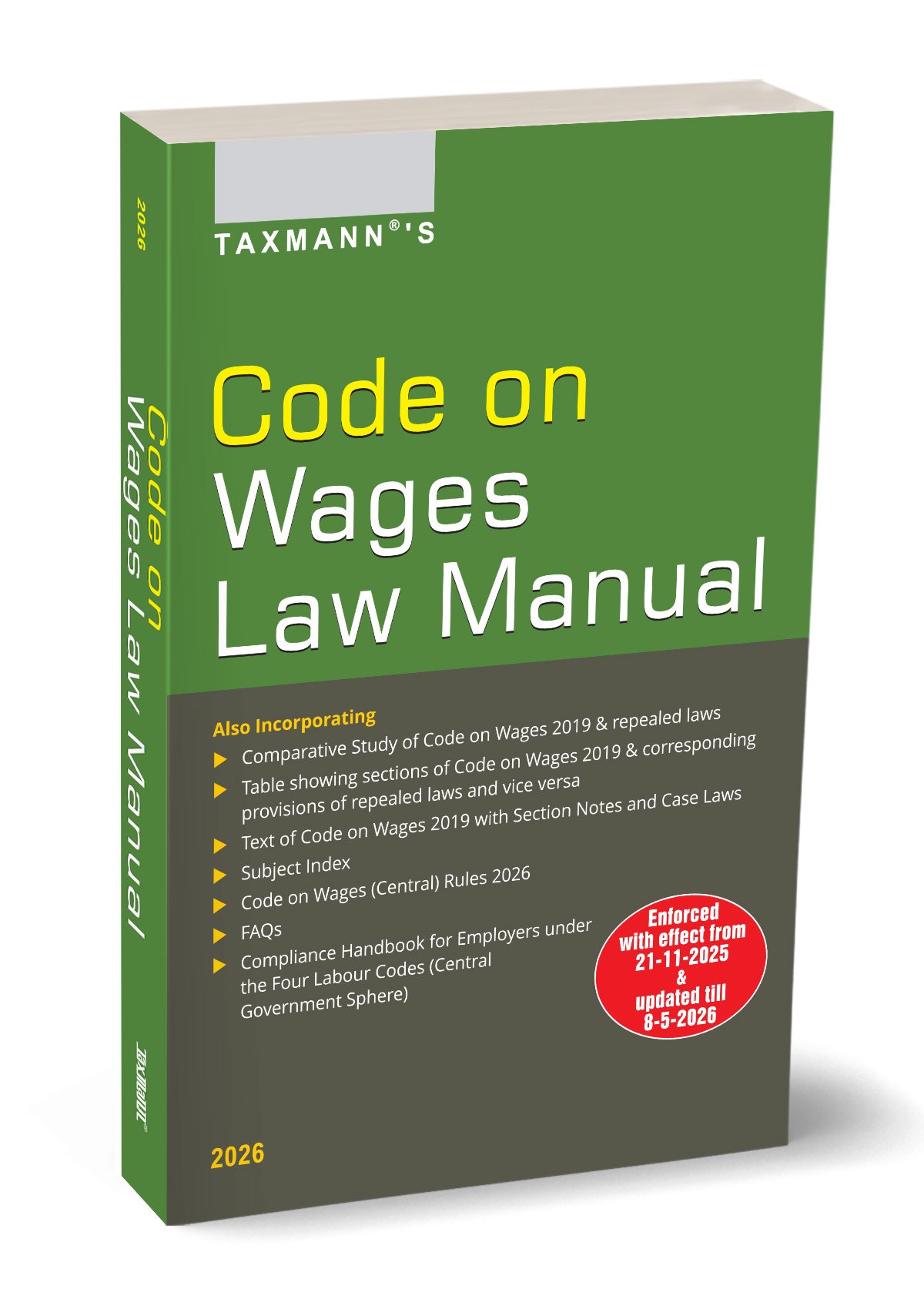
Code on Wages Law Manual By Taxmann – 1st May Edition 2026
Original price was: ₹495.00.₹425.00Current price is: ₹425.00.
Code on Wages Law Manual By Taxmann – 1st May Edition 2026
Description
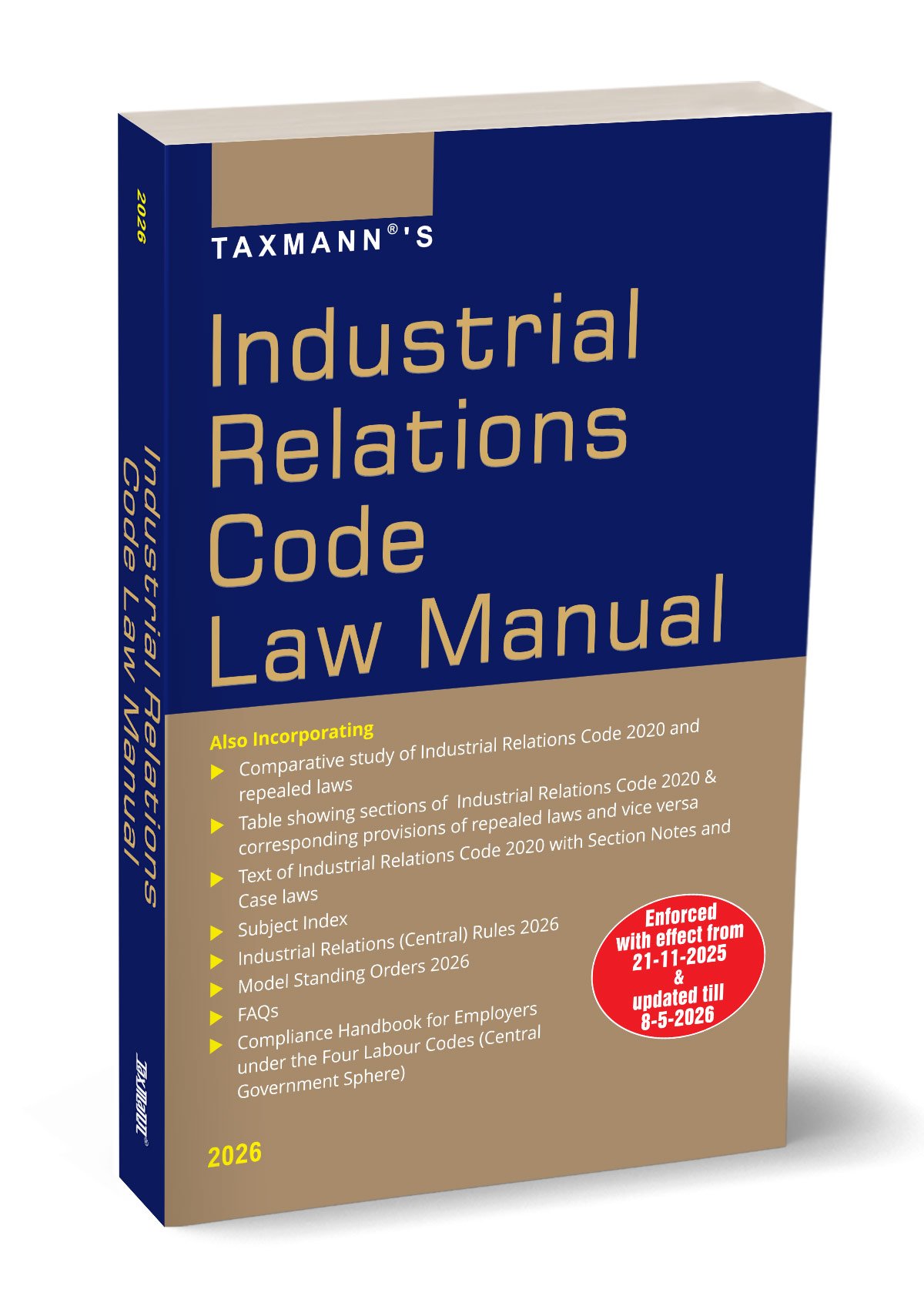
Code on Wages Law Manual is Taxmann’s authoritative single-volume working reference on India’s wage statute as it now operates in practice. The 2026 Edition is built around the editorial position that the Code on Wages 2019 must be read as a system: the statute together with the Central Rules made under it, the implementation notifications, the supervisor-exclusion ceiling notification, the cross-Code FAQ apparatus from the Ministry of Labour & Employment, and the four-Code compliance machinery that surrounds it. The Manual brings all of these into one volume and arranges them so the reader can move between them in the order their work actually requires—concordance lookup, section text, editorial restatement, supporting case law, applicable rule, prescribed form, jurisdictional notification, FAQ, compliance checklist—without leaving the book.
The Manual also incorporates the Code on Wages (Central) Rules 2026, the principal enforcement notification of 21-11-2025, the supervisor-exclusion ceiling notification of 30-1-2026, the Government’s tabular OSH&WC FAQ dated 13-3-2026, the Additional FAQs on Labour Codes dated 16-3-2026 and the Compliance Handbook for Employers under the Four Labour Codes (Central Government Sphere); this Edition is the first to carry the Code with that full implementation machinery in place.
The Manual is built for the reader who works with the Code on Wages as operative law and needs the supporting apparatus alongside the statutory text:
- HR, Payroll and Industrial Relations Heads in factories, mines, plantations, large-format service-sector establishments and Central-Sphere PSUs who have to re-baseline wage structures under the new Section 2(y) definition, re-issue appointment letters and wage slips, redesign the bonus computation under Chapter IV and migrate registers and returns to the Code-and-Rules framework
- In-House Counsel and Labour-Law Practitioners advising on the 50% allowance add-back, the floor-wage architecture under Section 9, claims and appeals under Sections 45 and 49, the three-year limitation regime, and the supervisor-exclusion ceiling under Section 2(z)(d)
- Compliance Officers, Company Secretaries and Plant HR Managers responsible for periodic returns, register maintenance, wage-slip issuance, notice-board displays, and the Inspector-cum-Facilitator interface in the Central Government sphere
- Chartered Accountants, Cost Accountants and Internal Auditors examining wage-cost, bonus liability, gratuity-base and provident-fund-base computations in light of the revised wages definition and the cross-Code impact on the Code on Social Security
- Inspector-cum-Facilitators, Authorities under Section 45, Appellate Authorities under Section 49, Government Officers in the Ministry of Labour & Employment, the Chief Labour Commissioner (Central) office and State Labour Departments who need a single citation-safe source
- Faculty, Researchers and Students of Labour Law across LL.B., LL.M., CS, the CA Industrial Law paper, MBA-HR and the AIBE Labour & Industrial Law module, who need the consolidated text along with comparative reference to the four legacy Acts the Code replaces
The Present Publication is the 2026 Edition, updated till 8th May 2026. It is authored/edited by Taxmann’s Editorial Board, with the following noteworthy features:
- [Four-Layer Per-Section Treatment] Each section in Division One opens with the statutory text and the Corresponding Provision flag tying it back to the four legacy Acts, then carries a Section Notes block that restates the operative content in plain-language bulleted form for quick recall, a Comments block of editorial restatement keyed by section number (with a nutshell synopsis followed by sub-numbered notes on the points that practitioners will actually argue), and—where the section has been substantively litigated—a Relevant Case Laws block carrying the line of decisions that bears on its interpretation, tagged ‘[now section X of Code on Wages]’ so that the pre-Code precedent reads directly into the new provision
- [Purpose-Built Concordance Tables] The preliminary part carries five concordance tables: one forward table from the Code into all four legacy Acts read together, and four reverse tables—one each from the Equal Remuneration Act 1976, the Minimum Wages Act 1948, the Payment of Bonus Act 1965 and the Payment of Wages Act 1936—back into the Code. The tables sit before the statutory text rather than at the back of the volume, on the editorial grounds that the buyer transitioning from a long-established legacy practice will start there
- [Long-Form Comparative Study] Set as a free-text analytical chapter rather than as a table, the Comparative Study reads the Code provision-by-provision against the four legacy Acts and flags every substantive change—uniform ‘appropriate Government’ definition under Section 2(d), omission of ‘scheduled employment’ as a gating concept, new ‘contractor’ definition under Section 2(f), recasting of the Advisory Board under Section 42, extension of the claim-filing limitation from 6 months to 3 years under Section 45, and removal of the pre-deposit requirement for appeals under Section 49—meant to be read in sequence for transitional understanding rather than dipped into as a lookup
- [Code on Wages (Central) Rules 2026 in Full] The full text of the operative Central Rules is reproduced with the prescribed statutory Forms, organised across its eight-Chapter sequence
- [Nine Statutory Forms in Full] The Forms are reproduced in full so the reader does not have to step outside the book to file, contest or maintain compliance
- [Material for Purposive Interpretation] The Statement of Objects and Reasons and the clause-by-clause Notes on Clauses for the originating Bill are reproduced as separate apparatus blocks, on the editorial reasoning that purposive interpretation arguments before the Authority, the Appellate Authority, Tribunals and High Courts often turn on these materials
- [In-Volume Appendix of Cross-Referenced Statutes] Where the Code refers to a provision of another Act—the Apprentices Act 1961, the Code of Criminal Procedure 1973, the Companies Act 2013, the Factories Act 1948, the General Clauses Act 1897, the Income-tax Act 1961, the Indian Penal Code, the Industrial Disputes Act 1947, the Merchant Shipping Act 1958, the Sales Promotion Employees (Conditions of Service) Act 1976, and the Working Journalists and Other Newspaper Employees (Conditions of Service) and Miscellaneous Provisions Act 1955—the referenced provision is reproduced in an Appendix, so the reader does not have to leave the volume to locate it
- [Concept-Led Subject Index] The index is built around the way HR, payroll and compliance professionals actually search—floor wage, payment of bonus, deductions, fines, overtime, wage period, mode of payment, equal remuneration, appeals, claims, registers, wage slip, Inspector-cum-Facilitator, composition of offences—rather than around the section list
- [Complete Notifications and Clarifications Module] Division Three reproduces in full the principal enforcement notification, the early Advisory Board enforcement notification, and the supervisor-exclusion ceiling notification
- [Cross-Code Frequently Asked Questions] A seven-part FAQ module covers all four Labour Codes—twelve FAQs on the Code on Wages, nineteen on the Industrial Relations Code, nineteen on the OSH&WC Code, twenty-six on the Code on Social Security (across nine topical groups), the Government’s official tabular FAQ on OSH&WC Code dated 13-3-2026, the cross-Code Labour Codes FAQ, and the Additional FAQs on Labour Codes dated 16-3-2026. The Code on Wages FAQs, in particular, address the most frequently asked operational questions on the floor wage, the revised wages definition and 50% allowance rule, the deductions cap, the universality of minimum wage coverage post-omission of ‘scheduled employment’, and the treatment of compounding of offences
- [Multi-Chapter Compliance Handbook for the Four Labour Codes] Division Three closes with a seven-chapter, five-Annexure compliance reference for employers in the Central Government sphere, organised in chapters per Code and ending with a Summary of Action Points for Employers structured as a four-row ready-reckoner across Foundational, Monthly, Periodical/Annual and Event-Based Compliance—each anchored to specific section references and rendered as bullet-form obligation maps so the practitioner can move from a topic to a compliance action quickly
The structure is the editorial backbone of the Manual, organised as one preliminary part and three numbered Divisions, each one corresponding to a distinct working purpose—transitional reading, statutory and interpretive reference, operative rule-making, and implementation and compliance.
- Preliminary Part | Transitional Anchor — The preliminary part anchors the transitional reading, carrying the five concordance tables and the Comparative Study before the statutory text, so a reader coming in from legacy practice begins with the bridge between the old and the new
- Division One | The Code and its Interpretive Apparatus — Division One carries the Code on Wages 2019 in full with its four-layer per-section apparatus—statutory text, Corresponding Provision flag, Section Notes, Comments and Relevant Case Laws—together with the supporting interpretive materials including the Subject Index, the Statement of Objects and Reasons, the Notes on Clauses and the Appendix of cross-referenced statutes
- Division Two | Operative Rule-Making — Division Two carries the operative rule-making: the Code on Wages (Central) Rules 2026 across its eight Chapters, with the Schedule of nine statutory Forms reproduced in full
- Division Three | Notifications, FAQs and Compliance — Division Three carries the implementation and compliance apparatus: the Notifications and Clarifications module, the seven-part cross-Code FAQs covering all four Labour Codes and the seven-chapter, five-Annexure Compliance Handbook for Employers under the Four Labour Codes in the Central Government sphere
Additional information
| BINDING | PAPERBACK |
|---|---|
| AUTHOR | Taxmann's Editorial Board |
| EDITION | 2026 |
| ISBN | 9789375611073 |
| PUBLICATION | TAXMANN PUBLICATIONS |
Related products
-
- Out of StockSale!
- LABOUR LAWS, DEPARTMENTAL ENQUIRIES, SERVICE LAWS, INDUSTRIAL LAW
B.C. Publication’s Law on Disciplinary Proceedings by Kumar Jyoti Singh
- Original price was: ₹795.00.₹635.00Current price is: ₹635.00.
- Read more
-
-
- Sale!
- CONSTITUTIONAL LAW, WRITS, HUMAN RIGHTS, HISTORY, PIL, IOS, POLITICAL SCIENCE, SOCIOLOGY, LABOUR LAWS, DEPARTMENTAL ENQUIRIES, SERVICE LAWS, INDUSTRIAL LAW
LAW RELATING TO PUBLIC SERVICE by Samaraditya Pal – 4th Edition 2021
- Original price was: ₹4,335.00.₹3,468.00Current price is: ₹3,468.00.
- Add to cart
-
- Out of StockSale!
- LABOUR LAWS, DEPARTMENTAL ENQUIRIES, SERVICE LAWS, INDUSTRIAL LAW
Commentaries on Employees’ Provident Funds and Miscellaneous Provisions Act, 1952 by V.K. Kharbanda – Edition 2022
- Original price was: ₹1,800.00.₹1,440.00Current price is: ₹1,440.00.
- Read more
-
Reviews
There are no reviews yet.