

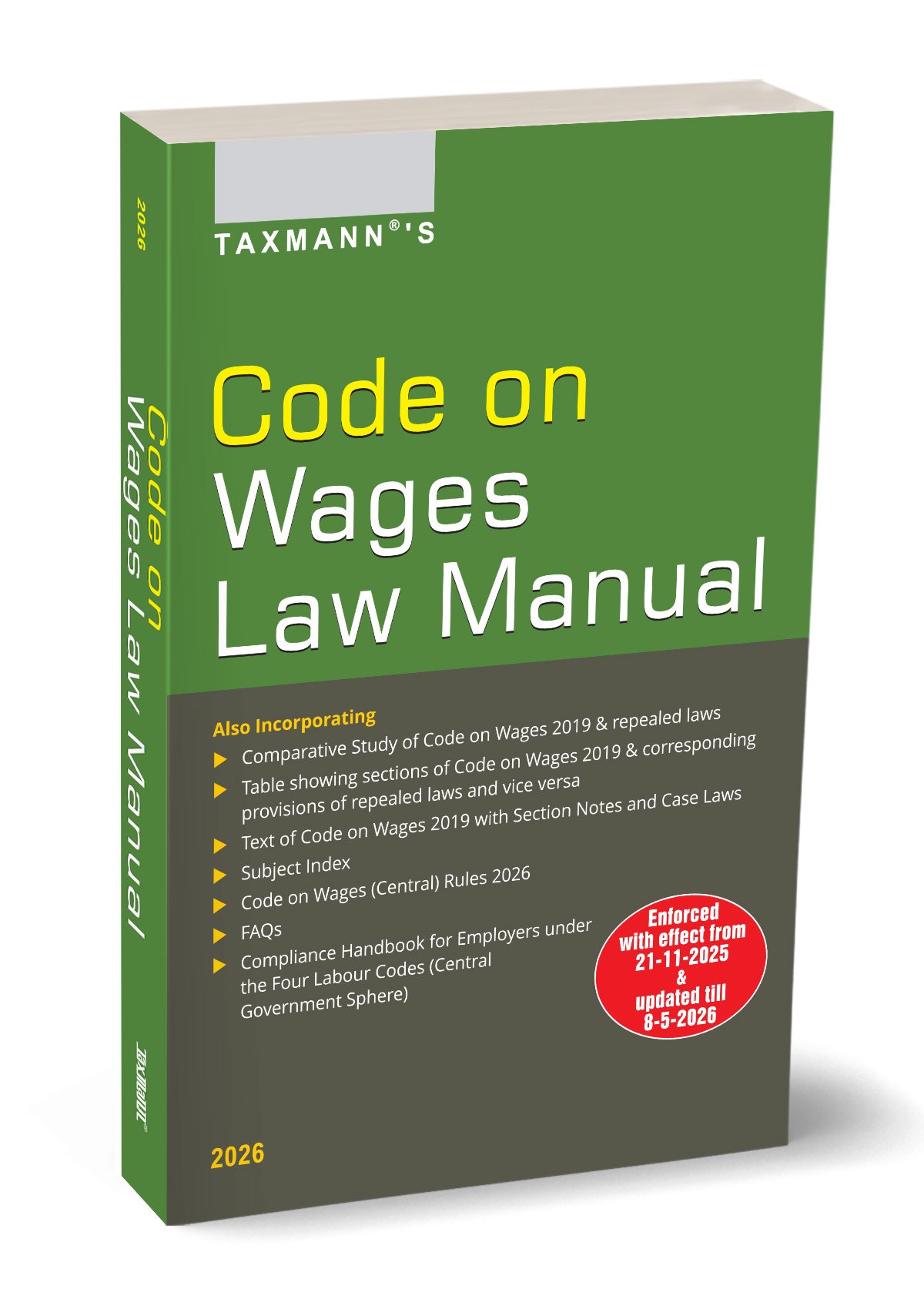
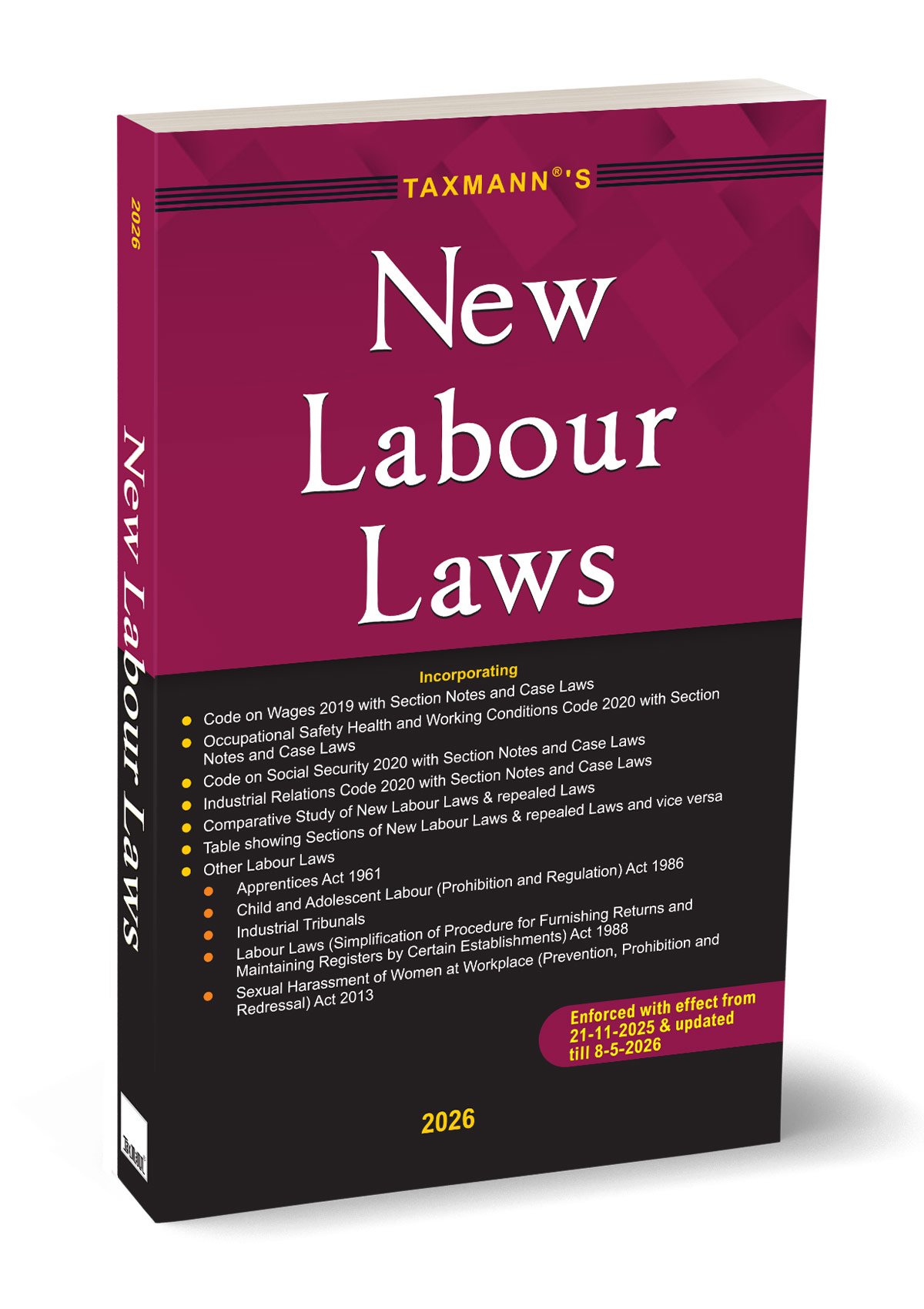
New Labour Laws By Taxmann – Edition 2026
Original price was: ₹1,195.00.₹950.00Current price is: ₹950.00.
New Labour Laws By Taxmann – Edition 2026
Description
New Labour Laws is Taxmann’s consolidated single-volume working reference to India’s reformed labour law architecture, anchored on the four new Labour Codes—the Code on Wages 2019; the Industrial Relations Code 2020; the Code on Social Security 2020; and the Occupational Safety, Health and Working Conditions Code 2020. Substantive provisions of the four Codes have been brought into force with effect from 21st November 2025 vide Notification S.O. 5322(E) and the cognate notifications under each Code, displacing twenty-nine pre-existing Central labour enactments. This 2026 Edition states the law as updated till 8th May 2026 and is therefore the first comprehensive Taxmann consolidation that reflects the operative regime rather than the pre-enforcement text. The volume is designed to function simultaneously as a bare-act compendium, a transitional companion that maps the codified provisions against the repealed Acts in both directions, an annotated commentary carrying editorial Section Notes and integrated case-law, an employer-side FAQ and compliance manual for the Central Government sphere, and a single-volume reference for the principal labour enactments that remain outside the codification.
The book is intended for:
- Human Resources, Industrial Relations, and Personnel Managers responsible for statutory compliance under the codified labour regime
- Compliance Officers, Company Secretaries, and In-house Counsel handling wage, social security, industrial relations, and occupational safety obligations
- Advocates and Law Firms with Employment, Labour, and Industrial Dispute Practices, including those appearing before Industrial Tribunals and National Industrial Tribunals
- Chartered Accountants and Management Consultants advising on payroll, bonus, gratuity, provident fund, ESI, and contract-labour compliance, particularly on the revised gratuity and wage-base computations
- Officers of the Labour Department, Inspectors-cum-Facilitators, Registering Officers, Certifying Officers, Conciliation Officers, and members of Industrial Tribunals and National Industrial Tribunals
- Factory Occupiers and Managers, mine owners, plantation managers, principal employers, contractors, building and other construction work employers, dock employers, and inter-State migrant work employers
- Aggregators of Gig and Platform Workers newly brought within the social security architecture
- Trade Union Office-Bearers, Federations, and Worker-Side Representatives engaged in registration, negotiation, conciliation, and adjudicatory proceedings
- Academicians, Research Scholars, and Students of labour law, industrial relations, and human resource management
- Internal Committee and Local Committee Members under the workplace harassment redressal regime
The Present Publication is the 2026 Edition, updated till 8th May 2026. It is authored/edited by Taxmann’s Editorial Board, with the following noteworthy features:
- [Statutory Architecture & Section-Level Annotation]
- Section-wise reproduction of each of the four Labour Codes carrying, against each section, a ‘Corresponding Provision’ footnote that identifies the section(s) of the repealed Acts that the codified provision traces to
- Curated editorial Section Notes that distil the substantive change effected by each codified provision—for example, the unified definition of ‘wages’ across all four Codes, the universalisation of minimum wages beyond the older ‘scheduled employment’ concept, the 50% add-back rule on allowances, the introduction of negotiating union and negotiating council, and the realignment to a two-member tribunal
- Integrated case-law commentary drawing on Supreme Court, High Court, and tribunal precedents whose ratio continues to operate under the substantively retained codified provisions, with neutral pointers where a precedent rests on a re-cast provision
- [Transitional Aids—Mapping Tables & Comparative Studies]
- Two-directional mapping tables for each Code
- Sections of the new Code against corresponding sections of each subsumed Act
- Sections of each subsumed Act against the codified provision, enabling transition reading from either entry point
- A standalone per-Code Comparative Study highlighting newly introduced provisions, omitted provisions, definitional realignments, threshold changes, and procedural reorganisations
- Two-directional mapping tables for each Code
- [Practitioner-Facing Compliance Module]
- A dedicated, seven-set FAQ collection covering each of the four Codes individually, a supplementary FAQ set on the OSH&WC Code as on 13th March 2026, a transitional FAQ set on the Labour Codes regime as a whole, and a further set of Additional FAQs as on 16th March 2026 addressing the 50% allowance rule, gratuity computation post-enforcement, fixed-term employment, leave and leave encashment, ESI continuity, ‘remuneration in kind’, and the wage ceiling for supervisory personnel
- A seven-chapter Compliance Handbook for Employers under the Four Labour Codes (Central Government sphere), opening with a quantified reforms snapshot— and closing with a calendarised action checklist (day-one, monthly, annual, and event-based)
- A ‘Summary of Action Points for Employers’ matrix in the Compliance Handbook organised by compliance frequency, covering foundational compliance, monthly compliance, periodical and annual compliance, and event-based compliance
- Five annexures to the Compliance Handbook reproducing the operative definitions of ‘wages’ and ’employee’ under the Code on Wages, the definition of ‘worker’ under the IR Code, the Third Schedule of the IR Code (service conditions for which change-of-service notice is required), the Third Schedule of the OSH&WC Code (notifiable occupational diseases), and the First Schedule of the Code on Social Security (chapter-wise applicability thresholds)
- [Legislative Context & Enforcement Tracking]
- Arrangement of Sections, Subject Index, Statement of Objects and Reasons, Notes on Clauses, and the official enforcement and threshold notifications reproduced alongside each Code for full legislative context—including S.O. 4604(E) (dated 18.12.2020, limited Advisory Board enforcement), S.O. 5322(E) (dated 21.11.2025, substantive enforcement), and S.O. 454(E) (dated 30.1.2026, ₹18,000/month wage ceiling for excluding supervisors from ‘worker’ under the Code on Wages)
- Industrial Relations Code (Removal of Difficulties) Order 2025 reproduced in Division Two as transitional context for the IR Code
- An Appendix at the foot of each Code reproducing the operative text of provisions of other Central Acts referred to within the Code, removing the need to cross-refer to allied statutes
- [Coverage of Allied Statutes & Tribunal Architecture] A dedicated Division for the labour enactments that remain outside the codification, with the Industrial Tribunals module incorporating the Tribunals Reforms Act 2021 and the Tribunal (Conditions of Service) Rules 2021, and editorially flagging that the Supreme Court has struck down key provisions of the Tribunals Reforms Act 2021 in Madras Bar Association v. Union of India [2025] 180 taxmann.com 608 (SC)
- [Navigational Design] Sequential intra-Division pagination enabling stable cross-referencing in compliance documentation, internal SOPs, and tribunal pleadings
The publication is organised into six Divisions, each operating as a self-contained module with sequential intra-Division pagination.
- Divisions One to Four | The Four Labour Codes — Each of Divisions One to Four follows a uniform architecture:
- Transitional Aids — Bi-directional mapping tables (Code → repealed Acts, and each repealed Act → Code), plus a Comparative Study against the repealed Acts
- Statutory Text — Arrangement of Sections and full text of the Code with editorial Section Notes and integrated Case Laws
- Legislative Context — Statement of Objects and Reasons, Notes on Clauses, and Notifications
- Navigation & Allied Provisions — Subject Index and Appendix of provisions of other Central Acts referred to in the Code
- The Divisions differ in scope and content as follows:
- Division One — Code on Wages 2019 subsumes 4 repealed Acts (Payment of Bonus Act 1965; Minimum Wages Act 1948; Payment of Wages Act 1936; Equal Remuneration Act 1976). The notifications reproduced include S.O. 4604(E) dated 18.12.2020, S.O. 5322(E) dated 21.11.2025, and S.O. 454(E) dated 30.1.2026
- Division Two — Industrial Relations Code 2020 subsumes 3 repealed Acts (Trade Unions Act 1926; Industrial Employment (Standing Orders) Act 1946; Industrial Disputes Act 1947), and additionally reproduces the IR Code (Removal of Difficulties) Order 2025
- Division Three — Code on Social Security 2020 subsumes 9 repealed Acts (Employee’s Compensation Act 1923; ESI Act 1948; EPF Act 1952; Employment Exchanges (CNV) Act 1959; Maternity Benefit Act 1961; Payment of Gratuity Act 1972; Cine-Workers Welfare Fund Act 1981; BoCW Welfare Cess Act 1996; Unorganised Workers’ Social Security Act 2008)
- Division Four — OSH&WC Code 2020 subsumes 13 repealed Acts (Factories, Plantations, Mines, Working Journalists (1955 and 1958), Motor Transport, Beedi and Cigar, Contract Labour, Sales Promotion Employees, Inter-State Migrant Workmen, Cine-Workers and Cinema Theatre Workers, Dock Workers, and BoCW Acts).
- Division Five — FAQs and Compliance Handbook (Central Government Sphere)
- Code-Specific FAQs | Four FAQ Sets — Code on Wages (12 FAQs), IR Code (19 FAQs), OSH&WC Code (19 FAQs), and Social Security (26 FAQs under nine sub-heads)
- Supplementary & Transitional FAQs | Three Further Sets — Supplementary OSH&WC FAQ as on 13.03.2026; Transitional FAQ on the Codes regime (transition rules, unified ‘wages’ definition, 50% add-back illustration, gratuity from 21.11.2025, ESI continuity); and Additional FAQs as on 16.03.2026 (statutory components in ‘wages’, aggregator cess, principal-employer-versus-contractor gratuity, leave encashment, State-versus-Code primacy)
- Compliance Handbook — Seven chapters covering the Handbook’s scope, the quantified reforms snapshot, Code-wise employer obligations, and a Summary of Action Points (foundational, monthly, periodical/annual, and event-based)
- Operative Definitions & Schedules — Five annexures reproducing the ‘wages’ and ’employee’ definitions under the Code on Wages, ‘worker’ under the IR Code, the Third Schedule of the IR Code, the Third Schedule of the OSH&WC Code, and the First Schedule of the Code on Social Security
- Division Six — Other Labour Laws
- Apprenticeship & Child Labour — Apprentices Act 1961, and the Child and Adolescent Labour (Prohibition and Regulation) Act 1986
- Tribunal Architecture — Industrial Tribunals module comprising the Tribunals Reforms Act 2021 and the Tribunal (Conditions of Service) Rules 2021, with editorial flagging of the Madras Bar Association decision
- Returns Simplification & Workplace Harassment — Labour Laws (Simplification of Procedure for Furnishing Returns and Maintaining Registers by Certain Establishments) Act 1988, and the Sexual Harassment of Women at Workplace (Prevention, Prohibition and Redressal) Act 2013
Additional information
| BINDING | PAPERBACK |
|---|---|
| AUTHOR | Taxmann's Editorial Board |
| EDITION | 2026 |
| ISBN | 9789375610069 |
| PUBLICATION | TAXMANN PUBLICATIONS |
Related products
-
- Out of StockSale!
- LABOUR LAWS, DEPARTMENTAL ENQUIRIES, SERVICE LAWS, INDUSTRIAL LAW
LAW OF EMPLOYEES’ PROVIDENT FUNDS BY DR R.G. CHATURVEDI
- Original price was: ₹1,795.00.₹1,345.00Current price is: ₹1,345.00.
- Read more
-
-
- Sale!
- LABOUR LAWS, DEPARTMENTAL ENQUIRIES, SERVICE LAWS, INDUSTRIAL LAW
Commentaries on Employee’s State Insurance Act, 1948 by Kharbanda & Kharbanda – Edition 2023
- Original price was: ₹2,200.00.₹1,650.00Current price is: ₹1,650.00.
- Add to cart
-
- Sale!
- LABOUR LAWS, DEPARTMENTAL ENQUIRIES, SERVICE LAWS, INDUSTRIAL LAW
Transfer of Employees Under Labour Laws by H L Kumar 6TH Edition 2023
- Original price was: ₹595.00.₹440.00Current price is: ₹440.00.
- Add to cart


Reviews
There are no reviews yet.