

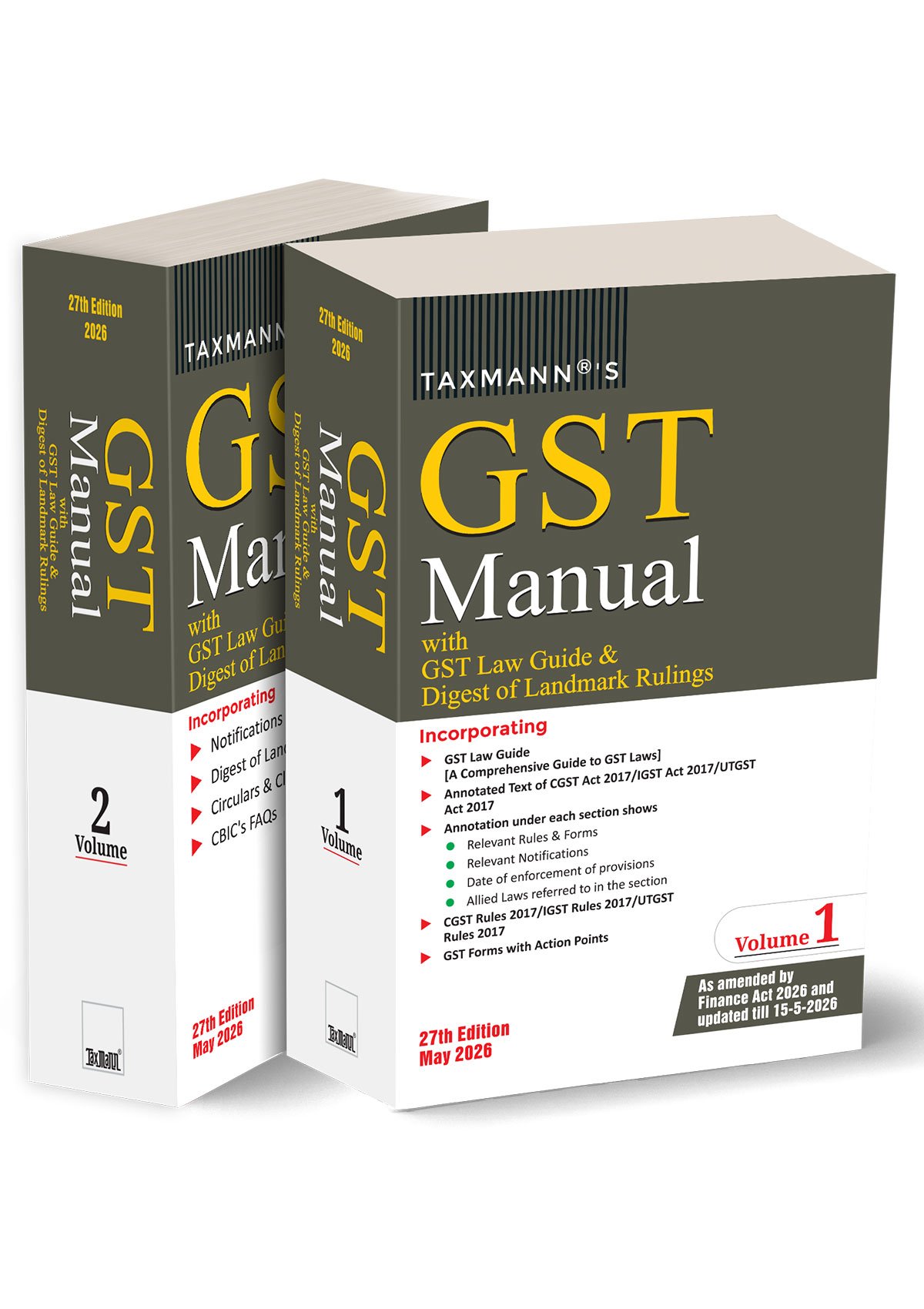
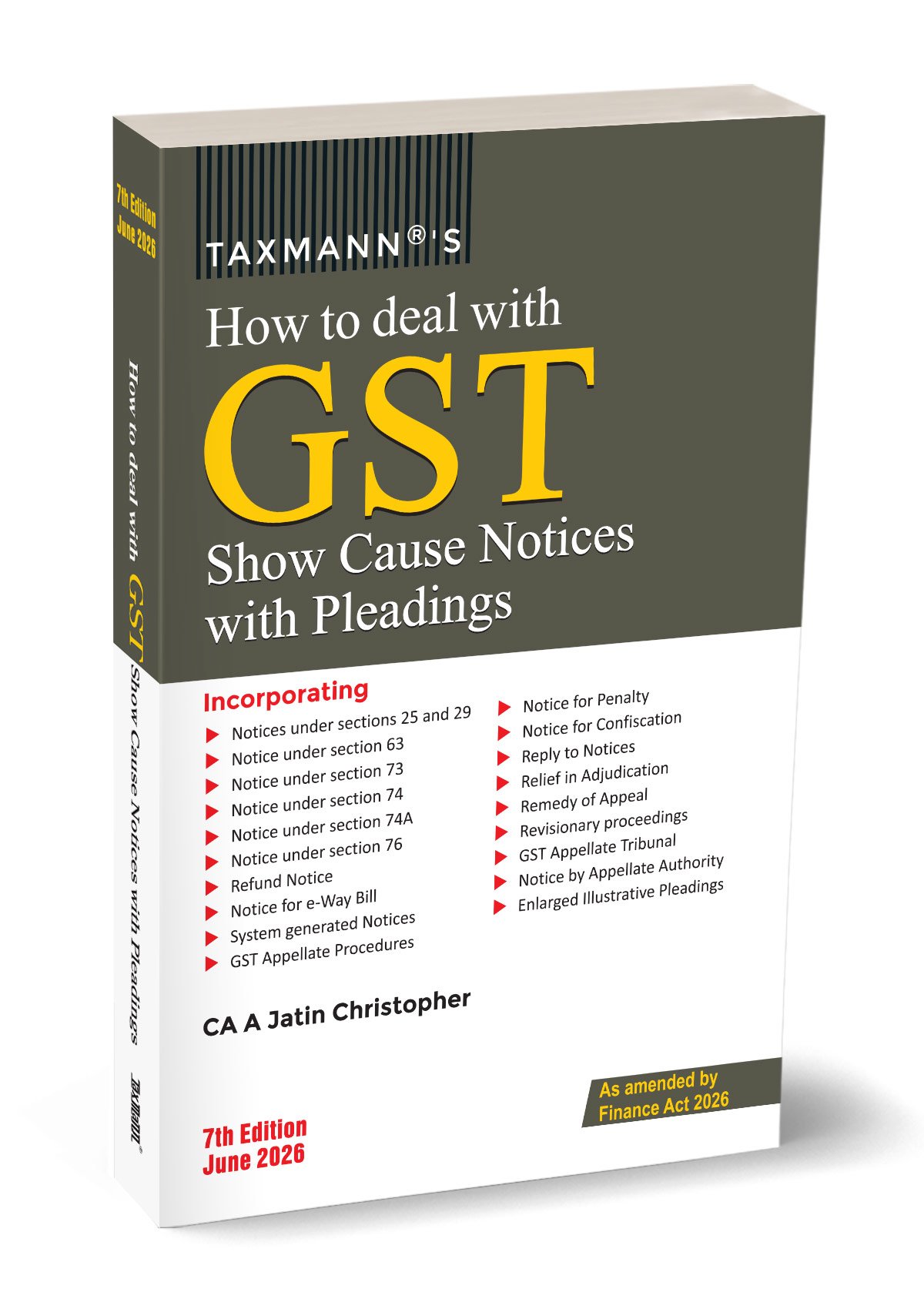
How to Deal with GST Show Cause Notices with Pleadings by A Jatin Christopher – 7th Edition June 2026
Original price was: ₹1,695.00.₹1,275.00Current price is: ₹1,275.00.
How to Deal with GST Show Cause Notices with Pleadings by A Jatin Christopher – 7th Edition June 2026
Description
How to Deal with GST Show Cause Notices with Pleadings is a practitioner’s manual on the most decisive phase of a GST dispute—the moment a notice arrives and a reply must be drafted. Rather than restating the statute, it teaches a method: read what a notice actually alleges, pin down the precise provision that authorises it (the book’s recurring test is ‘Under which section?‘), expose the deficiencies and discrepancies that are ‘incurable and fatal to the demand,’ and then plead the case with precision instead of volume.
The book is built on a hard-won philosophy. It warns against the reflex of filing ‘reams of submissions without making a single clinching point,’ argues that an over-eager response to a preliminary enquiry can hand the department its own case, and insists the ‘accept and discharge’ versus ‘dispute and litigate’ choice is a commercial decision best deferred until the notice is formally issued. Its opening chapter, Background, sets the constitutional spine—procedures established by law and due process—anchored in authorities such as Mohinder Singh Gill v. CEC (AIR 1978 SC 851), and that lens runs through every later chapter. It is, in the author’s words, ‘a work that draws from years of making mistakes so that no one needs to make the same old ones.’
This Edition covers the new section 74A demand regime, system-generated notices, revisionary proceedings, and the GST Appellate Tribunal (GSTAT)—its structure, procedure, and the GSTAT Procedure Rules.
This book is intended for the following audience:
- Chartered Accountants, Cost Accountants and Company Secretaries who draft replies and appear before adjudicating and appellate authorities
- Advocates and Tax Litigators building pleadings for departmental engagement, appeal memos, and Tribunal proceedings
- GST and Indirect-Tax Consultants handling assessments, audits, refunds, and demand notices
- In-House Tax Heads, CFOs and Finance Teams who must make the litigate-or-settle decision
- Departmental Officers wanting a jurisprudence-anchored view of how notices, adjudication, appeals, and revision are meant to operate
- Students and Entrants to Indirect-Tax Practice who want litigation craft, not just statutory text
The Present Publication is the 7th Edition | 2026, amended by the Finance Act 2026. It is authored by CA. A Jatin Christopher with the following noteworthy features:
- [Under Which Section?—A Defence Strategy] Every notice is traced to its enabling provision, because the section fixes who may act, what they may ask, and how far the enquiry can go
- [Notice-wise Anatomy] Each notice type is dissected by structure, prerequisites, limitations, scope, burden of proof, and the defects that quietly defeat a demand
- [The Discipline of the Reply] How to reject allegations and dispute demands cleanly, avoid over-disclosure, and resist the ‘long and winded reply’ that does the taxpayer’s case a disservice
- [The Full Dispute Lifecycle] Notice → adjudication → first appeal → the ‘sequel notice’ by the Appellate Authority → revision → Appellate Tribunal
- [A Dedicated Pleadings Division] Division Two is a bank of Enlarged Illustrative Pleadings spanning replies to notices, departmental engagement, appeal memos, and Tribunal grounds, mapped to practical controversies
- [Updated for the Finance Act 2026 and GSTAT] Section 74A, Rules 88C/142B/88D, GSTAT structure, Tribunal Procedure and the GSTAT Procedure Rules integrated throughout
- [Jurisprudence Applied, Not Listed] Administrative law, natural justice, burden of proof, best-judgment limits and maintainability are worked into live notice and appeal situations
The coverage of the book is as follows:
- Notices, by Provision and Type (Division One)
- Sections 25 & 29—registration notices: rejection of applications, suspension, suo motu and voluntary cancellation, revocation, appealable orders
- Section 63—best-judgment assessment of unregistered persons; ‘best judgment is not wild guesswork’; challenges to jurisdiction
- Section 73—non-fraud demands: pre-notice consultation, limitation, service and its validity, deficiencies and discrepancies, non-denial as admission
- Section 74—fraud/suppression demands: special circumstances, the penalty stages, ‘cum-tax’ demand
- New Section 74A—date of commencement, terminal date for old notices, ingredients to jurisdiction, fresh limitation, definition of suppression, ‘mother notice v. child notice’
- Section 76—tax collected but not paid; composite demand; absence of limitation
- System-generated notices—Rules 88C, 142B and 88D, response options, adverse inference, auto-generated appropriation
- Refund notice—unjust enrichment, credit-note mischief, protective notices, erroneous refund with interest
- Notice for e-Way Bill—binary verification, alteration/expansion of enquiry by circular, cryptic notices, pleading for lenience
- Notice for Penalty—general discipline on penalty, personal penalty on directors, penalty under section 52, waiver of penalty notice
- Notice for Confiscation—seizure as a pre-condition, release from detention, the (unlimited) limitation position
- Adjudication and Remedies (Division One)
- Preparation to reply; the jurisprudence of adjudication (e.g., interest as automatic rather than penal, the bar on plurality of penalty); drafting the reply; relief and outcomes in adjudication
- Remedy of appeal; the ‘sequel notice’ by the Appellate Authority; relief in appeal
- Revisionary proceedings—the anomaly of executive revision of appellate orders, the narrow grounds (illegal, improper, or omitting material facts), doctrine of election, bar on revision, ‘mischievous appeals,’ limitation
- GST Appellate Tribunal—GSTAT structure and benches, pre-deposit (including penalty-only and fine-only disputes), statement of facts and grounds, paper-books, interlocutory applications; Tribunal Procedure (APL-5, cross-objections, computational tables, condonation, withdrawal); the GSTAT Procedure Rules (powers, instituting appeal, registry, hearing, case management, e-filing, CPC); and a closing chapter on applicable jurisprudence
- Pleadings (Division Two) — Enlarged Illustrative Pleadings
- Pleadings for reply to notices—Chapter 26 alone runs to 58 numbered sub-paragraphs, the bulk of them worked reply scenarios: DRC-3 payments, GSTR-2A/3B and GSTR-1/3B mismatches, RCM unpaid, credit/debit notes, TRAN-1 transition credit, composition-taxpayer defaults, Rule 86A/86B, blocked and common credits, supplier-in-default, ‘interest only’/’penalty only’ demands, classification and exemption disputes, pure-agency collections
- Pleadings in departmental engagement—DRC-13 (third-party recovery), DRC-22 provisional attachment, CMP-6, ‘call book,’ time-barred-notice intimations, death of proprietor/appellant
- Pleadings in appeal memo—audit-led, inquiry-led and interception-led demands; relief under section 75(2); RVN-1/ADT-2 situations; condonation-of-delay affidavits
- Appellate Tribunal pleadings—notes on APL-5/APL-6, preliminary grounds (sections 61/65/67), special and common grounds
- Inherent powers of GSTAT—including extended-adjournment/call-book applications
The book is organised into two complementary divisions totalling 30 chapters.
- Division One | Notices under GST (Chapters 1–25) — Builds the dispute knowledge base in the order a controversy unfolds
- Foundations (Background—procedures established by law and due process) → each notice type (ss. 25/29, 63, 73, 74, 74A, 76) → system-generated, refund, e-way-bill, penalty and confiscation notices → preparation to reply, the jurisprudence of adjudication, the reply itself, and relief/outcomes in adjudication → the full appellate journey (remedy of appeal, the ‘sequel notice,’ relief in appeal, revisionary proceedings, the Appellate Tribunal, Tribunal Procedure, the GSTAT Procedure Rules) → a concluding chapter on applicable jurisprudence
- Division Two | Pleadings in GST (Chapters 26–30) — Converts that commentary into drafting practice with ready-to-adapt model pleadings: replies to notices, departmental engagement, appeal memos, Appellate Tribunal pleadings, and the inherent powers of the GSTAT
- Granular, Sub-Headed Chapters — Within each chapter, the treatment is granular and sub-headed (overview → anatomy → limitation → scope → defects → response), so the book works both as a cover-to-cover read and as a desk reference to open the moment a specific notice lands
Additional information
| BINDING | PAPERBACK |
|---|---|
| AUTHOR | A JATIN CHRISTOPHER |
| EDITION | 2026 |
| ISBN | 9789375612322 |
| PUBLICATION | TAXMANN PUBLICATIONS |
Related products
-
- Out of StockSale!
- TAXATION LAW, INDIRECT TAX, DIRECT TAX, INCOME-TAX, GST, TDS, CA BOOKS
GST PLEADING AND PRACTICE
- Original price was: ₹5,995.00.₹4,800.00Current price is: ₹4,800.00.
- Read more
-
-
- Sale!
- TAXATION LAW, INDIRECT TAX, DIRECT TAX, INCOME-TAX, GST, TDS, CA BOOKS
INCOME TAX GUIDELINES AND MINI READY RECKONER 2022-23 AND 2023-24
- Original price was: ₹690.00.₹587.00Current price is: ₹587.00.
- Add to cart
-
- Out of StockSale!
- INTERPRETATION OF STATUTES, TAXATION LAW, INDIRECT TAX, DIRECT TAX, INCOME-TAX, GST, TDS, CA BOOKS
INTERPRETATION OF INDIRECT TAX STATUTES INCLUDING GST
- Original price was: ₹3,399.00.₹2,550.00Current price is: ₹2,550.00.
- Read more
-
Reviews
There are no reviews yet.