

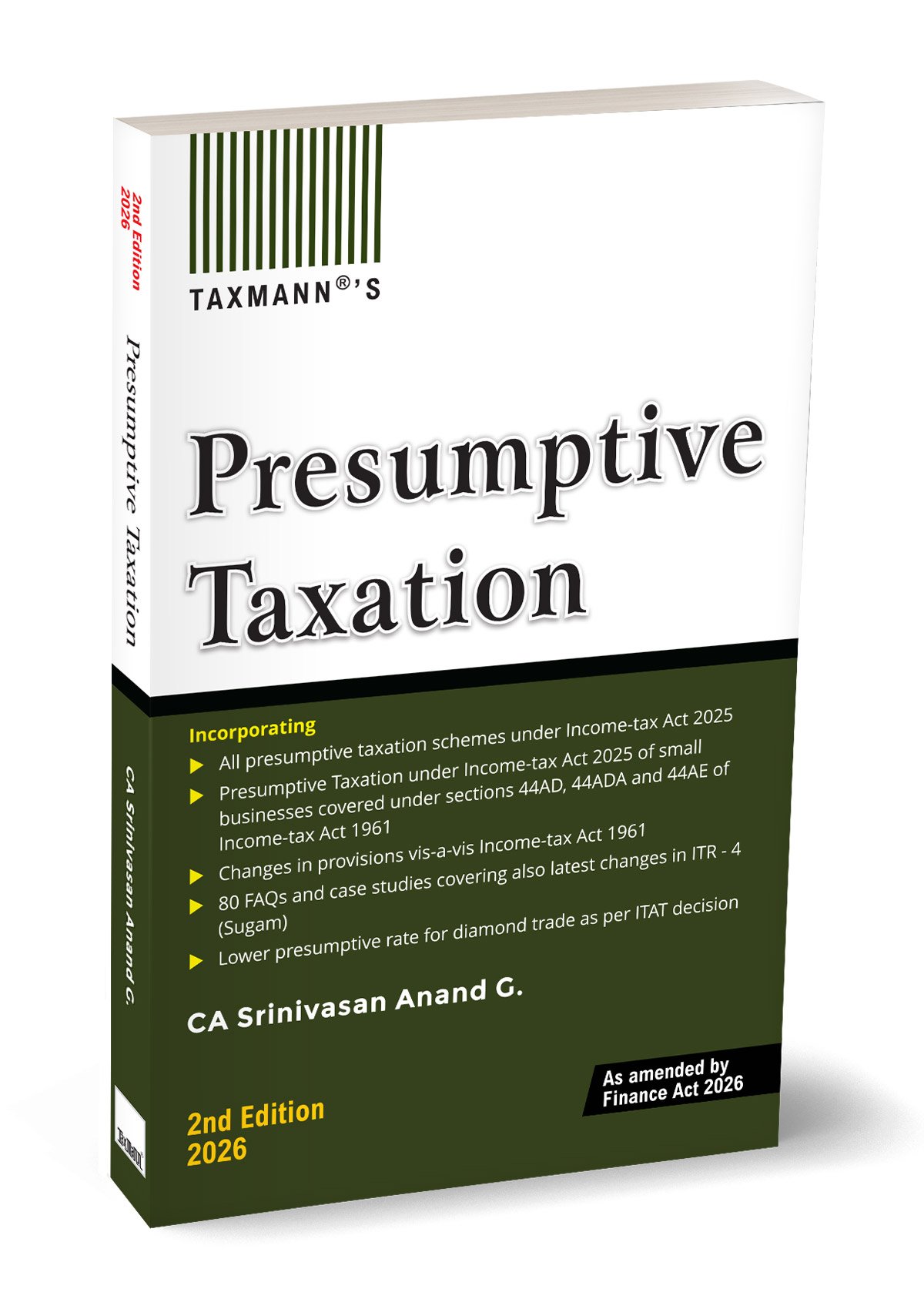

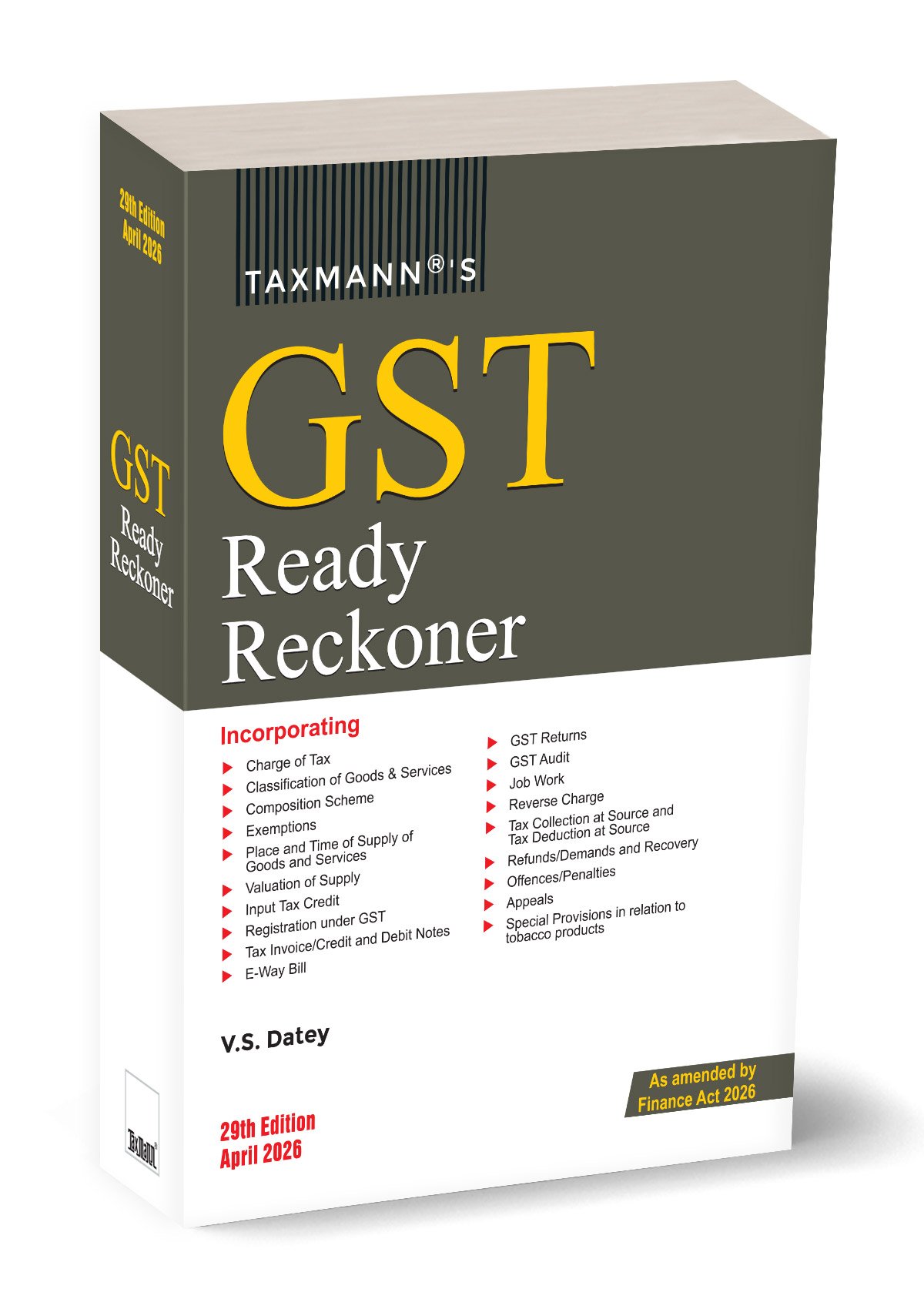
GST Ready Reckoner by V S Datey – 29th Edition April 2026
Original price was: ₹2,950.00.₹2,195.00Current price is: ₹2,195.00.
GST Ready Reckoner by V S Datey – 29th Edition April 2026
Description
GST Ready Reckoner by V.S. Datey is India’s most trusted and comprehensive single-volume reference on the Goods and Services Tax regime—now in its 29th Edition, fully updated to incorporate all amendments made by the Finance Act 2026. The book covers every dimension of the tax: conceptual foundations, charging provisions, sector-specific compliance, administrative procedures, enforcement, and the full appeals hierarchy.
The distinguishing character of this work is that it is simultaneously legislative and practical. The author does not merely restate statute, he explains it, critiques it where it is absurd or anomalous, traces its evolution, and anchors it in the reality of how it is applied in trade and litigation. The Finance Act 2026 changes, including the overhaul of the GST rate structure w.e.f. 22-9-2025 from the earlier Nil/5%/12%/18%/28% slabs to a rationalised Nil/5%/18%/40% structure, the abolition of GST Compensation Cess w.e.f. 1-2-2026, major amendments to post-sale discount provisions, the 90% provisional refund on inverted duty structure, refund of IGST on exports below ₹1,000, and the correction of the anomalous place of supply rule for intermediary services of export and import, are all incorporated into the text and explained with full statutory context.
This title is designed for every professional who works with GST law in any capacity—advisory, compliance, litigation, audit, or academic:
- Chartered Accountants, Cost Accountants, and Tax Consultants who need a single definitive source for GST compliance, structuring advice, and opinion work
- Advocates and Litigators who appear before GST authorities, the Appellate Tribunal, High Courts, and the Supreme Court and need rapid access to the applicable provision and the author’s assessment of how it works
- Company Secretaries and In-House Finance and Legal Teams responsible for day-to-day GST compliance, return filing, ITC reconciliation, and refund applications
- GST Departmental Officers who need a clear exposition of the law they administer
- Faculty and Students of CA, CMA, CS, LLB, B.Com, and MBA programmes where indirect taxation is a core subject
- Industry Professionals in sectors with complex GST treatment—real estate, construction, financial services, telecom, software, logistics, and manufacturing
The Present Publication is the 29th Edition | April 2026, amended by the Finance Act 2026. It is authored by Mr V.S. Datey, with the following noteworthy features:
- [Complete Finance Act 2026 Integration] Every amendment is explained in its practical context, identifying the pre-amendment position, the anomaly it created, what the amendment does, and its commercial and compliance implications. This is analytical commentary on the 2026 changes, not mere compilation
- [GST Rate Structure Overhaul—Gen 2 Reforms] The rationalisation of rates w.e.f. 22-9-2025 (Nil/5%/18%/40% replacing the earlier five-slab structure), abolition of GST Compensation Cess across all products from 1-2-2026, and the new tobacco-specific provisions under Chapter 53 are fully incorporated and explained throughout
- [Para-Based Section Index] Every provision of the CGST Act, IGST Act, CGST/SGST Rules, and relevant Constitutional Articles is mapped to a specific paragraph number within the book, enabling direct navigation from any statutory section or rule to the author’s discussion, and vice versa
- [GST Acronyms Glossary] The volume opens with a comprehensive glossary covering the full vocabulary of GST administration—AAR, AAAR, GSTIN, GSTN, ISD, ITC, QRMP, TCS, TDS, UIN, UTGST, and more—for immediate orientation
- [Author Commentary] The author identifies statutory anomalies, critiques illogical outcomes, and explains practical trade realities without hedging—for example, describing the pre-Finance Act 2026 intermediary place of supply rule as an anomaly that taxed Indian commission agents earning foreign exchange while exempting foreign agents receiving Indian Rupees, ‘continuing for over nine years, finally rectified—better late than never.’ CBI&C FAQ enforceability and e-way bill misuse are addressed with equal directness
- [Integrated Judicial Citations] AAR, AAAR, High Court, and Supreme Court decisions are cited by name, citation reference, and forum directly within the analytical text—reflecting the litigation reality of each provision rather than relegating case law to isolated tables
- [Eight Years of Accumulated Jurisprudence] The 29th Edition reflects not just the statute as it reads today but the practical way in which it has been administered, litigated, and clarified since 1-7-2017, incorporating eight years of Council decisions, CBI&C circulars, AAR and AAAR rulings, and High Court judgments. Provisions that have been amended, challenged, partially corrected, and amended again are explained in their full evolution, giving practitioners the context to handle disputes on pre-amendment periods alongside current compliance
- [Sector-Specific Depth Across 15+ Dedicated Chapters] Independent chapters cover industries and transaction types that generate disproportionate GST complexity, including real estate, construction, financial services, telecom, software, transport, e-commerce, and job work, each addressed as a self-contained reference for that sector
The following subject areas, specified for this edition, are covered as follows:
- Charge of Tax
- Full charging framework under CGST, IGST, SGST, and UTGST—dual GST structure, constitutional basis (Articles 246A and 269A), charging section mechanics, and the special position of petroleum products and alcohol
- Classification of Goods and Services
- HSN-based classification for goods, SAC-based for services, classification principles, and rate consequences, integrated with sector-specific classification guidance across transport, telecom, software, financial services, and real estate chapters
- Composition Scheme
- Eligibility thresholds, restricted supply categories, flat-rate tax payment, ITC restrictions, and the QRMP scheme for taxpayers with turnover below ₹5 crores, covered in Chapter 21 and cross-referenced in Chapter 40 (Returns)
- Exemptions
- Absolute and conditional exemptions by notification, mandatory nature of exemption, and sector-specific entries, including pure labour contract exemptions for single residential units, Housing for All/PMAY constructions, and government-supplied services
- Place and Time of Supply
- Domestic and cross-border place of supply rules, time of supply for goods and services, and full analysis of the Finance Act 2026 correction to the intermediary services place of supply rule (effective 30-3-2026)
- Valuation of Supply
- Transaction value under Section 15, inclusions and exclusions, the Finance Act 2026 post-sale discount amendment (credit note alone now sufficient, pre-agreement and invoice linkage no longer required), related party and agent valuation rules, cost-plus basis, and the residual method
- Input Tax Credit
- Conditions for taking ITC, blocked credits under Section 17(5), including the Finance Act 2025 retrospective amendment replacing ‘or’ with ‘and’ in Section 17(5)(d) w.e.f. 1-7-2017, GSTR-2B linkage requirement, proportionate reversal for mixed supplies, and the Input Service Distributor framework, with integrated AAR/AAAR decisions on construction, renovation, and works contract ITC
- Registration
- Threshold limits, mandatory registration categories, Aadhaar authentication (Rules 8(4A) and 10B), physical verification, multiple registrations, non-resident and OIDAR registrations, amendment, cancellation, suspension, revocation, and Unique Identity Numbers for foreign embassies and UN Agencies
- Tax Invoice, Credit and Debit Notes
- Mandatory invoice contents, e-invoicing framework, invoices marked ‘INPUT TAX CREDIT NOT ADMISSIBLE’ post-fraud/suppression, and the post-Finance Act 2026 position on credit notes for post-sale discounts
- E-Way Bill
- Rules 138–138D, threshold values, exemptions, CBI&C FAQs, April 2019 system changes, Rule 138E restriction on EWB generation for return non-filers and suspended registrations, and a frank assessment of misuse for transporter harassment
- GST Returns
- All return forms covered—GSTR-1, GSTR-2A, GSTR-2B, GSTR-3B, GSTR-4, GSTR-5, GSTR-6, GSTR-7, GSTR-8, GSTR-9, GSTR-9B, GSTR-9C, and final return—with QRMP scheme, IFF, sequential filing restriction, and late fee structure
- GST Audit
- Departmental audit, special audit, scrutiny of returns, provisional assessment, and best judgment and summary assessment procedures
- Job Work
- GST classification framework for manufacturing services on goods owned by others, tax treatment of inputs and capital goods sent for job work, conditions for nil-GST movement, and compliance obligations of principal and job worker
- Reverse Charge
- Notified goods and services under Section 9(3)/5(3), receipt from unregistered suppliers under Section 9(4)/5(4), e-commerce operator liability under Section 9(5), and procedural compliance
- TCS and TDS
- TCS obligations of e-commerce operators (Section 52, GSTR-8), TDS obligations of notified government and PSU recipients (Section 51, GSTR-7), and credit mechanics for both
- Refunds, Demands and Recovery
- Complete refund framework, exports (with and without IGST payment), inverted duty structure (including Finance Act 2026 amendment enabling 90% provisional refund), SEZ supplies, excess payment, unjust enrichment doctrine, and Consumer Welfare Fund. Demand procedures under Sections 73, 74, and the revamped Section 74A (w.e.f. 1-11-2024), provisional attachment, and liability of directors, partners, liquidators, and associated persons
- Offences and Penalties
- Penalty provisions, prosecution thresholds, compounding of offences, and the interplay between civil penalties and criminal prosecution
- Appeals
- Complete appeals ladder—first appeal (Section 107) with pre-deposit requirements, revision (Section 108), Appellate Tribunal (constitution, powers, procedure, Finance Act 2026 National Appellate Authority amendment), High Court (Section 117), and Supreme Court (Section 118), with prosecution and compounding covered separately in Chapter 49
- Special Provisions for Tobacco Products
- New Central Excise duty structure w.e.f. 1-2-2026 (tariff rate enhanced to ~70%), capacity-based excise on chewing tobacco, Jarda scented tobacco and Gutkha under Section 3A, track-and-trace obligations under Section 148A, and the 40% GST rate, all arising from the abolition of GST Compensation Cess w.e.f. 1-2-2026
The fundamental unit of the text is the numbered paragraph. Every chapter is divided into hierarchically numbered sub-paragraphs and every sub-paragraph is individually cross-referenced in the Section Index to its governing statutory provision—creating a bidirectional link between the statute and the commentary. The book offers three independent access points into the text:
- Table of Contents — Chapter-level orientation across 55 chapters
- Section Index — Provision-level look-up mapping every section of the CGST Act, IGST Act, CGST/SGST Rules, and relevant Constitutional Articles to the corresponding paragraph in the body
- Subject Index — Keyword-based search at the back of the volume
Additional information
| BINDING | PAPERBACK |
|---|---|
| AUTHOR | VS DATEY |
| EDITION | 2026 |
| ISBN | 9789375616672 |
| PUBLICATION | TAXMANN PUBLICATIONS |
Related products
-
- Out of StockSale!
- INTERPRETATION OF STATUTES, TAXATION LAW, INDIRECT TAX, DIRECT TAX, INCOME-TAX, GST, TDS, CA BOOKS
INTERPRETATION OF INDIRECT TAX STATUTES INCLUDING GST
- Original price was: ₹3,399.00.₹2,550.00Current price is: ₹2,550.00.
- Read more
-
-
- Out of StockSale!
- TAXATION LAW, INDIRECT TAX, DIRECT TAX, INCOME-TAX, GST, TDS, CA BOOKS
JYOTI RATTAN- TAXATION LAWS
- Original price was: ₹895.00.₹715.00Current price is: ₹715.00.
- Read more
-
-
- Sale!
- TAXATION LAW, INDIRECT TAX, DIRECT TAX, INCOME-TAX, GST, TDS, CA BOOKS
ATAL KUMAR-TAXATION LAWS
- Original price was: ₹390.00.₹332.00Current price is: ₹332.00.
- Add to cart

Reviews
There are no reviews yet.