

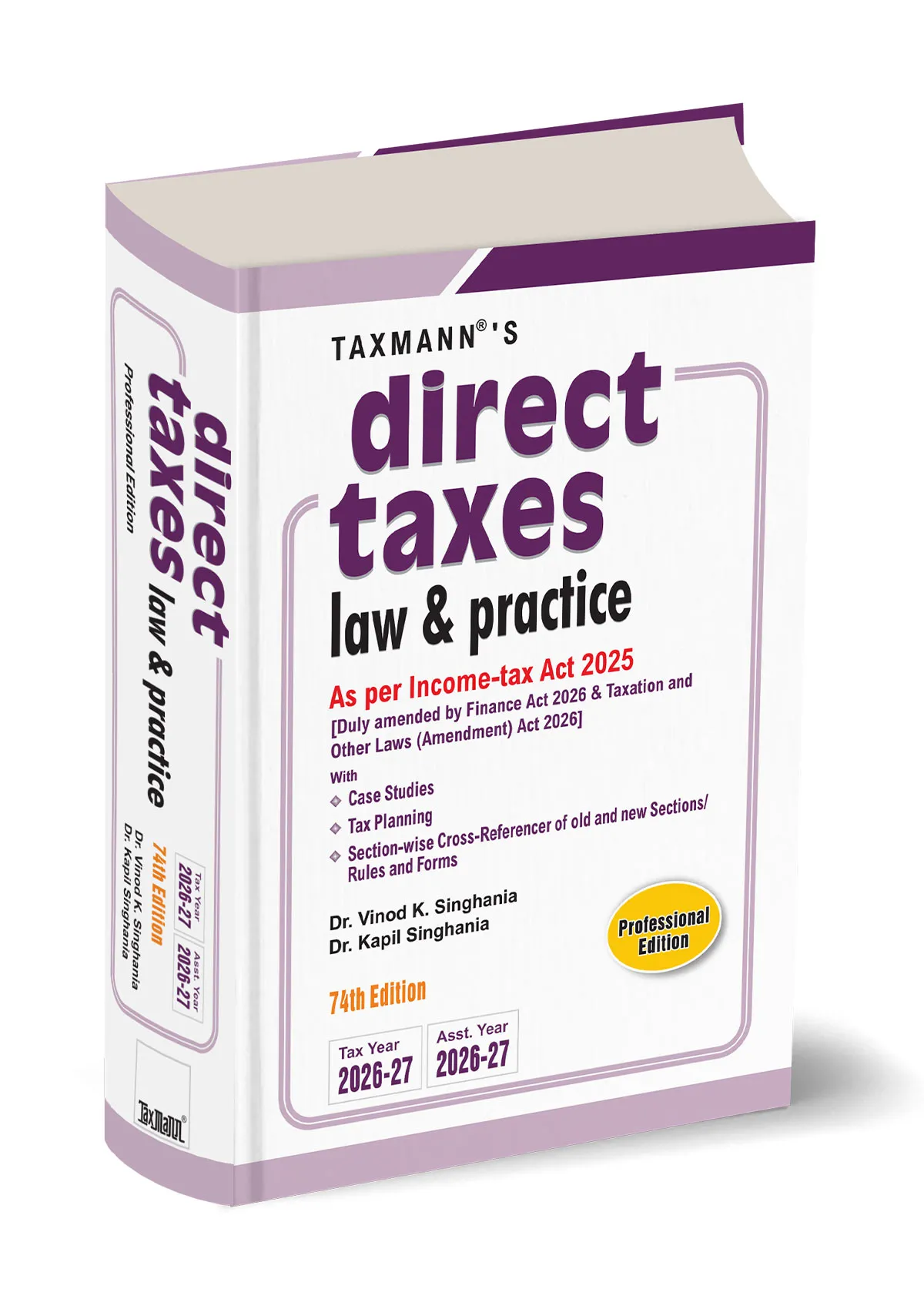
Direct Taxes Law and Practice | Professional Edition | Vinod K. Singhania and Kapil Singhania – 74th Edition 2026
Original price was: ₹4,995.00.₹3,745.00Current price is: ₹3,745.00.
Direct Taxes Law and Practice | Professional Edition | Vinod K. Singhania and Kapil Singhania – 74th Edition 2026
Description
Direct Taxes Law & Practice (Professional Edition) is the flagship treatise on Indian direct taxation by Dr Vinod K. Singhania and Dr Kapil Singhania, first published in August 1981 and now in its 74th Edition. This is the most significant revision in the work’s four-decade history: the entire text has been reconstructed around the Income-tax Act 2025, the statute that supersedes the Income-tax Act 1961 with effect from 1st April 2026, read with the Income-tax Rules 2026, which replace the Income-tax Rules 1962.
The law stated is as amended by the Finance Act 2026 and the Taxation & Other Laws (Amendment) Act 2026, and is updated up to 10th August 2026. The commentary incorporates the Central Board of Direct Taxes’ Office Memorandum dated 6th July 2026, cited at five separate points in the chapter on repeal and savings and including a ten-point clarification on the conduct of proceedings straddling the two statutes; it further sets out the Foreign Assets of Small Taxpayers Disclosure Scheme 2026 in full working detail.
As the authors observe, the Income-tax Act 2025 is ‘vast, intricate, and ever-evolving’, and for practitioners ‘the true challenge lies not merely in mastering its statutory provisions, but in applying them to real-world scenarios with clarity, precision, and confidence’. The work has accordingly been thoroughly rewritten rather than renumbered. Wherever a provision of the 2025 Act has an antecedent in the 1961 Act, the discussion carries that antecedent in brackets alongside—a convention observed throughout the headings, sub-headings, tables, footnotes, case-law notes and the computation lines within the case studies themselves. A practitioner accustomed to reasoning in terms of sections 10, 32, 45, 48, 80C, 139, 143(3) or 194J may therefore locate the corresponding proposition within the new architecture without interruption.
This Edition is designed to serve as the single work to which a practitioner turns when a question must be answered correctly, promptly and with authority. It is intended for the following readership:
- Practising Chartered Accountants, Company Secretaries and Cost Accountants handling return filing, tax audit, TDS/TCS compliance, assessments, appeals and advisory work
- Advocates, Tax Counsel and Litigators appearing before the JCIT(A)/CIT(A), the Appellate Tribunal, the High Courts and the Supreme Court, particularly upon transitional questions spanning both statutes
- In-House Tax Teams, CFOs, Finance Controllers and Corporate Tax Managers responsible for corporate tax positions, MAT/AMT, withholding obligations, group restructuring and disclosure
- Transfer Pricing and International Tax Specialists advising upon associated enterprises, arm’s length pricing, safe harbour rules, APAs, secondary adjustments, thin capitalisation and non-resident taxation
- Advisors to Non-Profit Organisations and Trusts, Co-operative Societies, Firms and LLPs, given the extent to which the 2025 Act recasts the charitable-institution regime
- Departmental Officers and Revenue-Side Professionals requiring the statutory position, the Board’s circulars and the judicial gloss upon a provision in a single place
- Academics, Researchers and Advanced Students of the CA Final, CS Professional, CMA Final, LLB/LLM, M.Com and comparable programmes
- Those Managing the 1961-to-2025 Transition, including carry-forward losses, unabsorbed depreciation, MAT/AMT credit, pending proceedings, options already exercised, past orders, expired limitation and search cases
The Present Publication is the 74th Edition for Tax Year 2026-27 and Assessment Year 2026-27. It is authored by Dr Vinod K. Singhania & Dr Kapil Singhania, with the following noteworthy features:
- [Comprehensively Rewritten] In line with the Income-tax Act 2025 and the Income-tax Rules 2026. Chapters have been restructured rather than renumbered: material which the new statute consolidates is consolidated here, and material which it redistributes is redistributed accordingly.
- [Section-wise Cross-Referencer of Old & New Provisions] Mapping every provision of the 1961 Act to its counterpart in the 2025 Act and to the paragraph of this book in which it is discussed. The referencer operates in both directions, carrying entries for provisions that are new and without antecedent as well as for provisions of the repealed Act that have no successor, so that no line of enquiry terminates without a result. It cites paragraph numbers rather than page numbers, directing the reader to the discussion itself.
- [Amendments at a Glance] More than 50 pages identifying what has changed and where each change is discussed. An 85-item referencer in three parts: the amendments introduced by the Finance Act 2026; the structural changes brought about by the Income-tax Act 2025; and the changes introduced by the Income-tax Rules 2026, the last presented in before-and-after tabular form. For a practitioner returning to the work after an interval, it constitutes the natural point of entry
- [Route-Map Tables] Placed at the head of the more substantial chapters, listing every topic against its section, its antecedent section and its paragraph number, so that a chapter extending to 250 pages may be surveyed in two before the reader proceeds
- [Theoretical Discussion Supplemented by 600+ Case Studies] Spanning an exhaustive range of issues and offering solutions to complex problems with reference to the latest case law. More than 450 carry a citable identifier, and 445 are worked through to a labelled solution accompanied by a full computation table. Running page headers carry the problem number, enabling a case study to be located and cited with precision
- [Lucid & To-the-Point Explanations] The matter is painstakingly arranged in numbered paragraphs and sub-paragraphs to conserve the reader’s time and effort, while debatable issues are deliberated through to their logical conclusion rather than left unresolved
- [Tax Planning Hints] Provided wherever the occasion arises. Six chapters conclude with a dedicated planning paragraph, and a full chapter develops the subject in its own right, distinguishing tax planning, avoidance, evasion and tax management, and tracing the leading authorities upon the limits of legitimate arrangement
- [Gist of Relevant Circulars, Clarifications & Notifications issued by CBDT] Covering January 2018 to February 2026: a 225-page digest arranged provision by provision, so that the departmental position upon a section may be read alongside the commentary upon it
- [Gist of Landmark Rulings of Supreme Court/High Courts] Covering 2018 to February 2026: a 159-page digest under more than 200 section headings, recording the status of Special Leave Petitions so that the precedential weight of a High Court ruling may be assessed. Across the commentary and both digests, the work carries upwards of 6,000 reported citations
- [Frequently Asked Questions] Upon the computation of salary income and the mode of computation of annual value, in which the authors address objections that a careful reader might raise regarding the method adopted in this book, including a numerical demonstration that the simplified computation employed here yields a result identical to that of the statutory sequence — a degree of methodological self-examination seldom encountered in works of reference
- [Ready Reckoners] A Tax Rates annexure, opening with a sixteen-step computation format and carrying the rate tables for every category of assessee, together with a complete Rates of Depreciation annexure
The structure of the book is as follows:
- A Research Layer Precedes the Commentary — Approximately 450 of the work’s 1,892 pages precede Chapter 1: abbreviations, the Section-wise Index, Amendments at a Glance and the two digests. Collectively they permit the reader to approach the work from whichever reference is to hand — an old section number, a new one, a circular, a judgment, a form, or simply the question of what has changed during the year
- Numbered Paragraphs Constitute the Unit of Reference — The commentary runs in numbered paragraphs from 1 to 779, subdivided into approximately 2,500 sub-paragraphs across as many as four levels of depth. Every internal cross-reference is to a paragraph rather than to a page; for this reason the work requires no alphabetical subject index, the numbering and the section-wise map serving that purpose with greater precision
- Each Topic Follows a Uniform Design — The rule is stated; the exceptions and contested readings are examined with the support of circulars and case law; the argument is resolved; the proposition is demonstrated upon a worked case study with a full computation; and a planning note is added where warranted
- The Allocation of Space Reflects Practical Significance — Profits and gains of business or profession occupies 251 pages, a fifth of the entire commentary, with depreciation alone subdivided into some ninety sub-paragraphs. Capital gains occupies 118 pages, salaries 90, tax deduction at source 86, and return of income and assessment 77. The procedural chapters are correspondingly concise, refunds occupying two pages and advance payment of tax five. The treatment throughout is proportionate to the practical weight of the subject.
Additional information
| BINDING | Hardcover |
|---|---|
| AUTHOR | VINOD K SINGHANIA & KAPIL SINGHANIA |
| EDITION | 2026 |
| ISBN | 9788167010827 |
| PUBLICATION | TAXMANN PUBLICATIONS |
Related products
-
- Out of StockSale!
- TAXATION LAW, INDIRECT TAX, DIRECT TAX, INCOME-TAX, GST, TDS, CA BOOKS
COMPENDIUM OF TOP 100 RULINGS UNDER GOODS & SERVICES TAX
- Original price was: ₹1,095.00.₹825.00Current price is: ₹825.00.
- Read more
-
-
- Sale!
- TAXATION LAW, INDIRECT TAX, DIRECT TAX, INCOME-TAX, GST, TDS, CA BOOKS
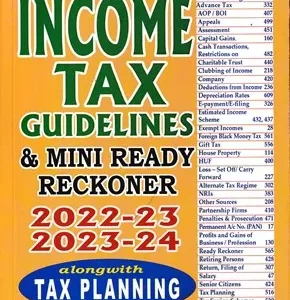
INCOME TAX GUIDELINES AND MINI READY RECKONER 2022-23 AND 2023-24
- Original price was: ₹690.00.₹587.00Current price is: ₹587.00.
- Add to cart
-
- Sale!
- INTELLECTUAL PROPERTY LAW, TRADE MARKS, COPYRIGHT, PATENTS, TAXATION LAW, INDIRECT TAX, DIRECT TAX, INCOME-TAX, GST, TDS, CA BOOKS
A COMPLETE GUIDE TO VALUAION OF IP ASSETS (WITH DISCUSSIONS ON MANAGING, AUDITING AND TAXING IPs
- Original price was: ₹900.00.₹720.00Current price is: ₹720.00.
- Add to cart

Reviews
There are no reviews yet.