

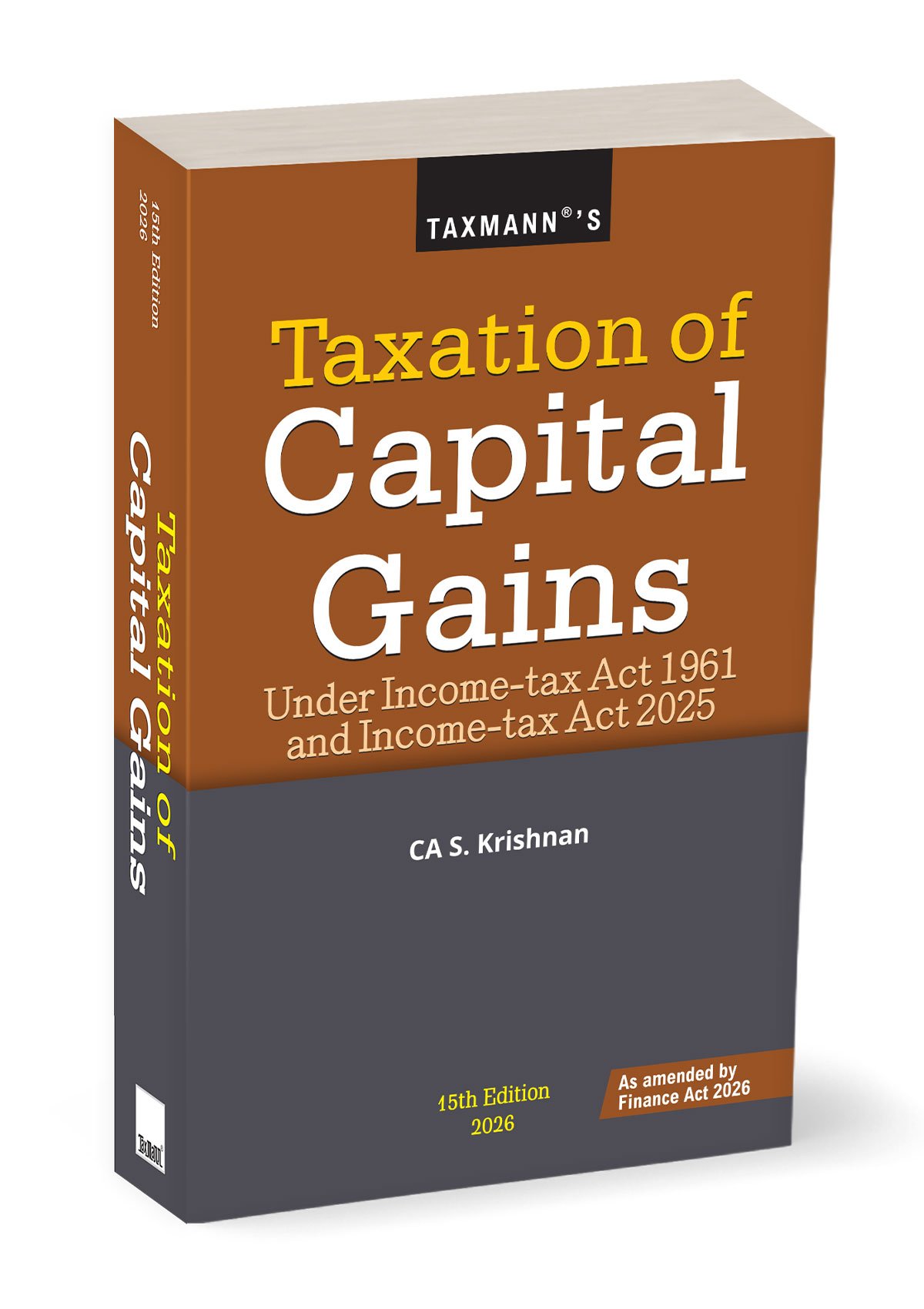
Taxation of Capital Gains by S. Krishnan – 15th Edition 2026
Original price was: ₹3,695.00.₹2,695.00Current price is: ₹2,695.00.
Taxation of Capital Gains by S. Krishnan – 15th Edition 2026
Description
Taxation of Capital Gains stands as one of the most comprehensive and widely respected treatises on capital gains taxation in India. The 2026 Edition crosses a significant threshold: it is the first edition to span two coexisting statutory frameworks simultaneously—the Income-tax Act 1961 and the newly enacted Income-tax Act 2025—both as amended by the Finance Act 2026. The book represents a complete, practitioner-grade reference that integrates statutory text, judicial decisions, CBDT Circulars and Notifications, worked illustrations, and the author’s own considered views on interpretational controversies.
This Edition is engineered to operate seamlessly in both statutory environments—every chapter opens with a dual-column cross-reference table mapping 1961 Act provisions to their 2025 Act counterparts, and the detailed preliminary pages contain a comprehensive master cross-reference spanning the entire capital gains framework.
The book is structured to answer every question a practitioner may encounter—from foundational definitional matters through computation mechanics, exemptions and rollover reliefs, tax rates, loss treatment, and a range of specialist topics including family arrangement and settlement, NRI taxation, slump sale, intangible assets, charitable trusts, joint development agreements, depreciable assets, buyback of shares, and ULIPs. The author does not merely restate the law. Throughout the work, he explicitly flags interpretational controversies, analyses conflicting Bench decisions, identifies legislative gaps, and offers his own views with reasoning, making this as much a practitioner’s analytical companion as it is a statutory commentary.
This title is designed for professionals who advise at an expert level on capital gains and cannot afford gaps in either statutory currency or judicial coverage. The primary audiences are:
- Chartered Accountants handling complex capital gains computations, assessment and appellate proceedings, and tax planning mandates for individuals, HUFs, partnership firms, LLPs, companies, trusts, and non-resident clients—particularly in areas involving property transactions, business restructuring, inheritance, gifting, and investment portfolios
- Tax Advocates and Litigation Professionals who need a citation-ready reference spanning Supreme Court, High Court, and ITAT decisions with substantive analysis rather than bare headnotes. The book’s integration of judgments up to March 2026 makes it current for the ongoing assessment season
- Corporate Tax Departments and Transaction Advisors involved in M&A transactions, amalgamations, demergers, slump sales, business restructuring, joint development agreements, and cross-border transfers, where capital gains implications are central to deal structuring and fair market value computations
- NRI Taxpayers and their Advisors navigating the procedural and substantive complexity of disposing of Indian assets, understanding TDS obligations, RNOR status and its two-year benefit, and managing compliance obligations under both Acts
- Senior Tax Officials and Assessees in Assessment Proceedings who need a balanced, exhaustive reference that addresses both the Revenue’s and the assessee’s positions on contested issues
- Advanced Tax Law Students and Academic Researchers who require a rigorously indexed, cross-referenced work that traces every capital gains provision from the 1961 Act into the 2025 Act and locates it within the judicial discourse
The Present Publication is the 15th Edition | 2026, amended by the Finance Act 2026. This book is authored by CA. S. Krishnan with the following noteworthy features:
- [Dual-Act Cross-Reference Architecture] A master cross-reference table in the preliminary pages maps the entire capital gains framework across both enactments, and every chapter opens with its own section-level cross-reference table. This is critical in the 2026 assessment season, where the 1961 Act governs tax years ending 31st March 2026 and the 2025 Act governs tax years from 1st April 2026—practitioners can navigate either framework without risk of applying the wrong Act’s analysis. While the 2025 Act largely reformats rather than rewrites the capital gains provisions, specific deletions are identified: Section 54GB has no 2025 Act counterpart; the sick company land transfer exemption and stock exchange demutualisation provision from Section 47 have been removed; and the tabular restructuring of Section 70 introduces its own interpretational questions—all addressed explicitly
- [Statutory Currency Through Finance Act 2026] All provisions, tax rates, exemption thresholds, investment limits, and computation mechanics reflect the law as amended by the Finance Act 2026. Practitioners working on current assessments, advance rulings, or transactional work have a single fully updated reference
- [Judicial Coverage Up to March 2026] Decisions are incorporated up to March 2026 and analysed in context, not merely cited. Coverage extends to unreported ITAT orders (identified by ITA number and order date), Supreme Court SLP dismissals, and Third Member decisions. The para-level citation structure gives precise locatability to every decision discussed. The author compares co-ordinate Bench reasoning, flags conflicts, and in several instances expresses disagreement with particular rulings
- [Worked Illustrations] Computation-intensive provisions carry practical numerical illustrations, not simplified textbook constructs. Section 50 mechanics, Section 50C stamp duty value override, the Section 54EC Rs. 50 lakh ceiling across consecutive financial years, and the Section 112A loss interaction are among the areas where worked examples are provided
- [Author’s Independent Analytical Views] CA. Krishnan explicitly offers his own views on contested interpretational questions, the soundness of a court’s reasoning, conflicts between Bench decisions, or the appropriate practitioner position following a legislative amendment. These views are clearly attributed and grounded in detailed reasoning, making the book useful as a second opinion in assessment and appellate proceedings
- [Dedicated NRI Chapter] Chapter 16B covers property disposal procedures, TDS obligations, RNOR transitional status, and guidance for returning Indians, including a candid account of a senior Income-tax Department official’s observations on the pattern of unintentional non-compliance by NRIs.
- [Historical CBDT Circular (April 1955)] Chapter 1 opens with the CBDT Circular of 11-4-1955 on the responsibilities of income-tax authorities in guiding assessees, an editorial choice that frames the practitioner’s role as a bridge between taxpayer and department, a theme that runs through the NRI chapter as well
- [Appendices on COVID-19 Compliance Relaxations] The three appendices preserve the legislative record of deadline extensions under the Taxation and Other Laws (Relaxation and Amendment of Certain Provisions) Act 2020, including the final extension to 31st March 2023 for exemption claims under Sections 54 to 54GB, relevant for assessments and appeals where investment timelines relied on these extensions
The book spans 34 chapters covering every dimension of capital gains taxation under both the 1961 Act and the 2025 Act.
- Chapter 0 — The Income-tax Act 2025 (Introductory)
- Traces the legislative journey from bill introduction (February 2025) through Select Committee revision and Presidential assent (August 2025), effective April 2026. Covers key structural changes—Tax Year concept replacing Financial Year/Assessment Year, expanded Virtual Digital Assets definition, and the restructuring of transfer exemptions from Section 47 to Section 70. Includes the master cross-reference table of capital gains provisions across both Acts and a provision-by-provision comparison of Section 70 versus Section 47
- Chapters 1–3 — Foundational Framework
- Chapter 1 establishes the Section 45 charging conditions and tax-free capital gains categories. Chapter 2 provides an exhaustive definition analysis of capital asset under Section 2(14)/Section 2(22)—covering all asset types from jewellery and bullion to agricultural land, with over 25 sub-paras of case law on agricultural land classification alone. Chapter 3 covers short-term versus long-term classification, holding period computation across all asset acquisition modes, and the Finance (No. 2) Act 2024 amendments
- Chapter 4 — What Constitutes a Transfer
- Covers all limbs of Section 2(47), with particular depth on joint development agreements, including the Balbir Singh Maini (SC, 2017) doctrine on unregistered JDAs and the extensive post-2017 jurisprudence distinguishing it on facts. Family settlement provisions run to a dedicated sub-series culminating in the Shanmuga Durai (ITAT Chennai, 2025) analysis. Firm-partner and shareholder-company transaction taxonomies addressed separately
- Chapter 5 — Transfers Not Regarded as Transfer
- Complete Section 47/Section 70 catalogue across 30+ categories—HUF partition, gifts and wills, parent-subsidiary and group company transfers, amalgamation and demerger exemptions (domestic and cross-border), co-operative bank reorganisations, non-resident bond/GDR/IFSC transfers, fund relocations, LLP and proprietary firm conversions, reverse mortgage, SPV-to-business trust conversion, and mutual fund mergers. Covers withdrawal provisions under Section 47A/Section 71 where conditions are subsequently violated
- Chapters 6, 6A, 6B — Year of Taxability
- Chapter 6 covers the general rule and exceptions—compulsory acquisition, JDA taxability, and Section 54H time extension for delayed compensation receipt. Chapter 6A is a standalone ULIP treatment covering the pre/post-February 2021 regime, the Rs. 2.5 lakh premium cap mechanics, fund switching, and the Finance Act 2023 changes. Chapter 6B covers the firm-partner and AoP/BoI framework—Section 45(3), the pre- and post-2021 Section 45(4), Section 9B, and reconstitution FAQs
- Chapters 7–12 — Computation Framework
- Covers the full Section 48 computation chain. Chapter 7: full value of consideration including Section 50C, 50CA, and 50D deemed consideration provisions. Chapters 8–9: special immovable property computation rules and the Section 48 deduction analysis across legal fees, brokerage, mortgage discharge, consultancy, and NRI travel expenses. Chapter 10: cost of acquisition across all modes, including bonus shares, rights shares, ESOPs, and inherited/gifted assets. Chapters 11–12: cost of improvement and indexed cost with Cost Inflation Index mechanics
- Chapters 13–21 — Exemptions and Rollover Reliefs
- Complete coverage of all rollover provisions. Sections 54 and 54F (Chapters 13 and 18) are the most extensive, covering eligibility conditions, the one-residential-house restriction, joint and relative-name investment, CGAS mechanics, and the full body of judicial decisions. Section 54B (Chapter 14) continues the agricultural land thread. Section 54EC (Chapter 16) covers the Rs. 50 lakh ceiling, the two-financial-year question, 5-year lock-in, and the V.S. Dempo (SC) ruling on availability against deemed STCG under Section 50. Chapter 16A examines investment in relatives’ names for Sections 54, 54B, and 54F. Chapter 16B covers NRI taxation. Chapters 15, 17, 19, and 20 address Sections 54D, 54EE, 54G/54GA, and 54GB, respectively, and note that Section 54GB has no counterpart in the 2025 Act
- Chapters 22–24 — Tax Rates and the Section 112A Regime
- Chapters 22–23 cover the computation of STCG and LTCG taxes. Chapter 24 is a comprehensive treatment of the Section 112A/Section 198 regime—all five applicability conditions, the STT pre-October 2004 acquisition issue, grandfathering mechanics as of 31st January 2018, loss set-off under Section 70(3), and the Finance (No. 2) Act 2024 rate revision
- Chapters 25–28 — Valuation, Loss, Liquidation, Buyback
- Chapter 25: Valuation Officer reference under Section 55A/Section 91. Chapter 26: capital loss set-off and carry-forward, including the Section 112A interaction with other long-term losses. Chapter 27: liquidation distribution and shareholder capital gains under Section 46/Section 68. Chapter 28: buyback of shares and specified securities under Section 46A/Section 69
- Chapter 29 — Depreciable Assets
- Section 50 / Section 74—block-of-assets framework, both operative scenarios (block survives; block ceases), worked four-scenario numerical illustrations, Section 50A (power generation), Section 50AA (market-linked debentures), goodwill amendment (Finance Act 2021), and the V.S. Dempo exemption availability ruling
- Chapter 30 — Slump Sale
- Section 50B/Section 77—slump sale definition (including the Finance Act 2021 expansion to all transfer modes), net worth computation, the negative net worth issue (Summit Securities Special Bench), FMV obligation from AY 2021-22, the 2021 amendment legislative history, and case law review spanning the lock-stock-and-barrel concept, the overruled decisions (Bharat Bijlee, Vatsala Shenoy, UTV Software, Oricon Enterprises), and the Telangana HC’s 2025 ruling in Spectra Shares
- Chapters 31–33 — Intangibles, Charitable Trusts, Real Estate
- Chapter 31: capital gains on goodwill, trademarks, copyrights, and know-how, including the B.C. Srinivasa Setty cost of acquisition problem and Finance Act 2021 interventions. Chapter 32: charitable trust capital gains and Section 11 exemption mechanics. Chapter 33: real estate transactions—JDA analysis, flat exchanges, power of attorney sales, stamp duty value issues, and multi-stage taxability
- Chapter 34 — Other Important Case Laws
- A current-affairs supplement compiling significant judicial decisions up to March 2026 that cut across multiple provisions or address procedural and assessment issues not covered in the thematic chapters
The book is organised as 34 thematically grouped chapters following a logical statutory progression—from the charging provision through definitional analysis, transfer concepts, computation, exemptions, rates, losses, and specialist asset classes. Each chapter follows a consistent internal architecture:
- Table of Corresponding Sections — Mapping the 1961 Act provision to the 2025 Act equivalent, positioned at the chapter’s outset
- Statutory Analysis — Section-by-section interpretation with legislative history where relevant
- Judicial Pronouncements — Case law analysis integrated within the narrative
- Illustrations — Worked numerical examples demonstrating computation in realistic scenarios
- Author’s Views — Clearly flagged commentary on contested or evolving interpretational questions
- The preliminary pages contain the comprehensive cross-reference master table that maps the full capital gains statutory framework between the two Acts. Three appendices at the end preserve the legislative record of COVID-19 compliance relaxations
Additional information
| BINDING | PAPERBACK |
|---|---|
| AUTHOR | S. Krishnan |
| EDITION | 2026 |
| ISBN | 9789371266963 |
| PUBLICATION | TAXMANN PUBLICATIONS |
Related products
-
- Out of StockSale!
- ADMINISTRATIVE LAW/JUDICIAL PROCESS, CONSTITUTIONAL LAW, WRITS, HUMAN RIGHTS, HISTORY, PIL, IOS, POLITICAL SCIENCE, SOCIOLOGY
PRINCIPLES OF ADMINISTRATIVE LAW
- Original price was: ₹1,850.00.₹1,600.00Current price is: ₹1,600.00.
- Read more
-
-
- Sale!
- ADMINISTRATIVE LAW/JUDICIAL PROCESS, COMPETITIVE/ENTRANCE EXAM - CLAT - LL.B./LL.M., JUDICIARY (RJS,HJS,DJS,UP CIVIL JUDGE, MP CIVIL JUDGE), Bar Council(AIBE), UGC-NET, APP, SUPREME COURT
LEADING AND LANDMARK JUDGEMENTS OF SUPREME COURT OF INDIA 2020
- Original price was: ₹795.00.₹635.00Current price is: ₹635.00.
- Add to cart
-
- Out of StockSale!
- ADMINISTRATIVE LAW/JUDICIAL PROCESS
BETTER DRAFTING (ENG-HINDI) (CIVIL, CRIMINAL)
- Original price was: ₹1,710.00.₹1,285.00Current price is: ₹1,285.00.
- Read more
-


Reviews
There are no reviews yet.