

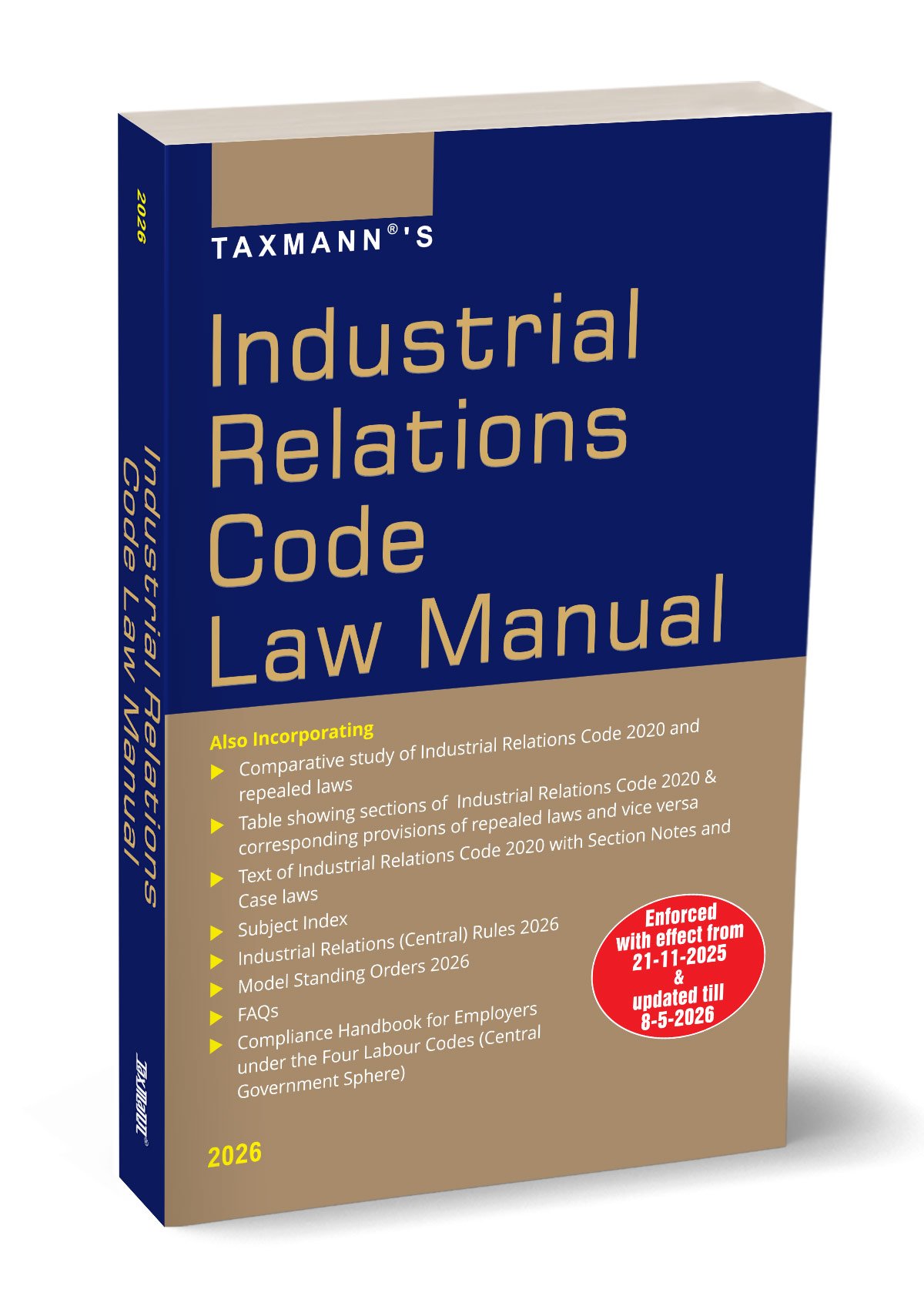
Industrial Relations Code Law Manual By Taxmann – 1st May Edition 2026
Original price was: ₹795.00.₹595.00Current price is: ₹595.00.
Industrial Relations Code Law Manual By Taxmann – 1st May Edition 2026
Description
Industrial Relations Code Law Manual is Taxmann’s authoritative single-volume working reference on India’s industrial relations statute as it now operates in practice. The 2026 Edition is built around the editorial position that the Industrial Relations Code 2020 must be read as a system: the statute together with the rules made under it, the Model Standing Orders adopted under it, the transitional instruments, the implementation notifications and the cross-Code compliance machinery that surrounds it. The Manual brings all of these into one volume and arranges them so the reader can move between them in the order their work actually requires—concordance lookup, section text, editorial restatement, supporting case law, applicable rule, prescribed form, jurisdictional notification, FAQ, compliance checklist—without leaving the book.
The Manual also incorporates the Industrial Relations (Central) Rules 2026, the Model Standing Orders 2026 and a cluster of further designation, delegation and recovery notifications under the Code; this Edition is the first to carry the Code with that full implementation machinery in place.
The Manual is built for the reader who works with the Industrial Relations Code as operative law and needs the supporting apparatus alongside the statutory text:
- HR, Industrial Relations and Compliance Heads in factories, mines, plantations, large-format service-sector establishments and Central-Sphere PSUs who have to reconfigure their standing orders, retrenchment processes, recognition protocols and dispute-resolution workflows under the new regime
- In-House Counsel and Labour-Law Practitioners advising on negotiating-union recognition, certification of Standing Orders, conciliation, Industrial Tribunal proceedings, retrenchment cases and the higher-threshold framework for the 300-worker establishment
- Trade Union Office-Bearers and Federations navigating the new recognition thresholds, the membership-reporting regime and the rights and disqualifications attaching to office-bearers
- Conciliation Officers, Inspector-Cum-Facilitators, Industrial Tribunal Members and Government Officers in the Ministry of Labour & Employment and State Labour Departments who need a single citation-safe source
- Chambers of Commerce, Employer Federations and ER Advisory Teams interpreting fixed-term employment, the Worker Re-skilling Fund obligation and the Bi-partite Forums framework
- Faculty, Researchers and Students of Labour Law across LL.B., LL.M., CS, the CA Industrial Law paper, MBA-HR and the AIBE Labour & Industrial Law module, who need the consolidated text along with comparative reference to the three legacy Acts the Code replaces
The Present Publication is the 2026 Edition, updated till 8th May 2026. It is authored/edited by Taxmann’s Editorial Board with the following noteworthy features:
- [Four-Layer Per-Section Treatment] Each section in Division One opens with the statutory text and the Corresponding Provision flag tying it back to the legacy Acts, then carries a Section Notes block that restates the operative content in plain-language bulleted form for quick recall, a Comments block of editorial restatement keyed by section number (with a nutshell synopsis followed by sub-numbered notes on the points that practitioners will actually argue), and—where the section has been substantively litigated—a Relevant Case Laws block carrying the line of decisions that bears on its interpretation
- [Purpose-Built Concordance Tables] The preliminary part carries four concordance tables: from the Code into the three legacy Acts, and from each of the three legacy Acts back into the Code. The tables sit before the statutory text rather than at the back of the volume, on the editorial grounds that the buyer transitioning from a long-established legacy practice will start there
- [Long-Form Comparative Study] Set as a free-text analytical chapter rather than as a table, the Comparative Study reads the Code provision-by-provision against the three legacy Acts and flags every substantive change—meant to be read in sequence for transitional understanding rather than dipped into as a lookup
- [Industrial Relations (Central) Rules 2026 in Full] The full text of the operative Central Rules notified on 8-5-2026 is reproduced with the prescribed statutory Forms, organised across its full chapter sequence
- [Model Standing Orders 2026 in Full with All Three Sector Schedules] Schedules are reproduced in full alongside the Central Rules. Because an employer’s certified Standing Orders must be drawn against the operative Model, and because the Model itself is deemed to apply pending certification, the in-volume reproduction is what makes this Manual an end-to-end compliance document for the Standing Orders regime—the reader does not have to step outside the book to draft, modify or contest a certification
- [Transitional Instrument Reproduced in Full] The Industrial Relations Code (Removal of Difficulties) Order 2025—is reproduced in full, at the point in Division One where a transitional reading is likely to be required
- [Material for Purposive Interpretation] The Statement of Objects and Reasons and the Notes on Clauses for the originating Bill are reproduced as separate apparatus blocks, on the editorial reasoning that purposive interpretation arguments before Tribunals and High Courts often turn on these materials
- [In-Volume Appendix of Cross-Referenced Statutes] Where the Code refers to a provision of another Act—the Apprentices Act 1961, the Banking Companies (Acquisition and Transfer of Undertakings) Act 1970 and several others—the referenced provision is reproduced in an Appendix, so the reader does not have to leave the volume to locate it
- [Concept-Led Subject Index] The index is built around the way HR and IR professionals actually search—retrenchment, lay-off, closure, standing orders, negotiating union, negotiating council, strikes, lock-outs, unfair labour practices, Tribunal, conciliation, registration of Trade Union, Works Committee, Grievance Redressal Committee, Worker Re-skilling Fund—rather than around the section list
- [Complete Notifications and Clarifications Module] Division Three reproduces the principal enforcement notification, the separate notification fixing the effective date of repeal of the three legacy Acts and the full implementation cluster—each reproduced in full with the jurisdictional tables that allocate work across the Chief Labour Commissioner (Central), Additional CLC, Deputy CLCs and Regional Labour Commissioners
- [Cross-Code Frequently Asked Questions] A four-part FAQ module covers all four Labour Codes—twelve FAQs on the Code on Wages, nineteen on the Industrial Relations Code, nineteen on the OSH&WC Code, and a separate Additional FAQs module dated as on 16-3-2026 covering all four Codes. The IR FAQs, in particular, address the most frequently asked operational questions on strikes, retrenchment, fixed-term employment, conciliation, the two-tier Tribunal architecture, Bi-partite Forums, and the treatment of working journalists and sales promotion employees under the worker definition
- [Multi-Chapter Compliance Handbook for the Four Labour Codes] Division Three closes with a compliance reference for employers in the Central Government sphere, organised in chapters per Code—each anchored to specific section references and rendered as bullet-form obligation maps so the practitioner can move from a topic to a compliance action quickly
The structure is the editorial backbone of the Manual, organised as one preliminary part and three numbered Divisions, each one corresponding to a distinct working purpose—transitional reading, statutory and interpretive reference, operative rule-making, and implementation and compliance.
- Preliminary Part | Transitional Anchor — The preliminary part anchors the transitional reading, carrying the four concordance tables and the Comparative Study before the statutory text, so a reader coming in from legacy practice begins with the bridge between the old and the new
- Division One | The Code and its Interpretive Apparatus — Division One carries the Industrial Relations Code 2020 in full with its four-layer per-section apparatus—statutory text, Corresponding Provision flag, Section Notes, Comments and Relevant Case Laws—together with the supporting interpretive materials including the Subject Index, the Removal of Difficulties Order 2025, the Statement of Objects and Reasons, the Notes on Clauses and the Appendix of cross-referenced statutes
- Division Two | Operative Rule-Making and Model Standing Orders — Division Two carries the operative rule-making: the Industrial Relations (Central) Rules 2026 with the Schedule of statutory Forms, followed by the Model Standing Orders 2026 with its three sector Schedules for Mining, Manufacturing and Service establishments
- Division Three | Notifications, FAQs and Compliance — Division Three carries the implementation and compliance apparatus: the Notifications and Clarifications module, the cross-Code FAQs covering all four Labour Codes and the Compliance Handbook for Employers under the Four Labour Codes in the Central Government sphere
Additional information
| BINDING | PAPERBACK |
|---|---|
| AUTHOR | Taxmann's Editorial Board |
| EDITION | 2026 |
| ISBN | 9789375612247 |
| PUBLICATION | TAXMANN PUBLICATIONS |
Related products
-
- Sale!
- LABOUR LAWS, DEPARTMENTAL ENQUIRIES, SERVICE LAWS, INDUSTRIAL LAW
KEY TO PRACTICE AND PROCEDURES IN INDUSTRIAL DISPUTES
- Original price was: ₹635.00.₹539.00Current price is: ₹539.00.
- Add to cart
-
- Sale!
- LABOUR LAWS, DEPARTMENTAL ENQUIRIES, SERVICE LAWS, INDUSTRIAL LAW
Introduction to Labour and Industrial Laws I by Avtar Singh and Harpreet Kaur
- Original price was: ₹1,035.00.₹879.00Current price is: ₹879.00.
- Add to cart
-
- Sale!
- LABOUR LAWS, DEPARTMENTAL ENQUIRIES, SERVICE LAWS, INDUSTRIAL LAW
COMMERCIAL’S LABOUR LAWS 2022 Edition
- Original price was: ₹995.00.₹795.00Current price is: ₹795.00.
- Add to cart



Reviews
There are no reviews yet.