

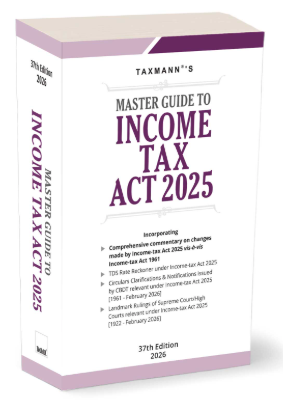
Master Guide to Income Tax Act 2025 By Taxmann – 37th Edition 2026
Original price was: ₹2,995.00.₹2,245.00Current price is: ₹2,245.00.
Master Guide to Income Tax Act 2025 By Taxmann – 37th Edition 2026
Description
Master Guide to Income Tax Act 2025 (37th Edition) is Taxmann’s flagship single-volume reference work for the transition from the Income-tax Act 1961 to the Income-tax Act 2025. This Edition of the Master Guide has been updated to reflect the Finance Act 2026, making it the definitive reference for the current assessment cycle. Across 1,800+ pages and four Divisions, it delivers:
- A provision-by-provision comparative commentary covering every substantive change from the ITA 1961 to the ITA 2025
- A complete TDS and TCS rate reckoner under the ITA 2025
- The full body of CBDT circulars, clarifications, and notifications from 1961 through February 2026 mapped to ITA 2025 sections
- A curated digest of landmark Supreme Court and High Court rulings, spanning 1922 through February 2026, indexed under the new statute
This book is intended for the following audience:
- Chartered Accountants and Tax Consultants managing compliance, structuring, and advisory under the new statutory framework while handling legacy ITA 1961 proceedings in parallel
- Corporate Tax Teams responsible for assessments, returns, and internal reporting across the transitional period, where both statutes operate simultaneously
- Advocates and Litigation Counsel appearing before income-tax authorities, ITAT, High Courts, and the Supreme Court—the landmark rulings digest is directly keyed to ITA 2025 section numbers
- Transfer Pricing Specialists working with the revised safe harbour rules, APA regime, associated enterprise definition, and arm’s length price determination under the new Act
- Officers of the Income Tax Department requiring a comparative reference to apply ITA 2025 provisions while administering or contesting matters arising under the ITA 1961
- Tax Policy Professionals and Academics tracking the legislative evolution of Indian income tax across the full spectrum—definitions, charging provisions, computation heads, procedural machinery, and penalties
The Present Publication is the 37th Edition | 2026, authored by Taxmann’s Editorial Board, with the following noteworthy features:
- [First Authoritative Comparative Commentary on ITA 2025 vs. ITA 1961] Division One—the intellectual centrepiece of the book at approximately 463 pages—provides a chapter-by-chapter, para-by-para comparative analysis of the ITA 2025 against the ITA 1961 across all 20 subject-matter areas. Every para follows a disciplined structure: position under the ITA 1961, corresponding section in the ITA 2025, and a full analysis of the change, including legislative intent, interpretive implications, and practical consequences. The commentary does not merely describe what changed—it explains why it changed, whether the change is substantive or merely structural, and where interpretive uncertainty survives despite the new drafting
- [Finance Act 2026 Fully Integrated] The book is updated to incorporate all amendments made to both the ITA 2025 and the ITA 1961 by the Finance Act 2026—including changes to prosecution provisions (replacement of ‘rigorous imprisonment’ with ‘simple imprisonment,’ introduction of graded punishment structures, decriminalisation of certain offences), provident fund investment rule rationalisation, MAT amendments, and further TDS/TCS adjustments. Where the Finance Act 2026 has not amended a provision of the ITA 2025, the commentary explicitly notes this, maintaining clean editorial discipline on which changes originate from the new statute versus the most recent Finance Act
- [Structural Transformation Fully Articulated] The book systematically maps the architectural redesign of the statute: the elimination of the ‘Previous Year’ and ‘Assessment Year’ concepts and their replacement with the unified ‘Tax Year’; the consolidation of all NPO/trust provisions (previously scattered across Section 10, Sections 11–13, and related provisions amended by more than 20 Finance Acts since 1961) into a single dedicated chapter; the recharacterisation of Section 10 exemptions as deductions; the migration of 1,200 provisos and 900 explanations into sub-sections, clauses, and sub-clauses; and the addition of five new schedules
- [Complete TDS/TCS Rate Reckoner Under ITA 2025] Division Two provides comprehensive tabular reference covering every TDS and TCS provision under the ITA 2025, with columns covering: nature of income/receipt, payer category, payee category, threshold, rate where PAN/Aadhaar is furnished, rate where PAN/Aadhaar is not furnished, and time of deduction/collection. All fourteen exemption categories are separately tabulated with full conditions. The TCS reckoner covers all nine TCS categories under Section 394(1), including the rationalised uniform 2% rate structure and the LRS/overseas travel package differential rates
- [Exhaustive CBDT Administrative Guidance—Dual-Indexed] Division Three compiles the complete body of CBDT circulars, clarifications, and notifications from 1961 through February 2026 that retain relevance under the ITA 2025. Critically, because the ITA 2025 renumbers and restructures sections relative to the ITA 1961, the section key maps legacy guidance to the corresponding ITA 2025 provision, preventing the section-numbering disconnect from rendering decades of administrative guidance inaccessible. An alphabetical key is also provided for keyword-based retrieval. The division spans approximately 584 pages, constituting the most extensive compilation of CBDT administrative guidance available in a single volume under the new Act
- [Century-Spanning Landmark Judicial Digest—Dual-Indexed] Division Four assembles the landmark rulings of the Supreme Court and High Courts from 1922 through February 2026 that continue to govern interpretation under the ITA 2025. The approximately 743 pages of judicial digest are indexed both section-wise (under ITA 2025 section numbers) and alphabetically by subject. The alphabetical index spans the full spectrum of direct tax jurisprudence—from agricultural income and amalgamation through transfer pricing, unexplained credits, and search and seizure
The book is divided into three core divisions:
- Division One | Comparative Commentary (approx. 463 pages) — Organised across 20 thematic chapters. Each chapter opens with an ‘Overview’ para listing all changes in that subject area, followed by detailed paras analysing each change in full.
- Chapter 1 | Introduction — Legislative history of the ITA 2025, its structural statistics (536 sections, 16 schedules, 2.60 lakh words, no provisos, no explanations), Finance Act, 2026 amendments to both statutes, and the 1 April 2026 effective date
- Chapter 2 | Definitions — Eleven changes including: unified Tax Year concept replacing Previous Year and Assessment Year; expansion of books of account to cover cloud-based storage; revised definition of ‘charitable purpose’; expansion of ‘income’ to cover all import/export incentives; and explicit clarification that ‘relative’ covers both maternal and paternal lineal ascendants
- Chapter 3 | Basis of Charge — TCS explicitly included in the Section 4 charging mechanism; POEM definition refined; ‘reasonably attributable’ standard extended to SEP-based attribution; ‘through or from’ applied uniformly to capital asset transfers; royalty definition expanded to ‘transfer or grant’ (legislative response to Engineering Analysis); eligible investment fund cap increased from 20% to 25%
- Chapter 4 | Salary and House Property — Structural realignment of salary exemptions into deductions; revised exclusions from ‘profits in lieu of salary’; definitional shift from ‘any house property’ to ‘any property’ for inadequate consideration transfers
- Chapter 5 | Business Income — Over 27 paras covering depreciation; employee welfare expense consolidation and timing alignment; commodity derivative definition; critical minerals expansion; presumptive tax scheme modifications for goods carriage, shipping, airlines, civil construction, cruise shipping, and electronics manufacturing; proportionate deduction rule consolidation; and tax audit threshold changes
- Chapter 6 | Capital Gains — Buyback of shares shifted from deemed dividend to capital gains; Sovereign Gold Bond exemption restricted to original holders holding to maturity; drafting correction to the capital gains charging provision
- Chapter 7 | Other Sources — Elimination of deemed dividend treatment for intra-group loans; restriction on expense deductions from dividend and mutual fund income; deduction now allowed for land revenue, local rates, and municipal taxes
- Chapter 8 | Deductions and Exemptions — Sixteen paras covering new exemptions (disability pension for armed forces; MACT compensation interest; RFCTLARR Act compulsory acquisition proceeds; income of foreign companies providing capital goods to contract manufacturers; returning residents’ income for five years; data centre service income exempt until TY 2046-47; New Development Bank exemption); rationalised co-operative society deductions; IFSC/OBU revisions; start-up turnover limit increase
- Chapter 9 | Taxation Framework for Registered NPOs — The most structurally significant chapter—19 paras covering the entire redesigned NPO framework: revised definition of charitable purpose; application and regime-switching; tax computation across regular, specified, residual income, and corpus donations; application and accumulation of income; commercial activity restrictions; specified violations; accreted income tax; merger non-triggering provision; and approval for donations
- Chapter 10 | Special Tax Rates — Unexplained income tax rate reduced from 60% to 30%; NRI foreign exchange asset regime consolidation; IFSC post-holiday income provisions; MAT rationalisation; concessional regime depreciation; and unexplained investment/asset/cash provisions
- Chapters 11–20 | Tonnage Tax, Transfer Pricing, TDS/TCS, Return & Appeals, Interest & Fee, Assessment Proceedings, Search & Seizure, Penalties, Prosecution, Miscellaneous — Exhaustive coverage of all remaining subject areas including: safe harbour rationalisation; APA regime changes; 22+ TDS/TCS amendments; extended return filing deadline; Dispute Resolution Committee enhancements; block assessment time limit extension; replacement of rigorous with simple imprisonment across all prosecution provisions; graded punishment structures; decriminalisation of specified offences; and provident fund investment rule rationalisation
- Division Two | TDS/TCS Rate Reckoner (approx. 28 pages) — Comprehensive tabular reference for every withholding provision under the ITA 2025, organised by category: salary and EPF; interest and dividend (domestic, foreign borrowings, infrastructure debt funds, bonds/GDRs, business trust, AIF, securitisation trust, FII/specified fund); virtual digital assets, lottery, horse racing; contractors, e-commerce, royalty, professional/technical services, purchase of goods; commission, rent, immovable property; remuneration and benefits; and non-resident payments. Fourteen exemption categories fully detailed. TCS reckoner covers the rationalised uniform 2% structure, LRS tiered rates, and overseas tour packages
- Division Three | CBDT Circulars, Clarifications & Notifications, 1961–February 2026 (approx. 584 pages) — The complete administrative corpus of CBDT guidance curated for continued relevance under the ITA 2025, preceded by two independent indices: a section key (cross-referencing ITA 2025 section numbers) and an alphabetical key. The section key resolves the numbering discontinuity between the two Acts, ensuring guidance originally issued under ITA 1961 section references is accessible via ITA 2025 section numbers
- Division Four | Landmark Rulings of the Supreme Court and High Courts, 1922–February 2026 (approx. 743 pages) — A curated digest spanning over a century of Supreme Court and High Court jurisprudence, organised under ITA 2025 section numbers and preceded by a section key and an alphabetical key covering over 120 subject heads. Integrates rulings from 1922 through February 2026, including recent 2024–25 High Court pronouncements. The alphabetical index spans the full field—agricultural income, amalgamation, arm’s length pricing, capital gains, charitable purpose, depreciation, deemed accrual, MAT, NPO taxation, penalties, search and seizure, transfer pricing, unexplained credits, and more
The structure of the book is as follows:
- Division One is organised in 20 chapters. Each chapter opens with a numbered ‘Overview’ para listing all changes in the subject area. This is followed by individual numbered paras, each covering one discrete change in a standard three-part format:
- Position under ITA 1961 → corresponding ITA 2025 provision → analysis of change
- Cross-references between chapters are provided where changes in one area have consequential implications in another
- Division Two uses a master table format for TDS and a separate table for TCS, with nine column-heads and footnoted conditions for rates-in-force, specified persons, PAN/Aadhaar differentials, and exemptions
- Divisions Three and Four are each preceded by two independently usable index systems: a section key organised by ITA 2025 section number, and an alphabetical key listed by subject. The substantive content is organised by ITA 2025 section number, with CBDT materials presented chronologically in Division Three and rulings presented under sub-headings derived from the legal principle established in Division Four
Additional information
| BINDING | PAPERBACK |
|---|---|
| AUTHOR | Taxmann's Editorial Board |
| EDITION | 2026 |
| ISBN | 9789375613633 |
| PUBLICATION | TAXMANN PUBLICATIONS |
Related products
-
- Out of StockSale!
- TAXATION LAW, INDIRECT TAX, DIRECT TAX, INCOME-TAX, GST, TDS, CA BOOKS
BHARAT’S DIRECT TAXES READY RECKONER-WITH TAX PLANNING (AY 22-23 & AY 23-24)
- Original price was: ₹1,795.00.₹1,167.00Current price is: ₹1,167.00.
- Read more
-
-
- Sale!
- INTELLECTUAL PROPERTY LAW, TRADE MARKS, COPYRIGHT, PATENTS, TAXATION LAW, INDIRECT TAX, DIRECT TAX, INCOME-TAX, GST, TDS, CA BOOKS
A COMPLETE GUIDE TO VALUAION OF IP ASSETS (WITH DISCUSSIONS ON MANAGING, AUDITING AND TAXING IPs
- Original price was: ₹900.00.₹720.00Current price is: ₹720.00.
- Add to cart
-
- Out of StockSale!
- TAXATION LAW, INDIRECT TAX, DIRECT TAX, INCOME-TAX, GST, TDS, CA BOOKS
GST TRACKER-CONTAINING SECTIONWISE/RULEWISE JUDGMENTS, CIRCULARS, NOTIFICATIONS AND MUCH MORE
- Original price was: ₹3,095.00.₹2,475.00Current price is: ₹2,475.00.
- Read more
-

Reviews
There are no reviews yet.