

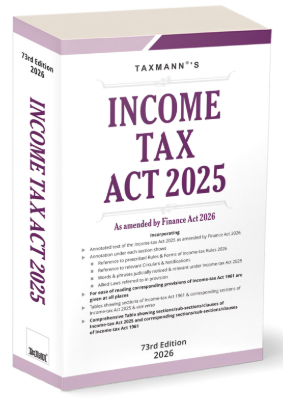
Income Tax Act 2025 By Taxmann – 73rd Edition 2026
Original price was: ₹2,795.00.₹2,095.00Current price is: ₹2,095.00.
Income Tax Act 2025 By Taxmann – 73rd Edition 2026
Description
Income-Tax Act 2025 is the definitive, fully annotated text of India’s landmark Income-tax Act 2025—the successor legislation to the Income-tax Act 1961—as further amended by the Finance Act 2026. This is Taxmann’s flagship publication, now in its 73rd Edition, and represents over six decades of unbroken editorial continuity.
The Income-tax Act 2025 is the most consequential restructuring of Indian direct tax law in over six decades. It repeals and replaces the Income-tax Act, 1961—consolidating, rationalising, and renumbering an entire body of law that had accumulated across nearly 300 amendments and countless provisos, explanations, and sub-clauses over 60 years. The 2025 Act restructures 298 sections of the old law into 535+ sections across 22 chapters, introducing logical sub-sectioning, tabular presentation of rates and conditions, cleaner definitional architecture, and a new concept of ‘tax year’ to replace the old ‘previous year/assessment year’ framework.
With over 1,500 pages, including five legislative instruments, three cross-reference tables, associated law provisions, and a comprehensive subject index—all centred around a fully annotated statutory text—this volume stands as the definitive single-volume reference on the Income-tax Act, 2025 for the Indian legal and tax community.
This publication serves the full spectrum of India’s direct tax constituency:
- Practising Professionals — Chartered accountants, tax advocates, and consultants who need an annotation-rich, always-updated primary text for daily advisory, compliance, and litigation work. The volume’s annotation structure is calibrated precisely for the working professional who needs to know not just the provision but also the applicable rule, the relevant CBDT circular, and the judicial meaning of key terms—all from a single source
- Corporate Tax Functions — In-house counsel, CFOs, and tax departments of companies navigating the transition from the old to the new Act, particularly in areas involving MAT computation, transfer pricing, capital gains, and the new tax regime applicable to domestic companies and co-operative societies
- Income Tax Department and Tribunal Members — Officers conducting assessment, reassessment, search, and survey proceedings; appellate authorities hearing appeals before the Commissioner (Appeals), Joint Commissioner (Appeals), and ITAT; and members dealing with revised faceless assessment and dispute resolution procedures introduced under the new Act
- International Tax Practitioners — Specialists advising on DTAA positions, non-resident taxation, transfer pricing, GAAR, CbCR, APAs, and IFSC unit taxation, all of which are significantly restructured and re-sectioned under the 2025 Act
- Law and Commerce Students, CA/CS/CMA Aspirants — The primary statutory text, with its institutional cross-references and contextual annotations, serves equally as an examination resource and a foundation for professional-level understanding of the new code
The Present Publication, in its 73rd Edition | 2026, upholds its tradition of unmatched accuracy and reliability. It is updated to incorporate the latest amendments introduced by the Finance Act 2026. The book is authored and edited by Taxmann’s Editorial Board, continuing its legacy as a cornerstone in Direct Tax, with the following noteworthy features:
- [Fully Annotated Statutory Text—Four-Dimension Architecture] The statutory text of every section is accompanied by four layers of structured annotation:
- Rules and Forms — Each provision is cross-referenced to the corresponding rule(s) under the Income-tax Rules 2026 and the prescribed form(s). For example, references to Rule 3 or Rule 4 alongside the relevant provision, and form references where compliance requires filing—eliminating the need to separately consult the Rules
- Circulars and Notifications — Relevant CBDT circulars and notifications are cited directly beneath the provision they qualify or clarify. Historical circulars going back to the 1970s and 1980s are retained where they remain operative, giving practitioners the complete administrative guidance landscape alongside the statutory text
- Words and Phrases Judicially Noticed — Terms that have acquired specific judicial meaning—such as ‘accumulated profits,’ ‘distribution,’ ‘beneficially held,’ ‘in the ordinary course of business,’ ‘manufacture,’ ‘charitable purpose,’ ‘person,’ and others—are flagged at the precise provision where they arise.
- Allied Laws — Where a provision cross-references another statute—the Companies Act 2013, the Indian Partnership Act 1932, the Reserve Bank of India Act 1934, the FEMA 1999, the Bharatiya Nyaya Sanhita 2023, the IT Act 2000, and several others—the relevant allied law provision is identified in the annotation and its full text is reproduced in the Appendix to Division One. This is a significant editorial feature: the reader does not need to cross-refer to a separate volume of statutes to understand the complete legal position
- [Finance Act 2026 Amendments—Incorporated]
- Every change introduced by the Finance Act 2026 is incorporated directly into the text of the relevant provision, not listed separately or flagged in a table of amendments. Where a sub-section has been substituted or a clause omitted, the amended text appears in its correct position with a footnote identifying the change, effective date (w.e.f.), and the prior text. This ensures that the reader always works with the current legal position—not an unamended base text with addenda
- Representative Finance Act 2026 amendments incorporated include the substitution of the definition of ‘co-operative society’ (Section 2(32)) to include Multi-State Co-operative Societies, the omission of sub-clause (f) from the definition of ‘dividend’ (Section 2(40)) relating to buybacks, and the expanded definition of ‘group entity’ for IFSC Finance Company purposes—all incorporated inline with the statutory text
- [Three-Layer 1961–2025 Correspondence System] The most operationally critical feature of this Edition for practitioners trained under the old Act is the three-tier cross-reference apparatus between the 1961 and 2025 Acts:
- Inline Corresponding Provision — Every section carries a ‘Corresponding Provision’ reference to its 1961 Act equivalent immediately after the section text. This is consistently applied throughout, even where a single 2025 provision consolidates multiple 1961 provisions (e.g., Section 2(90) corresponds to Section 2(37A); Section 8 corresponds to Section 9B; Section 116 maps to Sections 72, 72A, and 72AB of the 1961 Act)
- Table 1 | 1961 Act → 2025 Act — A dedicated table at the front maps every section (and key sub-sections/clauses) of the 1961 Act to the corresponding provision of the 2025 Act, with section headings for both
- Table 2 | 2025 Act → 1961 Act — The reverse mapping, allowing practitioners beginning from the 2025 Act provision to identify its 1961 origin
- Comprehensive Table | Sub-Section and Clause Level — The most granular layer maps every sub-section and clause of the 2025 Act to the equivalent sub-section and clause of the 1961 Act. Where a single 2025 clause corresponds to multiple 1961 provisions—as is common given the consolidation exercise—all are listed. For complex provisions such as Section 206 (MAT/AMT) or Section 532 (power to frame schemes), the mapping runs to several pages
- [Five Legislative Instruments in One Volume] The volume extends beyond the 2025 Act to include the full text of four companion legislative instruments—converting it into a complete desk reference for direct tax practice:
- Income-tax Act 2025 (as amended by Finance Act 2026)
- Finance Act 2026
- Securities Transaction Tax
- Commodities Transaction Tax
- Foreign Assets of Small Taxpayers Disclosure Scheme 2026
- [Appendix of Allied Laws and Subject Index] The Appendix reproduces the complete text of every allied law provision cited anywhere in the 2025 Act—including relevant sections from the Companies Act 2013, the Indian Partnership Act 1932, the RBI Act 1934, the LLP Act 2008, SCRA 1956, FEMA 1999, the Bharatiya Nyaya Sanhita 2023, the Information Technology Act 2000, the PFRDA Act, and several regulatory frameworks under IRDAI and SEBI. The Subject Index provides a parallel, concept-based point of entry into the Act for practitioners who are navigating a legal question rather than a known section number.
The coverage of the book is as follows:
- Preliminary Comparative Tables
- Table 1 — All sections of the Income-tax Act 1961 with their corresponding sections in the Income-tax Act 2025 (section headings for both Acts included)
- Table 2 — All sections of the Income-tax Act 2025 with their corresponding sections in the Income-tax Act 1961
- Table 3 — A comprehensive, clause-level table mapping every section, sub-section, and clause of the 2025 Act to the corresponding provision of the 1961 Act—an indispensable tool for practitioners migrating institutional knowledge from the old regime to the new
- Division One — Income-tax Act 2025
- Arrangement of Sections — Full topical listing of all 535+ sections across 22 chapters
- Complete annotated text of the Income-tax Act 2025 as amended by the Finance Act 2026
- Appendix — List of provisions of Allied Acts, Circulars, and Regulations referred to in the Act, followed by the full text of each such provision
- Subject Index — A detailed keyword and concept index enabling rapid location of any topic within the Act
- Division Two — Finance Act 2026 (Dedicated Section)
- Arrangement of Sections
- Full text of the Finance Act 2026
- Division Three — Securities Transaction Tax
- Arrangement of Sections
- Full statutory text of the Securities Transaction Tax
- Division Four — Commodities Transaction Tax
- Arrangement of Sections
- Full statutory text of the Commodities Transaction Tax
- Division Five — Foreign Assets of Small Taxpayers Disclosure Scheme 2026
- Arrangement of Paragraphs
- Full text of the Scheme
The book follows a five-layer navigational architecture:
- Layer 1 — Macro Cross-Reference (Front Matter) | Three tables occupying over 350 pages map the entire 1961–2025 Act transition at section, sub-section, and clause level. This is the primary orientation tool for a profession that has worked with the 1961 Act for six decades
- Layer 2 — Chapter and Section Arrangement | The Arrangement of Sections within Division One provides a chapter-by-chapter, sub-head-by-sub-head, section-by-section page reference across all 535+ sections and their sub-divisions
- Layer 3 — Annotated Section Text | Within each section, the layout is: statutory text → ‘Corresponding Provision’ cross-reference → footnotes covering rules, forms, circulars, notifications, judicial vocabulary, and allied law references. Finance Act, 2026 amendments are incorporated into the body with identifying footnotes
- Layer 4 — Appendix as Self-Contained Allied Law Reference | The Appendix in Division One reproduces the complete text of every allied statute provision cited in the Act—eliminating the need to consult separate volumes for definitions, procedural provisions, and regulatory frameworks drawn from dozens of other statutes
- Layer 5 — Subject Index as Reverse Entry Point | The detailed Subject Index enables concept-driven access to the Act, complementing the section-based and table-based navigation available at the front of the volume
Additional information
| BINDING | PAPERBACK |
|---|---|
| AUTHOR | Taxmann's Editorial Board |
| EDITION | 2026 |
| ISBN | 9789375610083 |
| PUBLICATION | TAXMANN PUBLICATIONS |
Related products
-
- Sale!
- TAXATION LAW, INDIRECT TAX, DIRECT TAX, INCOME-TAX, GST, TDS, CA BOOKS
Tax Planning : Issues*Ideas*Innovation 11th Edition – S Rajaratnam (By VG Aravindanayagi)
- Original price was: ₹3,995.00.₹2,995.00Current price is: ₹2,995.00.
- Add to cart
-
- Sale!
- TAXATION LAW, INDIRECT TAX, DIRECT TAX, INCOME-TAX, GST, TDS, CA BOOKS
MYSTIQUES OF MLI BROUGHT ALIVE
- Original price was: ₹1,095.00.₹875.00Current price is: ₹875.00.
- Add to cart


Reviews
There are no reviews yet.