

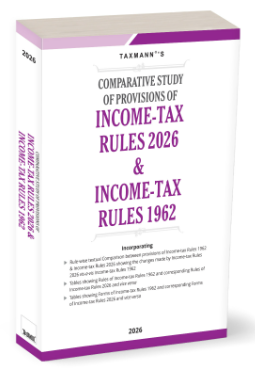
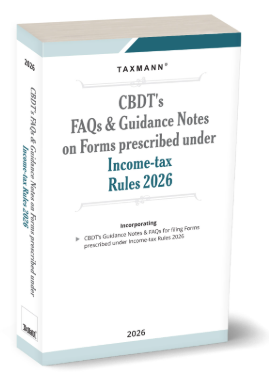
CBDT’s FAQs and Guidance Notes on Forms Prescribed under Income Tax Rules 2026 by Taxmann – Edition 2026
Original price was: ₹995.00.₹745.00Current price is: ₹745.00.
CBDT’s FAQs and Guidance Notes on Forms Prescribed under Income Tax Rules 2026 by Taxmann – Edition 2026
Description
India’s income-tax compliance architecture has been comprehensively recodified under the Income-tax Act 2025 and the Income-tax Rules 2026. Every prescribed form has been renumbered, redesigned, and digitally restructured. To assist taxpayers and professionals in navigating this transition, the Central Board of Direct Taxes has issued official Guidance Notes and FAQs for each prescribed form. This Taxmann volume consolidates the entirety of that CBDT-issued material—covering approximately 167 forms across 863 pages—making it the single authoritative reference for form-level compliance under the new regime. The publication contains no third-party commentary. The interpretive voice throughout is the CBDT’s own.
This book in intended for the following audience:
- Chartered Accountants and Tax Practitioners required to certify, audit, or file reports in prescribed forms, and who need authoritative CBDT-issued guidance on form completion and filing methodology
- Corporate Tax and Finance Functions managing TDS/TCS compliance, advance tax intimations, APA filings, CbCR reporting, and MAT/AMT computations
- Transfer Pricing Specialists dealing with TP audit reports, Safe Harbour applications, APA negotiations, MAP invocations, and CbCR constituent entity filings
- Company Secretaries and Cost Accountants involved in secretarial compliance, amalgamation certifications, tonnage tax audits, and statutory reporting under special regimes
- Non-Profit Organisations and Charitable Trusts navigating the registration, approval, accumulation, and audit form requirements under sections 332 and 354
- Appellate Practitioners handling proceedings before JCIT(A), CIT(A), ITAT, and High Courts, as well as Dispute Resolution Committee and advance ruling applications
- Tax Officials and Administrators seeking to understand prescribed form requirements and the CBDT’s own interpretive position on those forms
- IT and Compliance Teams implementing the new e-filing system, for whom the guidance’s documentation of smart form changes, auto-population logic, API integrations, and UDIN requirements is directly operational
The Present Publication is the 2026 Edition, edited by Taxmann’s Editorial Board, with the following noteworthy features:
- [CBDT Guidance as Primary Authority] Every guidance note reproduced is CBDT-issued—not a practitioner’s interpretation. Where a professional has relied on this guidance in completing a prescribed form, that reliance carries formal weight in compliance and penalty proceedings
- [Dual Statutory Cross-Reference Throughout] Every form entry carries an explicit footnote cross-referencing its predecessor form under the 1962 Rules and mapping the governing section from the Income-tax Act 1961 to its equivalent in the Income-tax Act 2025
- [Standardised Guidance Architecture] Every form in the volume follows a consistent internal structure:
- Purpose — What the form accomplishes and which statutory provision it serves
- Who Should File — Eligible/obligated categories of taxpayers
- Frequency and Due Dates — Filing calendar, including quarter-wise tables where applicable
- Structure of the Form — Part-by-part breakdown of what information is required and why
- Filing Method — Online-only, DSC or EVC, UDIN requirements for accountant certificates
- Historical Filing Count — Actual filing volume data from prior years
- Changes Proposed — Qualitative explanation of what has changed from the predecessor form
- FAQs — Numbered Q&A covering mandatory filing, revision eligibility, consequences of non-filing, document requirements, and common errors
- [Substantive Guidance Depth] The guidance is not perfunctory. For complex forms, it runs to multiple pages of substantive analysis. This is practical, deployment-ready material
- [Smart Form Transition Documentation] The guidance systematically documents the shift from the old form architecture to the new digital framework—including auto-population of taxpayer master data, real-time field validations, dropdown-based category selection, API integrations, UDIN linkage for accountant certificates, and the replacement of ‘Assessment Year/Financial Year/Previous Year’ with ‘Tax Year’ throughout. These changes are documented form-by-form, making the guidance equally useful for the IT teams implementing the new e-filing system
The 863 pages cover the complete form set across eight functional domains:
- Source Taxation (TDS/TCS)
- Quarterly Salary TDS Statement — Form 138 (successor to Form 24Q)
- Quarterly Non-Salary Domestic TDS Statement — Form 140 (successor to Form 26Q)
- Quarterly Non-Resident TDS Statement — Form 144 (successor to Form 27Q)
- Quarterly Virtual Digital Asset TDS Statement — Form 142
- Quarterly TCS Statement — Form 143 (successor to Form 27EQ)
- TDS/TCS Certificates — Forms 130–133
- Government Book-Adjustment TDS/TCS Statement — Form 137 (successor to Form 24G)
- Challan-Cum-Statement — Form 141
- IFSC Unit Remittance Statement — Form 148
- Accountant Certificates to Avoid Deductor-in-Default Classification — Forms 149–150
- International Taxation and Transfer Pricing
- TP Audit Report for International and Specified Domestic Transactions — Form 48 (successor to Form 3CEB); receives the most detailed guidance in the volume, including full method-wise ALP computation illustrations for all five TP methods
- Safe Harbour Application — Form 49
- Pre-filing Consultation Application — Form 50
- APA Application, Annual Compliance Report, and Renewal — Forms 51–54
- MAP Invocation — Form 55
- CbCR Constituent Entity Information, Designated Entity Intimation, and Parent Entity Report Under Section 511 — Forms 56–60
- Non-Resident Payment Information and Accountant Certificate (Functional Equivalents of Forms 15CA and 15CB) — Forms 145–146
- Royalty and FTS Audit Report for Non-Residents — Form 24
- Certificate of Residence for Treaty Purposes — Forms 42–43
- Non-Profit Organisations and Charitable Trusts
- Provisional Registration and Approval Application — Form 104
- Regular Registration under Section 332 and Approval under Section 354 — Form 105; guidance covers six distinct re-registration scenarios and the new 10-year registration window for smaller NPOs under the Income-tax Act 2025
- Provisional Registration and Approval Orders, Including Rejection — Form 106
- Regular Registration/Approval Grant, Rejection, and Cancellation Orders — Form 107
- Option for Application of Income for Charitable or Religious Purposes — Form 108
- Income Accumulation Statement under Section 342(1) — Form 109
- Change-of-Purpose Application for Accumulated Income — Form 110
- NPO Audit Report under Section 348 — Form 112
- Donee Statement and Donation Certificate under Section 354 — Forms 113–114
- Special Regimes
- Tonnage Tax Option/Renewal Application and Audit Report — Forms 80–81
- SEZ Unit Deduction Particulars under Section 144 — Form 33
- Additional Employee Cost Deduction Report — Form 34
- OBU and IFSC Income Deduction Report — Form 35
- Specified Fund Concessional Taxation Statement and OBU Investment Division Certifications — Forms 68–71
- Income Statements for Securitisation Trusts, VCCs/VCFs, Business Trusts, and Investment Funds (Both Entity-Level and Investor-Level) — Forms 72–79
- Patent Royalty Taxation Option — Form 65
- MAT Book Profit Computation Report — Form 66
- AMT Adjusted Total Income Computation Report — Form 67
- Scientific Research and Investment Incentives
- Zero Coupon Bond Notification Application and Annual Compliance Certification — Forms 2–3
- Preliminary Expense Statement and Audit Report — Forms 5–6
- Approval, Order, Receipt, and Reporting Chain for CBDT-Approved Scientific Research Programmes Under Section 45(3)(C) — Forms 7–10
- In-House R&D Facility Agreement, Accountant Report, and Approval Order — Forms 11–14
- Research Institution Donation Statement, Certificate, and Approval Forms — Forms 15–17
- Affordable Housing Project Notification — Form 18
- Semiconductor Wafer Fabrication Unit Notification — Form 19
- Agricultural Extension Project Approval and Notification — Forms 20–21
- Skill Development Project Approval and Notification — Forms 22–23
- Appellate and Dispute Resolution
- Appeal To JCIT(A) or CIT(A) — Form 99
- Audit Report and Inventory Valuation Report under Section 268(5) — Forms 100–101
- ITAT Appeal Form and Memorandum of Cross-Objections — Forms 115–116
- Identical Question of Law Declaration and Appeal Deferment Application — Forms 117–118
- Dispute Resolution Committee Application — Form 119
- Advance Ruling Application — Form 120
- Non-Resident and Foreign Income
- Statement of Foreign Income and Foreign Tax Credit — Form 44
- FTC Dispute Intimation — Form 45
- Relief on Arrear Salary, Gratuity, Retrenchment Compensation, and Pension Commutation — Form 39
- Retirement Benefit Account Taxation Option — Form 40
- Treaty Information Under Section 159(8) — Form 41
- Non-Domiciled Person Undertakings, No-Objection Certificate, and Clearance Certificate — Forms 154–159
- Annual Statement under Section 505 — Form 162
- Information and Documents for Indian Concerns Under Section 506 — Form 163
- Film Production and Specified Activity Statement Under Section 507 — Form 164
- Annual Information Statement — Form 168
- Registration and Administration
- PAN Allotment for All Four Taxpayer Categories (Indian Individuals, Indian Entities, Foreign Individuals, Foreign Entities) — Forms 93–96
- TAN Allotment — Forms 134–135
- Accounts Office Identification Number (AIN) Application — Form 136
- Income-Tax Practitioner Registration — Form 171
- Provident Fund Subscriber Account Maintenance and Recognition Application — Forms 185–186
- Superannuation Fund and Gratuity Fund Approval Application — Form 188
- Appeal Against Fund De-Recognition or Approval Withdrawal — Form 187
- Public Company Issue Approval and Mutual Fund Approval under Schedule XV — Forms 189–190
Every form entry functions as a self-contained compliance dossier, uniformly structured across all 167 forms in the volume. Each entry contains:
- Predecessor Form Identity — Explicit cross-reference to the corresponding form under the 1962 Rules
- Governing Rule — The specific rule under the Income-tax Rules 2026
- Applicable Section — Mapped to the Income-tax Act 2025
- Filing Calendar — Frequency, due dates, and quarter-wise tables where applicable
- Part-By-Part Form Breakdown — Field-level explanation of what information is required and why
- FAQ Set — Numbered Q&A covering mandatory filing status, revision eligibility, consequences of non-filing, document requirements, and common errors
- Changes From Predecessor Form — Explicit documentation of what has been added, modified, or removed relative to the old form
Additional information
| BINDING | PAPERBACK |
|---|---|
| AUTHOR | Taxmann's Editorial Board |
| EDITION | 2026 |
| ISBN | 9789375611066 |
| PUBLICATION | TAXMANN PUBLICATIONS |
Related products
-
- Out of StockSale!
- COMPANY LAW, CORPORATE LAWS, BUSINESS LAW, SEBI, SECURITIES, STOCK, FEMA, COMPETITION, MSMEs, START-UPs, INDUSTRIES, TAXATION LAW, INDIRECT TAX, DIRECT TAX, INCOME-TAX, GST, TDS, CA BOOKS
MSME READY RECKONER
- Original price was: ₹1,795.00.₹1,350.00Current price is: ₹1,350.00.
- Read more
-
-
- Out of StockSale!
- TAXATION LAW, INDIRECT TAX, DIRECT TAX, INCOME-TAX, GST, TDS, CA BOOKS
GST PLEADING AND PRACTICE
- Original price was: ₹5,995.00.₹4,800.00Current price is: ₹4,800.00.
- Read more
-
-
- Out of StockSale!
- TAXATION LAW, INDIRECT TAX, DIRECT TAX, INCOME-TAX, GST, TDS, CA BOOKS
GST LAW & PROCEDURE ( SET OF 3 VOLUMES)
- Original price was: ₹6,995.00.₹5,245.00Current price is: ₹5,245.00.
- Read more
-


Reviews
There are no reviews yet.