

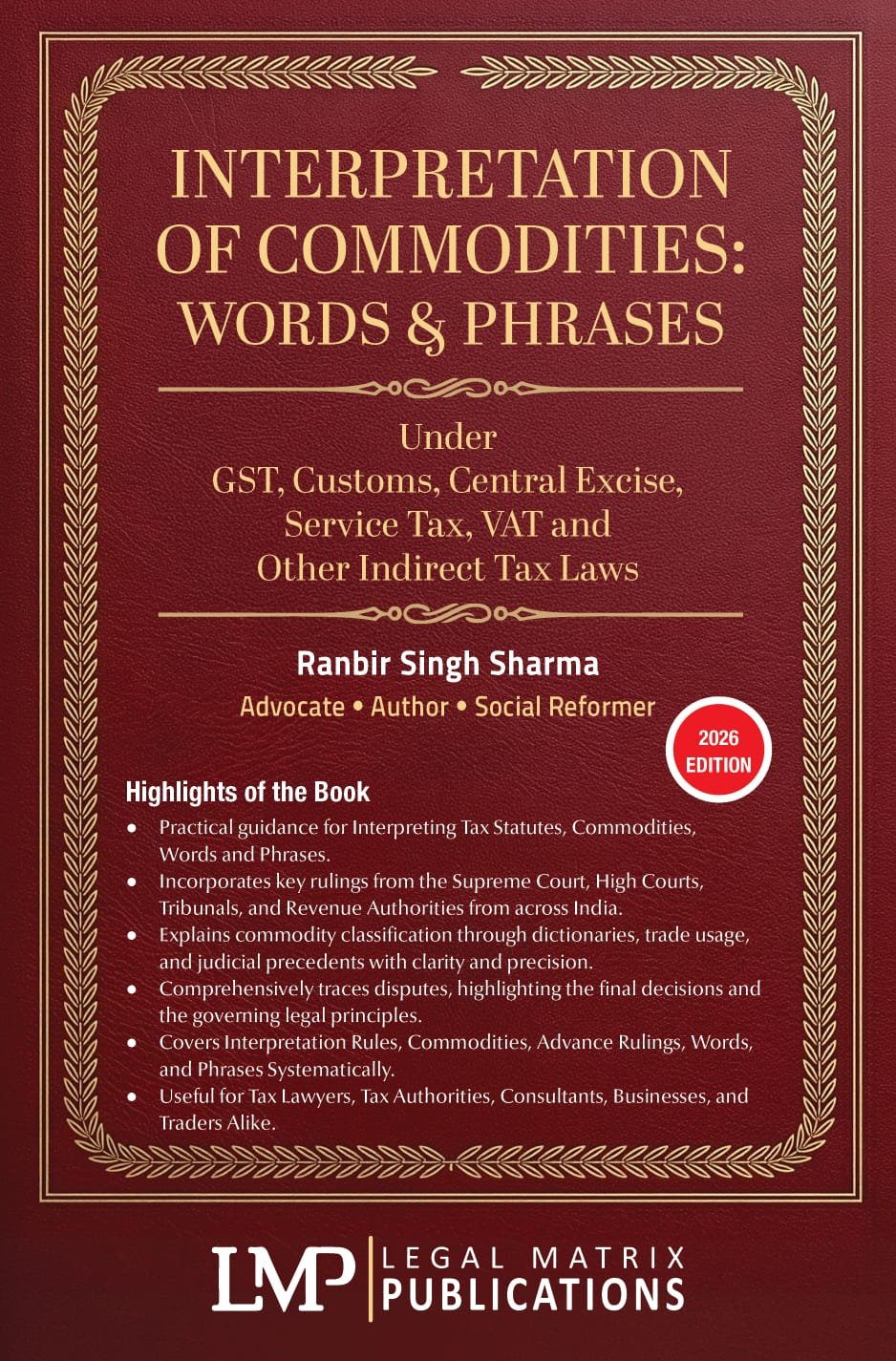
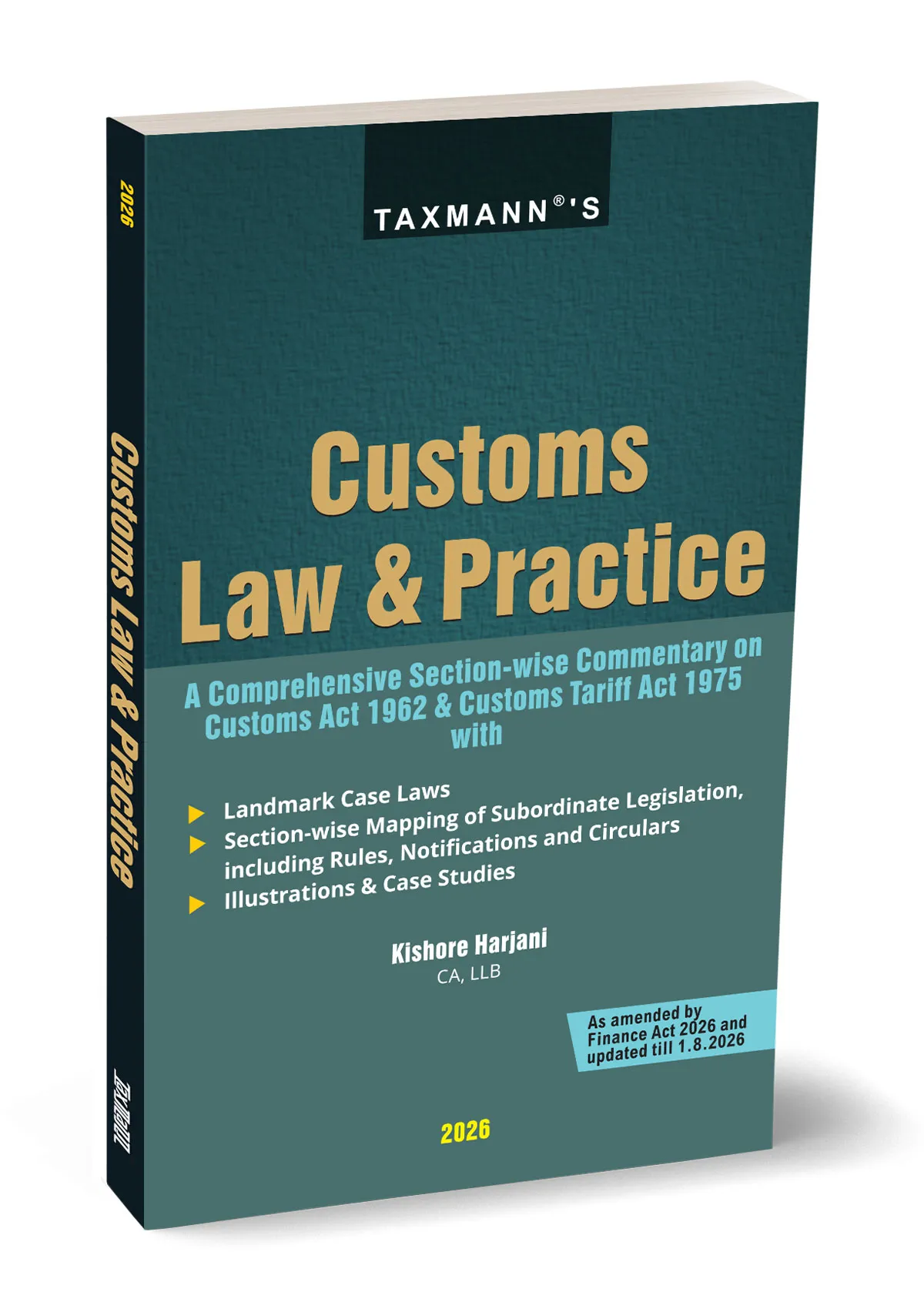
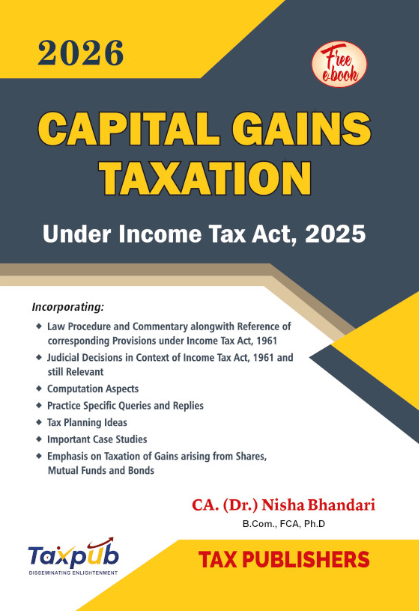
Capital Gains Taxation under Income Tax Act, 2025 | CA (Dr.) Nisha Bhandari | Edition 2026
Original price was: ₹2,240.00.₹1,685.00Current price is: ₹1,685.00.
Capital Gains Taxation under Income Tax Act, 2025 | CA (Dr.) Nisha Bhandari | Edition 2026
Description
The law relating to capital gains continues to occupy a position of exceptional importance under the Income-tax Act. As investments diversify and transactions involving real estate, securities, business reorganisations, digital assets and family settlements become increasingly sophisticated, the taxation of capital gains has assumed a level of complexity that demands both conceptual clarity and practical guidance. Few areas of direct taxation have witnessed such extensive legislative intervention and judicial scrutiny as the law governing capital gains.
The present edition has been comprehensively revised in the light of the Income-tax Act, 2025, which has become operative from 1-4-2026. Every chapter has been carefully revisited to align with the new statutory framework, updated terminology and revised legislative structure introduced under the new enactment. References throughout the book have been harmonised with the provisions of the new law while preserving the rich judicial principles developed under the earlier enactment wherever they continue to remain applicable.
The statutory framework governing capital gains is principally contained in sections 67 to 91 read with sections 2(22), 2(67), 2(68), 2(101) to 2(103), 2(109), 196 to 198 of the Income Tax Act, 2025 (corresponding to sections 45 to 55A read with sections 2(14), 2(29AA), 2(29B), 2(42A), 2(47), 111A, 112, 112A) of the Income Tax Act, 1961. Although these provisions appear concise, their practical application has generated an enormous body of litigation over the years, making capital gains one of the most dynamic and evolving branches of income-tax law.
Practically the law of capital gains revolves around six interrelated concepts i.e. capital asset, transfer, chargeability, cost of acquisition, computation and exemptions. Before any tax liability can arise, it is necessary to determine whether the asset qualifies as a capital asset, whether there has been a transfer recognised by law, whether the asset possesses a determinable cost of acquisition where required, and whether the charging provisions are attracted. Only thereafter do the computational provisions and exemption mechanisms assume significance. Each of these elements has been the subject of extensive judicial interpretation, often resulting in principles that are as significant as the statutory provisions themselves.
The present edition of this treatise seeks to present a comprehensive, analytical and practice-oriented commentary on every important aspect of capital gains taxation. The discussion extends far beyond a mere reproduction of statutory provisions. It examines the legislative scheme, traces the evolution of judicial principles, analyses practical implications and explains the law through illustrations, computational examples, practical notes and tax planning opportunities. The objective has always been to bridge the gap between theory and practice so that the reader is equipped not merely to understand the law but also to apply it with confidence.
The extensive amendments introduced in recent years, particularly those rationalising the holding periods for capital assets, restructuring the tax rates applicable to capital gains and modifying the availability of indexation benefits, have fundamentally altered the manner in which capital gains are computed and reported. Their practical consequences continue to unfold through administrative guidance and judicial interpretation. Accordingly, this edition has been thoroughly revised to ensure that the discussion remains relevant and useful for Assessment year 2026-27 and for the Tax Year 2026-27 as well. Special emphasis has been placed on issues that frequently arise in professional practice, including taxation of immovable property transactions, family arrangements, inheritance, gifts, slump sales, business reorganisations, compulsory acquisitions, development agreements, transfer of development rights, taxation of securities and financial instruments, employee stock options, buy-backs, valuation issues, cost of acquisition disputes and exemptions under sections 82 to 88 (corresponding to sections 54 to 54GB of the Income tax Act, 1961).
One of the distinctive features of this treatise continues to be its extensive reliance upon judicial precedents. This edition analyses and discusses more than 4,400 decisions of the Supreme Court, High Courts and various Benches of the Income-tax Appellate Tribunal. Tribunal decisions have been accorded due importance since they frequently provide the earliest judicial interpretation of newly enacted provisions, while similar questions may take several years to reach constitutional courts.
The book is intentionally structured as a practical reference work. Throughout the text, statutory analysis is supplemented by numerous illustrations, solved computational examples, practical notes, tax planning ideas and comparative discussions designed to simplify complex legal issues. In addition, readers will find carefully selected real-life queries, considered opinions and illuminating case studies addressing situations commonly encountered by taxpayers and tax professionals.
The book is further updated in the wake of the Finance Act, 2026 and incorporates significant judicial pronouncements available upto the date of publication. As the interpretational principles laid down in these decisions continue to guide the understanding of the provisions of the Income Tax Act, 2025 and there is no material statutory departure under the new Act, hence the jurisprudence developed under the erstwhile Act remains still relevant and authoritative for construing the provisions relating to taxation of capital gains.
For the convenience of readers, the entire subject has been divided into the following Parts:
| Part A | – | Capital Gains and Chargeability to Tax |
| Part B | – | Capital Assets |
| Part C | – | Nature of Capital Asset or Capital Gain |
| Part D | – | Transfer |
| Part E | – | Chargeability under Special Circumstances |
| Part F | – | Computation of Capital Gains |
| Part G | – | Land Development Agreements (LDA) and Transferable Development Rights vis-a-vis Capital Gains |
| Part H | – | Exemptions from Capital Gains |
| Part I | – | Rates of Tax on Capital Gains |
| Part J | – | Capital Gains vis–vis Shares, Securities, Bonds, Debentures, Units and Stock Options |
| Part K | – | Assessee-specific Capital Gains Taxation |
| Part L | – | Business Reorganisations |
| Part M | – | Miscellaneous Issues |
| Part N | – | Tax Planning Ideas |
| Part O | – | Real-life Queries with Replies and Illuminating Case Studies |
The chapter dealing with taxation of share and securities transactions deserves particular mention. Questions relating to the distinction between investment and business income, characterisation of gains, derivative transactions, buy-backs, ESOPs and other contemporary issues continue to generate substantial litigation. This edition comprehensively examines these issues through an exhaustive analysis of judicial precedents and practical experience.
No treatise on taxation can ever claim to be final, for the law evolves continuously through legislative amendments and judicial interpretation. It is therefore my constant endeavour to ensure that each successive edition reflects not only the current state of the law but also the direction in which it is developing. Although the statutory framework has now entered a new legislative era under the Income-tax Act, 2025, the underlying principles governing capital gains taxation continue to evolve through judicial interpretation and administrative guidance. It has therefore been my endeavour to produce a work which not only reflects the law as it is relevant under the erstwhile Income Tax Act, 1961 but also serves as a dependable guide for addressing the practical challenges that are likely to arise under the new enactment.
Additional information
| BINDING | PAPERBACK |
|---|---|
| AUTHOR | CA Nisha Bhandari |
| EDITION | 2026 |
| PUBLICATION | Tax Publishers |
Related products
-
- Sale!
- TAXATION LAW, INDIRECT TAX, DIRECT TAX, INCOME-TAX, GST, TDS, CA BOOKS
GST FOR DECISION MAKERS
- Original price was: ₹995.00.₹795.00Current price is: ₹795.00.
- Add to cart
-
- Sale!
- TAXATION LAW, INDIRECT TAX, DIRECT TAX, INCOME-TAX, GST, TDS, CA BOOKS
INCOME TAX GUIDELINES AND MINI READY RECKONER 2022-23 AND 2023-24
- Original price was: ₹690.00.₹587.00Current price is: ₹587.00.
- Add to cart
-
- Out of StockSale!
- TAXATION LAW, INDIRECT TAX, DIRECT TAX, INCOME-TAX, GST, TDS, CA BOOKS
DECODING TRANSFER PRICING FOR SELLING (DISTRIBUTION AND AGENCY) FUNCTIONS-PRACTICAL SOLUTIONS FOR MARKETING INTANGIBLES AND PROFIT ATTRIBUTION TO AGENCY PERMANENT ESTABLISHMENTS
- Original price was: ₹1,000.00.₹850.00Current price is: ₹850.00.
- Read more
-
Reviews
There are no reviews yet.