

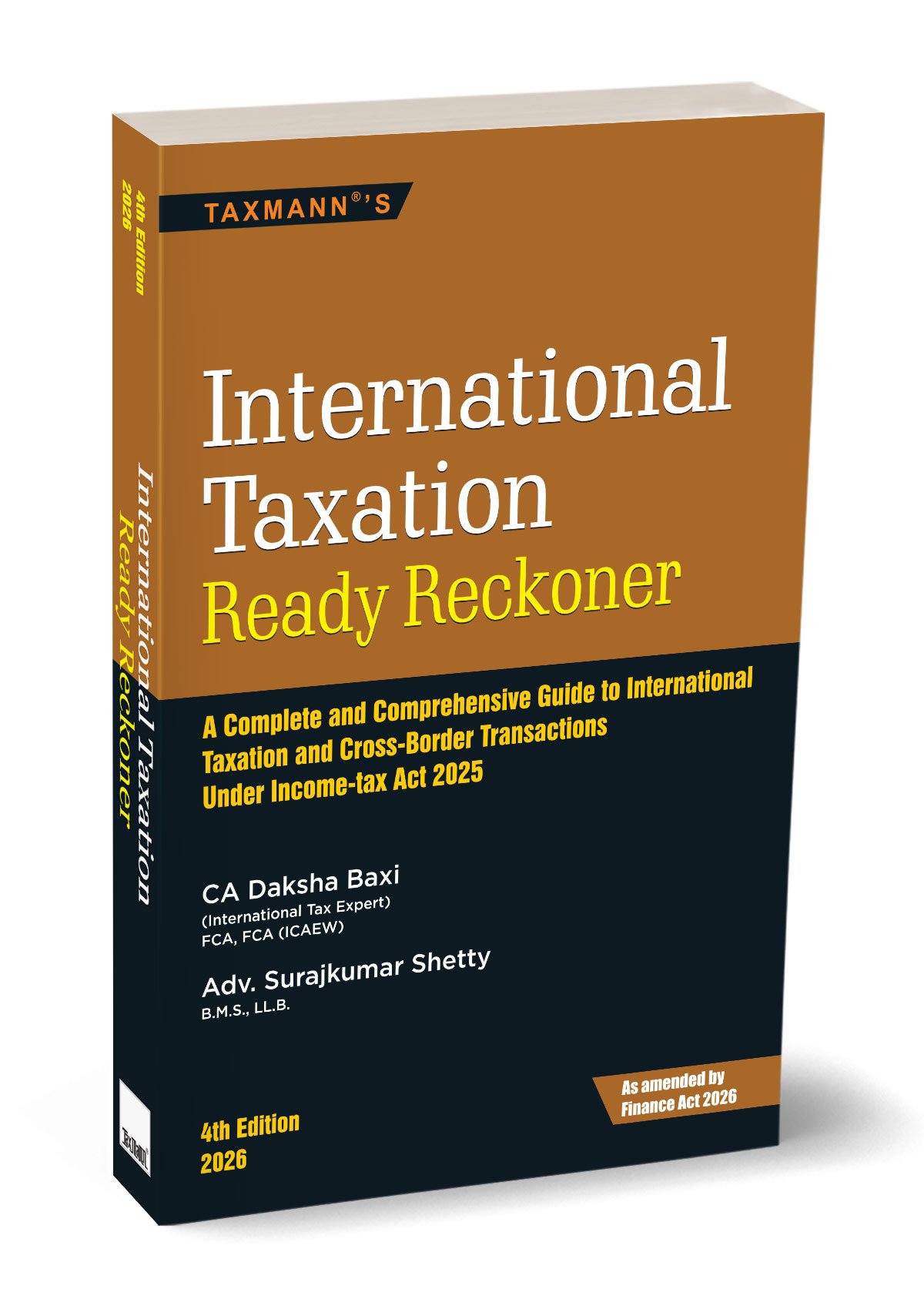
International Taxation Ready Reckoner by Daksha Baxi and Surajkumar Shetty – 4th Edition 2026
Original price was: ₹2,395.00.₹1,795.00Current price is: ₹1,795.00.
International Taxation Ready Reckoner by Daksha Baxi and Surajkumar Shetty – 4th Edition 2026
Description
International Taxation Ready Reckoner is a complete, practice-oriented guide to the taxation of cross-border transactions under the new Income-tax Act 2025, as amended by the Finance Act 2026, and read with the Income-tax Rules 2026. With the more-than-half-century-old Income-tax Act 1961 now replaced, this Edition restates the entire field of international taxation in the language and section-scheme of the new statute—so that advisers fluent in the old law can move to the new framework without losing their footing, and so that every provision can be located by its new section number.
True to its name, the book is engineered as a reckoner rather than a sprawling commentary. It is built around the questions a professional actually confronts: Is this income or payment taxable in India? How do the Income-tax Act and the relevant Double Taxation Avoidance Agreement (DTAA) interact? Does the treaty apply to this person and to this transaction—and after PE, GAAR and the Principal Purpose Test, does the benefit survive? Drawing on decades of work on mergers, acquisitions, fund structures and inbound/outbound deals, the authors lay out a repeatable method: read the residence position, read the treaty, then work the specific stream of income under both the Act and the DTAA, supported by worked examples and up-to-date judicial precedents, and finally apply it all through a single end-to-end case study.
This book is intended for the following audience:
- Chartered Accountants, Tax Advisers and Consultants advising on inbound and outbound cross-border transactions
- Tax Lawyers and the Direct-Tax Teams of law firms
- In-House Tax and Finance Teams of multinational corporations, of Indian groups investing overseas, and of any business that pays or contracts with non-residents
- Professionals advising NRIs, Foreign Portfolio Investors, AIFs, REITs, InvITs, private-equity and venture-capital funds, and IFSC/GIFT City units
- Trusted Advisers to SMEs and Family Businesses who meet cross-border issues occasionally and need a dependable first reference
- Anyone Responsible for Withholding Tax on payments to non-residents and for obtaining lower/nil withholding certificates
- Faculty and Students of practical international taxation
The Present Publication is the 4th Edition, amended by the Finance Act 2026. This book has been authored by CA. Daksha Baxi & Adv. Surajkumar Shetty, with the following noteworthy features:
- [Fully Recast Under the New Law] The subject is re-presented in the framework, terminology and section numbering of the Income-tax Act 2025 (read with the Income-tax Rules 2026), bridging the transition for readers trained on the Income-tax Act 1961
- [A Teachable Method, Not Just Black-Letter Law] A step-by-step approach to non-resident taxability, including how to read a DTAA, whether and to whom it applies, the IT-Act-versus-treaty interplay, treatment of surcharge and cess on treaty rates, the Most-Favoured-Nation clause, and the consequences of PE, GAAR and the PPT under the MLI
- [Stream-By-Stream Treatment Under Both Regimes] Each major head of income is analysed first under the IT Act and then under the relevant DTAA article, side by side
- [Treaty and Model-Convention Text] Discussion built on the UN and OECD Model Conventions (Articles 6, 7, 12 and 12A) and on the actual language of a wide range of India’s bilateral treaties—including those with the United States, the United Kingdom, Australia, Singapore, Germany, France, the Netherlands, Mauritius, the UAE, Japan, Belgium and the Philippines, with further treaties such as China, Cyprus and Poland drawn on in the case-law discussion, and MLI-synthesised texts used where relevant
- [BEPS-Aware] Integrates BEPS Action 6 (principal purpose/treaty abuse) and Action 7 (artificial avoidance of PE status) into the stream analysis, alongside the MFN debate and CBDT Circular No. 3/2022
- [Grounded in Current Case Law] Curated, up-to-date judicial precedents woven through, including Tiger Global (SC), Vodafone-Essar, Sanofi Pasteur, Vanenberg Facilities, Indostar Capital, GE India Technology Centre, Toshoku, Infosys BPO, Cadila Healthcare, and the Giesecke & Devrient/Total Oil India split on the DTAA rate for DDT
- [A Genuine Capstone] Comprehensive, fact-based case study built around an Indian joint-venture company and a foreign ‘know-how’ LLP, worked through eleven sequential questions that apply the whole book to one scenario
- [Built-In Ready References] A front-of-book table of withholding (TDS) rates for non-residents under Part II of the First Schedule to the Finance Act 2026; a detailed Glossary of Terms; decision charts and flowcharts (including a process chart for determining a non-resident’s taxability); summary tables (DTAA article map, valuation-rule summary, transfer-pricing summary); FAQs on GAAR; and an Appendix listing the forms referred to
- [Current and Emerging Issues] The digital economy and e-commerce, Equalisation Levy-2, Significant Economic Presence, indirect transfer of Indian assets, and the IFSC/GIFT City regime
The book spans 25 chapters, organised in five practical blocks:
- Foundations (Ch. 1–5)
- The tax system for non-residents, with residential status (individuals, HUFs and other persons), deemed residence and the scope of total income under section 5 (Ch. 1); tax treaties and how to read a DTAA, with a chart mapping every treaty article to the income it covers and worked MFN-clause examples (Ch. 2); setting up a business in India—PAN/TAN, directors’ registration, anti-avoidance valuation rules and FMV determination, and transfer-pricing basics including Form 48 (Ch. 3); classification of income across all heads (Ch. 4); and eligibility to claim DTAA benefits, covering ‘person’ and ‘resident’ under a treaty, taxes covered, surcharge/cess, whether EL-2 is covered, and the PE/GAAR/PPT gateway (Ch. 5)
- Income-Stream Taxation, IT Act & DTAA (Ch. 6–13)
- Rental/immovable-property income with Article 6 across treaties (Ch. 6); business income, with Permanent Establishment, allocation of profits under Article 7, Force of Attraction, BEPS Action 7, ‘business connection’ under section 9, Significant Economic Presence, agency PE and POEM (Ch. 7); dividend (Ch. 8); interest, including the MFN clause and Circular 3/2022 (Ch. 9); royalty under the IT Act, ICDS IV, and Article 12 of the UN/OECD Models and the India-US treaty, with the equipment-use and technical-knowledge controversies (Ch. 10); fees for technical services under section 9(7), the nexus approach, gross-basis taxation under section 207, and Article 12A, with US and Germany treaty analysis (Ch. 11); capital gains, including indirect transfer of Indian assets under section 9(10) and its valuation rules, holding-period and rate tables, FPI/Category-III AIF treatment, and treaty positions for the US, France, the Netherlands, Singapore and Mauritius (Ch. 12); and employment income, including ESOPs for globally mobile employees, foreign-asset reporting and tax equalisation (Ch. 13)
- Special Persons and Vehicles (Ch. 14–16)
- Non-Resident Indians and the optional regime under section 214 (Ch. 14); Foreign Portfolio Investors (Ch. 15); and AIFs, REITs, InvITs and securitisation trusts (Ch. 16)
- Anti-Avoidance and Restructuring (Ch. 17–19)
- Transfer pricing under sections 161–173, covering associated enterprises, international transaction, ALP and the most-appropriate-method, the TPO reference, Safe Harbour, Advance Pricing Agreements and roll-back, secondary adjustment, documentation and the accountant’s report (Ch. 17); business reorganisations—share sales, amalgamations/mergers and demergers, with loss carry-forward conditions (Ch. 18); and discontinuance of business and liquidation of an Indian company under sections 320–323 (Ch. 19)
- Credits, Compliance and Disputes (Ch. 20–24)
- Foreign tax credit, methods, Rule 76 and supporting documentation (Ch. 20); making payments to non-residents, the sections attracting withholding, GDR income, ‘net of tax’ payments under section 393, and the TDS-versus-TCS overlap (Ch. 21); assessments, appeals and dispute resolution—summary, mandatory faceless scrutiny, best-judgment and reassessment, the DRP, and appeals from CIT(A) through ITAT, High Court and Supreme Court (Ch. 22); the General Anti-Avoidance Rules, with the approving-panel process, FAQs and precedents (Ch. 23); and miscellaneous matters—the Board of Advance Rulings under sections 380–389, the Mutual Agreement Procedure, the IFSC regime under section 147, and the presumptive regime for domestic cruise services (Ch. 24)
- The volume closes with the comprehensive case study (Ch. 25), applying the book’s full machinery to one set of facts. Supporting material includes the front-of-book non-resident TDS rate table, a Glossary of Terms, and an Appendix listing the forms referred to
The structure of the book is as follows:
- A Deliberate Advisory Sequence – The 25 chapters move in the order an adviser actually works a problem: establish residence, read the treaty, then work income-stream by income-stream, on to special entities, anti-avoidance, credits, compliance and disputes, and finally an applied case study
- A Consistent Chapter Template – Each chapter opens with a ‘Scope of this Chapter,’ sets out the IT Act position and then the DTAA position (often quoting the relevant Model Convention and treaty text), draws on judicial precedents, and frequently closes with a worked example or case study
- Pinpoint Navigation – A decimal numbering system allows precise cross-referencing throughout
- An Integrated Capstone (Ch. 25) – The closing chapter mirrors a live engagement, built on a single fact pattern: an Indian JV company, a foreign ‘know-how’ LLP that licenses technology and provides technical services, a seconded employee, and a cross-border transfer of the LLP interest
- Resolved Through Eleven Sequential Questions – DTAA eligibility; whether the JV constitutes the LLP’s business connection and PE in India; the secondee’s taxability and the withholding obligation (section 192 of the 1961 Act/section 392 of the 2025 Act); the secondee’s return-filing obligation; taxation of the licence fee (royalty) and the technical-service fee; whether the secondee’s salary forms part of the technical-service fees; taxation of interest payable to the know-how LLP; applicability of transfer-pricing regulations to the LLP–JV transactions; whether a UK resident’s transfer of its interest in the LLP to a Netherlands subsidiary triggers Indian capital-gains tax; and the secondee’s residential status across the years of secondment
Additional information
| BINDING | PAPERBACK |
|---|---|
| AUTHOR | Daksha Baxi and Surajkumar Shetty |
| EDITION | 2026 |
| ISBN | 9789371265843 |
| PUBLICATION | TAXMANN PUBLICATIONS |
Related products
-
- Out of StockSale!
- TAXATION LAW, INDIRECT TAX, DIRECT TAX, INCOME-TAX, GST, TDS, CA BOOKS
GST TRACKER-CONTAINING SECTIONWISE/RULEWISE JUDGMENTS, CIRCULARS, NOTIFICATIONS AND MUCH MORE
- Original price was: ₹3,095.00.₹2,475.00Current price is: ₹2,475.00.
- Read more
-
-
- Out of StockSale!
- TAXATION LAW, INDIRECT TAX, DIRECT TAX, INCOME-TAX, GST, TDS, CA BOOKS
MEHTA’S INCOME TAX READY RECKONER (AY 2022-23 & AY 2023-24)
- Original price was: ₹1,400.00.₹1,120.00Current price is: ₹1,120.00.
- Read more
-
-
- Out of StockSale!
- TAXATION LAW, INDIRECT TAX, DIRECT TAX, INCOME-TAX, GST, TDS, CA BOOKS
DIRECT TAXES READY RECKONER (AY 2022-23 & 2023-24)- IN HINDI
- Original price was: ₹1,795.00.₹1,347.00Current price is: ₹1,347.00.
- Read more
-
Reviews
There are no reviews yet.