

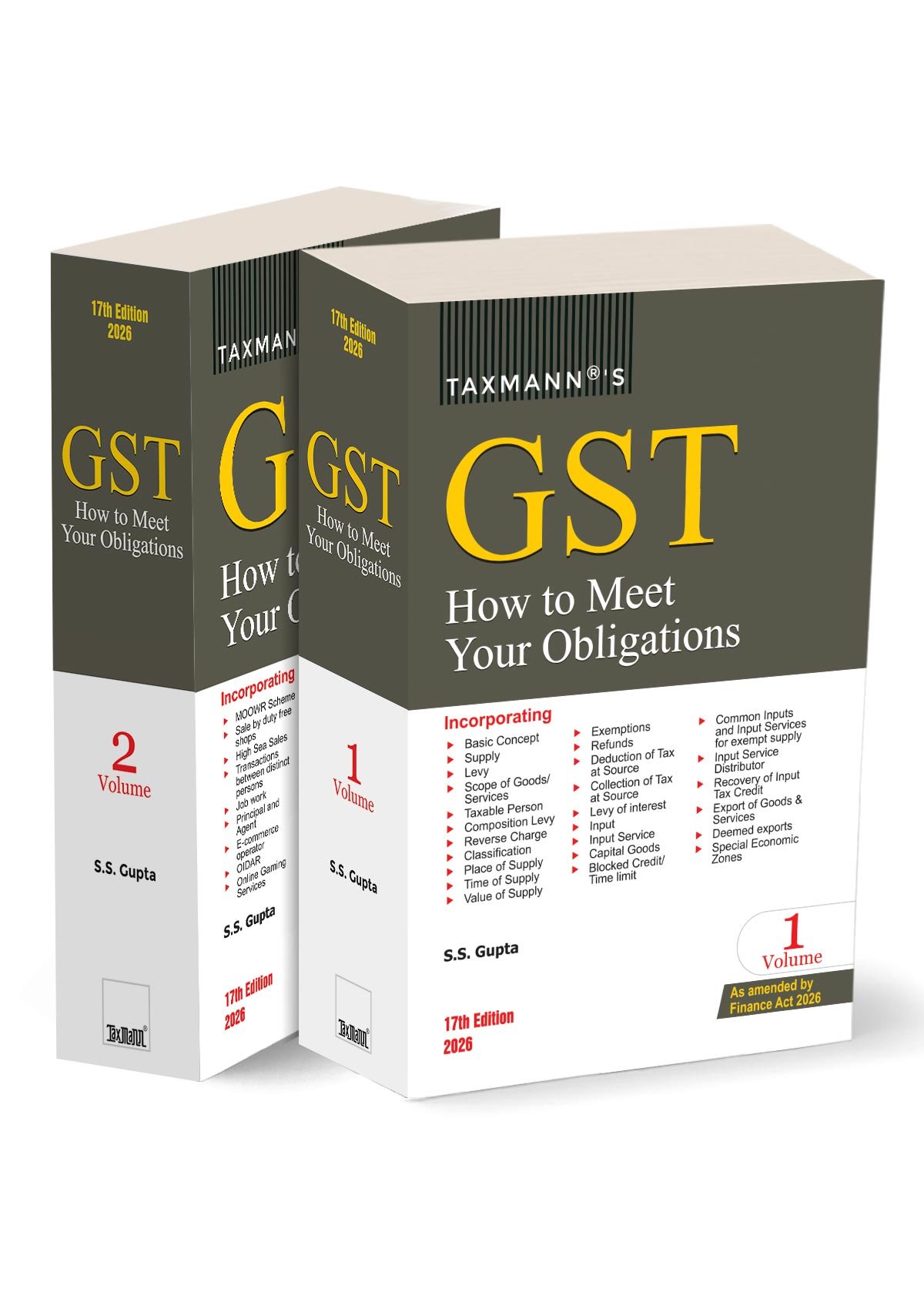
GST How to Meet Your Obligations By S.S. Gupta (Set of 2 Vols.) – 17th Edition 2026
Original price was: ₹7,995.00.₹5,895.00Current price is: ₹5,895.00.
GST How to Meet Your Obligations By S.S. Gupta (Set of 2 Vols.) – 17th Edition 2026
Description
GST – How to Meet Your Obligations is the flagship GST treatise—a two-volume work that, over successive editions, has become the standard reference relied upon by indirect-tax professionals, departmental officers, and the bench. The work approaches GST not as a static body of rules but as a continuously evolving body of law shaped by statute, rules, departmental clarifications, and the steady accretion of judicial interpretation—including a substantial body of pre-GST jurisprudence whose ratio continues to inform the present regime. Each chapter is built around the operative provision, reproduced verbatim, then examined clause by clause, with circulars and notifications reproduced at the point of doctrinal relevance and judicial rulings cited in extenso for their controlling principles. The result is a treatise that gives the reader both the doctrinal architecture and the working apparatus needed to discharge practical obligations—to file returns, advise on transactions, defend a notice, or argue a case—with confidence grounded in the source material.
This book is intended for the following audience:
- Chartered Accountants, Cost Accountants, and Company Secretaries handling indirect-tax compliance, audit, certification, and litigation support
- Tax Counsel, Advocates, and Law Firms representing assessees through show-cause, adjudication, appellate, and writ proceedings
- In-House Tax, Finance, and Legal Teams of corporates, banks, NBFCs, insurers, manufacturers, exporters, e-commerce operators, online gaming companies, and SEZ/EOU/MOOWR units
- Departmental Officers, Adjudicating Authorities, and Members of Appellate Forums seeking a structured, source-tied treatment
- Academic Libraries, Faculty, and Senior Students of indirect taxation, including those preparing for CA/CS/CMA Final, LL.M., and Diploma in GST examinations
- Consultants advising on contested or fast-evolving positions—corporate guarantees, online money gaming, intermediary services, vouchers, M&A slump sales, related-party valuations, and cross-border services
The Present Publication is the 17th Edition, amended by the Finance Act 2026. It is authored by S.S. Gupta, with the following noteworthy features:
- [Finance Act 2026 Changes Worked Through Transactionally] The deletion of Section 13(8)(b) on intermediary services is treated with a transition-impact matrix distinguishing import RCM exposure, export-of-service implications, and the cut-off date of 30th March 2026; the amendment to Section 15(3)(b) on post-sale discounts is analysed alongside the withdrawn Circular 212/6/2024-GST and the new Invoice Management System (IMS) framework introduced by Circular 253/10/2025-GST; consequential amendments propagate through interconnected chapters
- [Statute-first, Source-tied Treatment] Each chapter opens by reproducing the operative section and the corresponding rule, then proceeds ingredient by ingredient—definitions, charging language, machinery, provisos—before any layer of analysis is introduced
- [Pre-GST Jurisprudence Integrated] Where Supreme Court, High Court, CEGAT, CESTAT, and AAR rulings under central excise, service tax, customs, and VAT continue to govern GST interpretation, the ratio is cited with the author’s view on its applicability to the present regime
- [CBIC Circulars, Notifications, and FAQs Reproduced] Operative paragraphs are quoted verbatim and tabulated where the circular itself is structured as a Q&A, so the reader sees the administrative position alongside the legal one—including the most recent circulars (240/34/2024, 242/36/2024, 251/08/2025, 253/10/2025) and the latest 2024-2025 rulings
- [Three-level Paragraph Numbering] With over 1,400 numbered sub-paragraphs across the work and nesting to three levels, navigation is granular and cross-references are precise
- [Illustrations and Worked Computations] They are included at every junction where the mechanics turn on numbers—reverse charge, time and place of supply, value of supply under Rule 28(2) for corporate guarantees, ITC reversal under Rules 42/43, refund formulae, e-commerce TCS net-value mechanics
- [Author’s Analysis Sections at the Close of Contested Issues] Flagging departmental positions that the author views as legally unsustainable, identifying litigation risk, and indicating the alternative interpretive route open to the assessee
- [Bidirectional Cross-references Between Chapters] They are included so that a question on the reverse charge on a corporate guarantee can be traced from the levy chapter through valuation, ITC eligibility, and the dedicated corporate-guarantee treatment without losing context
- [Full Statutory Appendices] CGST Act, IGST Act, UTGST Act, CGST Rules, and IGST Rules—with footnoted amendment history showing inserts and substitutions, including those introduced by the Finance Act 2026
- [Deep Para-level Subject Index] Entries are tied to numbered paragraphs rather than page numbers, allowing direct lookup to the operative discussion
The coverage of the book is as follows:
- Foundations & Charging Architecture
- The constitutional foundations of the GST regime and its replacement of the multi-tax pre-GST architecture, including territorial jurisdiction, the appointed-day machinery, and the post-reorganisation treatment of Jammu & Kashmir
- The taxable event of supply—its inclusive definition, deemed-supply scenarios under Schedule I and Schedule II, composite and mixed supplies, the treatment of joint ventures and slump sales, and the exclusions in Schedule III
- The complete charging architecture—levy of CGST, SGST, IGST, UTGST, and Compensation Cess; the taxable-person concept; composition levy and its threshold mechanics; reverse charge on notified goods and services and on supplies from unregistered persons
- Classification, Valuation & Refund Mechanics
- Classification of goods and services, rate notifications, exemptions, non-taxable supplies, and the doctrine of revenue neutrality
- Place of supply for domestic and cross-border transactions, time of supply and change in rate, and value of supply under the general and special valuation rules, including the deeming provision in Rule 28(2) for corporate guarantees and the post-Finance Act 2026 valuation position
- Refunds—zero-rated supplies, inverted duty structure, deemed exports, unutilised ITC, and excess balance in the electronic cash ledger
- Deduction of tax at source, collection of tax at source, and the interest levy under Section 50
- Input Tax Credit
- The full input tax credit lifecycle—input, input service, capital goods, the blocked-credit list, time limits, common credit attribution between taxable and exempt supplies under Rules 42 and 43, the Input Service Distributor mechanism, matching and blacklisting of dealers, recovery, and the IMS-driven verification framework
- Cross-Border Transactions & Special Locations
- Export and import of goods and services, export incentives, deemed exports, EOU and STP units, Special Economic Zones, the MOOWR scheme, sale by duty-free shops and bonded warehouse sales, and high-sea sales
- Special Scenarios & Sector-Specific Treatment
- Transactions between related parties and distinct persons, job work, principal-agent supplies, e-commerce operator obligations under Section 9(5) and Section 52, OIDAR, online gaming and online money gaming including the skill-versus-chance jurisprudence, corporate guarantees, sale of business including mergers and acquisitions, vouchers, discounts and incentives, intermediary services post-deletion of Section 13(8)(b), and actionable claims
- Transitional Provisions, Compliances & Documentation
- Transitional credits, the impact of GST on continuing contracts, anti-profiteering measures including the sunset position, and the repeal-and-saving regime of the erstwhile laws
- GST compliances—registration and administration, documentation including tax invoices, bills of supply, debit and credit notes, electronic way bills, procedures and records for input tax credit, payment of tax and interest, returns and reconciliations, special compliances for tobacco and other notified categories, unique identification marking, and the GST Practitioner Scheme
- Administration, Enforcement & Dispute Resolution
- Administration, assessments, audits and special audits, scrutiny of returns, demand and recovery, adjudication, inspection, search and seizure, provisional attachment, and residual administrative matters
- Penalties, confiscation, fines, arrest, and prosecution—together with the procedural safeguards built into each
- Dispute resolution—first appeal, the GST Appellate Tribunal, appeals before the High Court and the Supreme Court, advance rulings, the Scheme of Waiver of Interest or Penalty, and the GST Amnesty Scheme with its pre-deposit and refund-restriction mechanics
The work is organised into ten Divisions across two volumes and 89 chapters (including the inserted Chapters 58A and 70A), with the same internal architecture observed throughout.
- Volume 1 — Chapters 1 to 43
- Division One — Basic Concepts
- Division Two — Levy of GST – Key Aspects
- Division Three — Input Tax Credit
- Division Four (Part I) — Export and Import of Goods and Services
- Volume 2 — Chapters 44 to 89 and Statutory Appendices
- Division Four (Part II): MOOWR Scheme
- Division Five — Special Scenarios
- Division Six — Transitional Provisions
- Division Seven — GST Compliances
- Division Eight — Administration, Assessments, Audits and Investigation
- Division Nine — Penalties and Prosecution
- Division Ten — Dispute Resolution
- Each chapter follows the same internal architecture:
- The operative statutory provision is reproduced and located within the broader legislative scheme
- Each ingredient of the section is unpacked at three levels of paragraph nesting, with defined terms cross-referenced to the chapter that treats them in detail
- Judicial pronouncements—pre-GST and GST, Supreme Court through Tribunal and AAR—are cited and the controlling principle distilled
- CBIC circulars, FAQs, and notifications are reproduced at the point of doctrinal relevance, with tabulated extracts where the circular itself is structured as a Q&A
- Worked illustrations and numerical examples are placed alongside the rule that governs them
- The author’s view is offered where the position is contested or evolving, including where in his judgment the departmental position is legally unsustainable
Additional information
| BINDING | PAPERBACK |
|---|---|
| AUTHOR | SS GUPTA |
| EDITION | 2026 |
| ISBN | 9789375614531 |
| PUBLICATION | TAXMANN PUBLICATIONS |
Related products
-
- Out of StockSale!
- COMPANY LAW, CORPORATE LAWS, BUSINESS LAW, SEBI, SECURITIES, STOCK, FEMA, COMPETITION, MSMEs, START-UPs, INDUSTRIES, TAXATION LAW, INDIRECT TAX, DIRECT TAX, INCOME-TAX, GST, TDS, CA BOOKS
START-UPs & MSMEs (POLICIES, PROCEDURES & FINANCE)
- Original price was: ₹1,195.00.₹895.00Current price is: ₹895.00.
- Read more
-
-
- Out of StockSale!
- TAXATION LAW, INDIRECT TAX, DIRECT TAX, INCOME-TAX, GST, TDS, CA BOOKS
MEHTA’S INCOME TAX READY RECKONER (AY 2022-23 & AY 2023-24)
- Original price was: ₹1,400.00.₹1,120.00Current price is: ₹1,120.00.
- Read more
-
-
- Out of StockSale!
- TAXATION LAW, INDIRECT TAX, DIRECT TAX, INCOME-TAX, GST, TDS, CA BOOKS
GST TRACKER-CONTAINING SECTIONWISE/RULEWISE JUDGMENTS, CIRCULARS, NOTIFICATIONS AND MUCH MORE
- Original price was: ₹3,095.00.₹2,475.00Current price is: ₹2,475.00.
- Read more
-
Reviews
There are no reviews yet.