

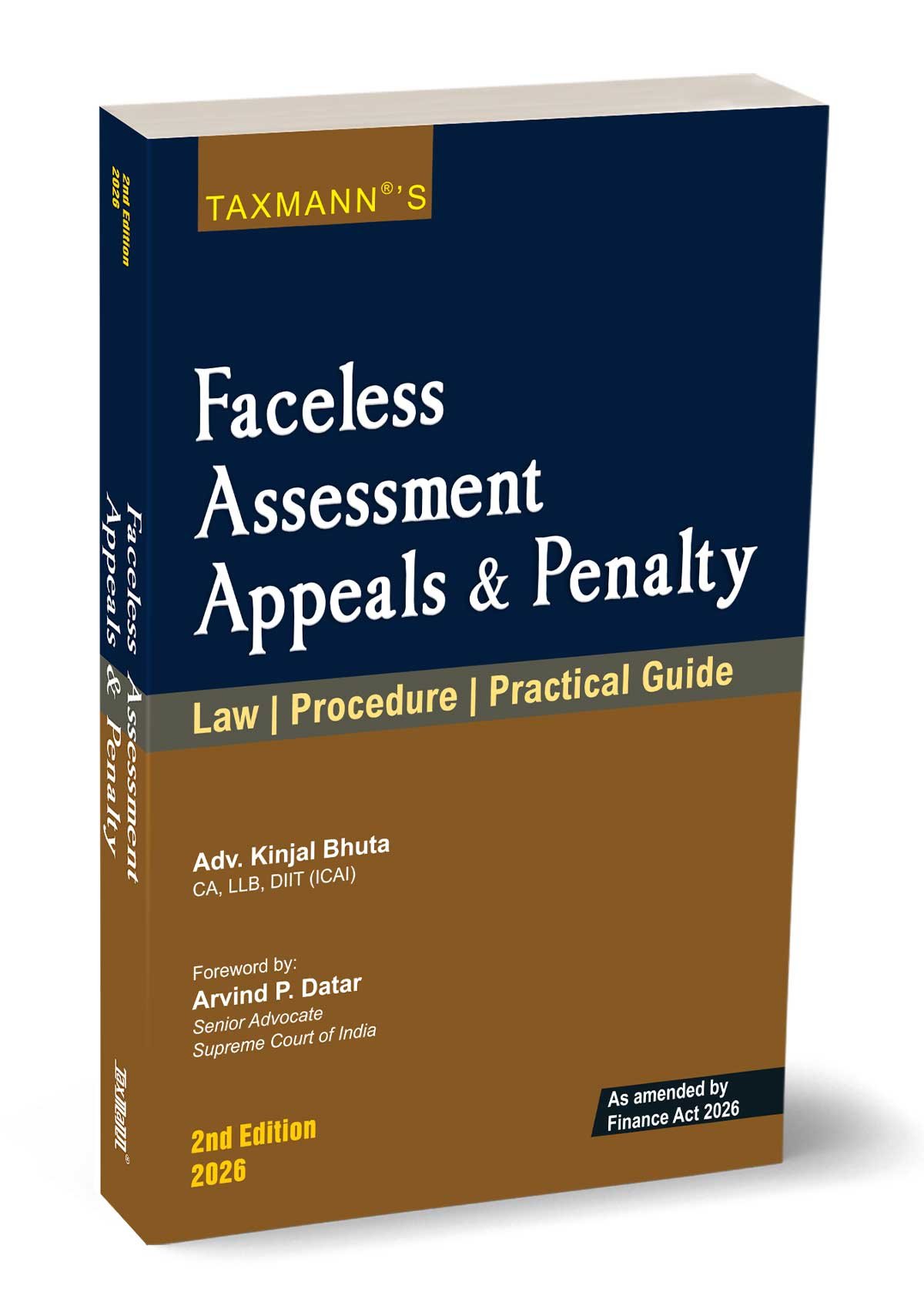
Faceless Assessment Appeals and Penalty – Law | Procedure | Practical Guide By Kinjal Bhuta – 2nd Edition 2026
Original price was: ₹1,695.00.₹1,275.00Current price is: ₹1,275.00.
Description
Faceless Assessment Appeals & Penalty – Law | Procedure | Practical Guide is a practitioner’s reference on India’s faceless tax regime as it stands after the Finance Act 2026. It treats the three pillars of departmental adjudication—faceless assessments, faceless first appeals (CIT(A) and JCIT(A)) and faceless penalty proceedings—together with the allied e-schemes (verification, valuation, jurisdiction, escaping assessment, advance rulings, rectification, dispute resolution) that now sit alongside them.
The defining feature of this Edition is its parallel handling of the Income-tax Act 1961 and the Income-tax Act 2025 during the transitional period: every section, rule, form and procedural reference is mapped to its counterpart in the other statute (section 144B ↔ section 273; section 270A ↔ section 439; section 245MA ↔ section 379; section 273A ↔ section 469; section 273B ↔ section 470; section 250 ↔ section 359; section 263 ↔ section 377; Rule 46A ↔ Rule 192; Form 35 ↔ Form 99) so the reader can argue under either Act without losing their footing.
The book combines black-letter exposition with three layers of practitioner-facing material:
- The internal CBDT Standard Operating Procedures of every faceless unit reproduced and broken down question-by-question
- An original survey of 25 senior tax practitioners on the lived experience of seven years of faceless practice
- Fifteen worked case scenarios with full specimen submissions covering the issues that recur most often in scrutiny and re-assessment work—bogus purchases, cash deposits, change of opinion, denial of cross-examination, on-money additions, penny stocks, sanction without application of mind, and others
The writing places deliberate emphasis on the craft of written advocacy, on the footing that the disappearance of the personal hearing has made the quality of the written submission almost the only thing that remains in the practitioner’s control.
This book is intended for the following audience:
- Chartered Accountants and Advocates representing assessees in scrutiny, re-assessment, first-appeal and penalty proceedings under the faceless regime
- In-House Direct Tax Teams of Corporates, MSMEs, Family Offices and High-Net-Worth Individuals managing the assessment-to-Tribunal litigation cycle
- Senior Counsel and Partners requiring a consolidated reference that handles the Income-tax Act 1961 and the Income-tax Act 2025 in parallel during the transitional years
- Tax Consultants and Authorised Representatives drafting grounds of appeal, statements of facts, condonation petitions, affidavits, applications for additional evidence, stay applications, and written submissions
- Departmental Officers seeking a structured account of the SOPs of the Assessment, Verification, Technical, Review, Penalty and Penalty Review Units, and the legal limits on each
- Tax Counsel preparing for writ proceedings on faceless infirmities, who need a curated digest of the natural-justice jurisprudence emerging from the High Courts since 2021
- Practitioners moving from the conventional regime into faceless practice who need an end-to-end procedural bridge
- Faculty, Students and Trainees on the ICAI, BCAS, CTC and AIFTP representation-and-drafting courses
The Present Publication is the 2nd Edition | 2026, amended by the Finance Act 2026. This book is authored by Adv. Kinjal Bhuta, with the following noteworthy features:
- [Dual-Statute Mapping] Provision-wise comparative tables linking every section, rule and form of the Income-tax Act, 1961/Rules 1962 with the Income-tax Act 2025/Rules, 2026, extending across penalty, appellate, rectification, revision and limitation provisions
- [Finance Act 2026 Penalty Amendments] Dedicated treatment of the section 466 (272AA) maximum penalty hike from ₹1,000 to ₹25,000; the section 102 (115BBE) special rate cut from 60% to 30% with the offsetting 200% penalty pushing the effective burden from 85.80% to 117%; the section 440 (270AA) immunity extension to misreporting on payment of additional 100% tax; the new crypto-asset reporting penalty regime under sections 446 and 509 (271B and 285BAA); and the ₹1 lakh cap on the SFT failure penalty under section 454 (271FA)
- [Common Assessment-and-Penalty Order] Coverage of the section 471 (274) regime introduced by the Finance Act 2025 for orders passed after 1 April 2027, with the author’s note on its interaction with the Faceless Penalty Scheme
- [Internal CBDT SOPs Decoded] Reproduction and question-by-question decomposition of the SOPs of the Assessment, Verification, Technical, Review, Penalty and Penalty Review Units, including case allocation, response timelines, PCIT approval matrices, Insight and ITBA workflows, AU-1 to AU-9 annexure formats, and inter-unit reference protocols
- [FAQ Treatment of Every Scheme] Separate Q&A blocks on the Faceless Assessment, Faceless Appeals 2021, e-Appeals 2023, Faceless Penalty (Amendment) 2022, e-Verification 2021, Faceless Inquiry or Valuation 2022, Faceless Jurisdiction 2022, e-Dispute Resolution 2022, e-Assessment of Income Escaping Assessment 2022, e-Advance Rulings (Amendment) 2023, and e-Rectification (section 157) Schemes
- [Annotated Portal Walkthroughs] Step-by-step screen-by-screen guidance covering the response window, attachment rules (5 MB single, 50 MB zipped, 10-attachment limit, 4,000-character remark cap), partial vs. full responses, adjournment windows, e-verification, video-conference scheduling, and Form 99 (Form 35) appeal filing in eight stages
- [Procedural Maps] Bird’s-eye-view diagrams tracing a case through the faceless pipeline, including the structural arrangement of the centres and units and the communication flow between AU, VU, TU, RU and NaFAC
- [Original Practitioner Survey] DIP-stick survey of 25 senior practitioners across metro, tier-2, tier-3 and pan-India practices, with fourteen multiple-choice questions across three sections, generating empirical findings such as 76% citing attachment size as the most pervasive technical problem, 72% flagging video-conference unreliability, 80% dissatisfied with the quality of faceless appellate orders, and only 24% rating the regime as very effective
- [Drafting Curriculum] Two-chapter framework built on the ‘A, B, C’ principles (Accuracy, Brevity, Clarity), the Betty S. Flowers ‘Madman, Architect, Carpenter, Judge’ role model, the recommended placement of grounds (jurisdictional → legal/technical → merits by quantum → without-prejudice → consequential → prayer), and a Tribunal-tested checklist for statements of facts
- [Specimen Drafts Across the Lifecycle] Templates for jurisdictional, technical, natural-justice, merits-based, without-prejudice and prayer grounds, condonation of delay, affidavit, application for additional evidence, stay application, and factual and legal submissions for assessment and appellate stages
- [Fifteen Worked Case Scenarios] Chapter 6 specimen submissions covering bogus purchases, cash deposits under section 104 (69A), change-of-opinion re-assessments, denial of cross-examination, additions on documents not furnished, political-party donations, hardship compensation in re-development, re-assessment on incorrect information, additions based only on Investigation Wing reports, non-service of section 281(1) (148A(1)) notice, on-money/cash payments for property, misreporting penalty under section 439(11) (270A(9)), penny stock additions, sanction under section 284 (151) without application of mind, and section 92(2)(m) (56(2)(x)) on tenancy-rights sales
- [Sixteen Procedural Infirmities Digested] Issue-wise case-law digest covering reasonable opportunity, video-conference denial, addition without SCN, opportunity for all additions, missing SCN, reply not considered, non-speaking orders, best judgment not exercised, adjournment ignored, pre-conceived notions, technical glitches, regional-language documents, DRP objections ignored, SOPs not followed, cross-examination and document access denied, and voluminous-attachment hearings
- [Doctrines of Construction and Precedent] Treatment of per incuriam, sub silentio, obiter dicta, ratio decidendi, stare decisis, res judicata, estoppel, specific-over-general, statute-over-rules, ejusdem generis, casus omissus, charging vs. machinery provisions, deeming provisions, binding nature of circulars, and the doctrine of precedence, each anchored to leading authorities including Punjab Land Development, Gurnam Kaur, Sun Engineering Works, Balwant Rai Saluja, Radhasoami Satsang and Bagyalakshmi & Co.
- [AI in Legal Drafting] Dedicated framework on the responsible use of generative AI, covering risks (citation hallucination, jargon-without-context, voice mismatch, factual drift), practical dos and don’ts, workflow tools (Grammarly, WordRake, QuillBot), and a structured verification protocol for AI-generated case law
- [Five Source-Document Appendices] Reproduction of the Faceless Assessment SOP (full A-through-O paragraphing), the Faceless Appeal and e-Appeal Schemes, the Faceless Penalty Scheme with annexures, the suite of other Faceless/e-Schemes, and the original Press Releases including the 13 August 2020 ‘Honouring the Honest’ announcement and the 25 September 2020 Faceless Appeals launch
- [Palkhivala Anchors] Each chapter opens with a curated quotation from Sr. Adv. Nani Palkhivala as the author’s tribute, framing the substantive legal analysis that follows
The coverage of the book is as follows:
- Architectural Foundations
- Constitutional, statutory and administrative framework of faceless tax proceedings, traced from the Tax Administration Reforms Commission (Shome Committee, 2014), through the CASS system, the e-Assessment Scheme of 2019, the Amendment Act of 2020, the insertion of section 144B (now section 273 of the Income-tax Act 2025), and the Finance Act 2026 amendments
- Four Iterations of the Assessment Regime
- Side-by-side comparison of the Faceless Assessment Scheme 2019, the New Faceless Regime from 1 April 2021, the substituted regime from 1 April 2022 to 31 March 2026, and the Income-tax Act, 2025 framework, covering governing legislation, jurisdiction, scope, draft-order procedure, the Income or Loss Determination Proposal (ILDP) mechanism, the deletion of the ‘non est’ sub-section, and DRP reference handling
- Faceless First Appeals
- Treatment of appeals before the JCIT(A) and CIT(A) under the Faceless Appeal Scheme 2021 and e-Appeals Scheme 2023—appealable and non-appealable orders, conditions of admission, the Form 35 to Form 99 transition, electronic filing requisites, additional grounds and evidence, enhancement, transfer, rectification, and progression to the ITAT
- Faceless Penalty Proceedings
- Initiation, abeyance, show-cause stage, immunity under section 440 (270AA), waiver under section 469 (273A), the section 470 (273B) reasonable-cause defence including the new section 451 and 452 (271DA, 271DB) inclusions, common assessment-and-penalty orders, time limits under section 472 (275), and the risk of multiple penalties allocated across Penalty Units
- Thirteen Portal-Level Concerns
- Session expiry mid-submission, the 5 MB attachment limit and its workarounds, partial vs. full submission strategy, retraction of mistaken attachments, the 15-day adjournment window, time-of-day vs. end-of-day cut-off ambiguity, real-time alert failure, jurisdiction-industry mismatch, non-speaking orders and their interplay with sections 263 and 264 (377/378), case-law attachment practice, reasonable cause for non-response, partial-submission treatment, and section 144A directions in light of the Income-tax Act, 2025 silence
- Legal Conundrums in Practice
- Insufficient response time at the show-cause stage, departmental silence on adjournments, set-aside matter procedure, AO failure to exercise best-judgment power, the right to cross-examine and access relied-upon material, orders passed before the SCN deadline, opportunity for all proposed additions, the FAO–JAO controversy on section 148 jurisdiction, validity of orders without DIN, and the live debate on Circular F. No. 225/157/2017 compliance for section 143(2) notices (with Bharat Bansal v. NFAC and pending Karnataka and Kerala High Court matters)
- Drafting Documents in the Practitioner’s Toolkit
- Grounds of appeal in their proper hierarchy, statement of facts (descriptive, non-argumentative, mistake-correcting), condonation of delay (day-by-day explanation, affidavit, supporting evidence), affidavit form, application for additional evidence with rule-anchoring, stay application invoking KEC International and Bhupendra Murji Shah, and factual and legal submissions for assessment and CIT(A) stages
- Doctrines, Citation Craft and Case-Law Research
- Statutory and judicial interpretation as actually deployed in income-tax submissions, with instruction on case-law research, reading and citing an order (full reading, ratio over headnote, speed-reading, three-aspect focus on facts/issues/findings), citation discipline (italicisation of verbatim text, single citation, fact-linking), and avoidance of the recent judicial backlash against AI-generated phantom citations
- Other Faceless and e-Proceedings
- Coverage of the e-Verification Scheme 2021 (with portal workflow, section 133(6) response procedure and the section 139(8A) updated-return option), the Faceless Inquiry or Valuation Scheme 2022, the Faceless Jurisdiction of Income-tax Authorities Scheme 2022, the e-Dispute Resolution Scheme 2022 with its eligibility filters and Form 34BC procedure, the e-Assessment of Income Escaping Assessment Scheme 2022, the e-Advance Rulings (Amendment) Scheme 2023, and e-Rectification under section 157
- Alternative Remedies Outside the Faceless Track
- E-Nivaran grievance redressal procedure, complaint emails, writ jurisdiction of the High Courts as a last resort, the Right to Information Act with category-wise information sought and FAQ-driven procedure, CPGRAMS, the section 375 (158A) repetitive-appeal protection, immunity provisions under sections 469 and 470 (273A and 273B), the Dispute Resolution Committee under section 379 (245MA), and the High-Pitched Assessment Committee under CBDT Instruction F. No. 225/101/2021-ITA-II dated 23 April 2022
- Continuing Role of Jurisdictional Authorities
- The JAO’s residual statutory powers, the Commissioner’s supervisory jurisdiction over unattended rectifications, appeal effect not given, withheld refunds and undecided stay petitions, the PCIT’s revision jurisdiction under sections 377 and 378 (263 and 264), the CIT(A)’s continuing power to allow early hearing, additional evidence, video-conference hearing and stay, and the structured escalation pathway from JAO to Addl. Commissioner/CIT to PCIT before the writ remedy
- Natural Justice as Connective Thread
- Speaking-order requirement, opportunity to be heard, right to cross-examine, access to relied-upon documents and video-conference rights, anchored to the sixteen-infirmity case-law digest and supported by Andaman Timber Industries, Canara Bank v. V.K. Awasthy, H.R. Mehta, Healthcare Global, Global Vectra Helicorp, Federal Bank, Arris Estates, C. Chellamuthu, CPF (India), Inox Wind Energy, Hiraben Pragjibhai Tala, Indu Goenka, Fayeza Muffadal Contractor, Antony Alphonse Kevin Alphonse, BL Gupta Construction, KBB Nuts and other recent High Court rulings
The book is built in two interlocking blocks of four chapters each, followed by five appendices.
- Block I – The Faceless Regime Itself (Chapters 1 to 4) — Chapters 1 to 4 lay the legal and procedural foundation of the faceless mechanism—history and journey, faceless assessments, faceless appeals, and faceless penalty—and each follows a uniform internal architecture so the reader knows where to find each layer of analysis:
- Journey-so-far Panel — Chronological timeline with a master snapshot of CBDT notifications, circulars, instructions and internal orders from 2015 onwards
- Comparative Provision Table — Mapping of corresponding sections under the Income-tax Act 1961 and the Income-tax Act 2025 (and Rules, 1962 vs. 2026), with explicit treatment of Finance Act 2026 amendments
- Scheme FAQ Exposition — Coverage of scope, units and functions, automated allocation, communication and authentication of electronic records, personal hearing rights, video-conference procedure, and powers to specify formats and processes
- Bird’s-eye-view Diagrams — Visual maps of the centres, functional units and procedural flow
- Decoded SOPs — Standard Operating Procedures of each unit reproduced question-by-question, with PCIT approval matrices, response timelines, ITBA workflows and Insight database references
- Portal Walkthrough — Step-by-step submission procedure on the e-filing portal with annotated screenshots
- Practical Concerns — Issues arising from portal mechanics in day-to-day practice
- Legal Conundrums — Constitutional and natural-justice questions at stake in faceless proceedings
- Jurisprudence Digest — Issue-wise summary of recent High Court and Tribunal rulings
- Closing Dénouement — Consolidated takeaways at the end of each chapter
- Chapter 2 carries the additional original DIP-stick survey of 25 practitioners. Chapter 4 carries the dedicated treatment of the Finance Act 2026 penalty amendments and the common assessment-and-penalty order regime
- Block II – Drafting, Allied Proceedings and Alternative Remedies (Chapters 5 to 8) — Chapters 5 to 8 move from system-level understanding to the craft of representation:
- Chapter 5 | Drafting Curriculum — Pre-drafting preparation and planning, the writing process (the ‘A, B, C’ framework and the Madman-Architect-Carpenter-Judge role model) and finalisation, applied to grounds of appeal, statement of facts, condonation, affidavit, additional evidence, stay, and assessment- and appellate-stage submissions, closing with a structured framework for the responsible use of AI in drafting
- Chapter 6 | Worked Case Scenarios — Fifteen scenarios with brief-facts panels, complete specimen submissions backed by statute and case-law, and the author’s tactical notes, preceded by a working manual on case-law research, reading and citing an order, and the doctrines that determine precedential weight
- Chapter 7 | Allied e-Proceedings — Consolidation of verification, valuation, jurisdiction, dispute resolution, escaping-assessment, advance rulings and rectification, maintaining the dual-statute comparative format and FAQ exposition used in Block I
- Chapter 8 | Alternative Remedies — Remedies outside the faceless track in escalating order: E-Nivaran, email submissions, writ petitions, RTI applications, CPGRAMS, repetitive-appeal protection under section 375 (158A), immunity provisions, the Dispute Resolution Committee, the continuing role of jurisdictional authorities, and the High-Pitched Assessment Committee
- Appendices — The five appendices reproduce the underlying source material in full so the book can be used as a self-contained reference
Additional information
| BINDING | PAPERBACK |
|---|---|
| AUTHOR | CA Kinjal Bhuta |
| EDITION | 2026 |
| ISBN | 9789375619109 |
| PUBLICATION | TAXMANN PUBLICATIONS |
Related products
-
- Out of StockSale!
- TAXATION LAW, INDIRECT TAX, DIRECT TAX, INCOME-TAX, GST, TDS, CA BOOKS
TAXMANN’S DIRECT TAXES READY RECKONER (AY 2022-23 & 2023-24)
- Original price was: ₹1,850.00.₹1,388.00Current price is: ₹1,388.00.
- Read more
-
-
- Out of StockSale!
- TAXATION LAW, INDIRECT TAX, DIRECT TAX, INCOME-TAX, GST, TDS, CA BOOKS
MEHTA’S INCOME TAX READY RECKONER (AY 2022-23 & AY 2023-24)
- Original price was: ₹1,400.00.₹1,120.00Current price is: ₹1,120.00.
- Read more
-
-
- Sale!
- TAXATION LAW, INDIRECT TAX, DIRECT TAX, INCOME-TAX, GST, TDS, CA BOOKS
ATAL KUMAR-TAXATION LAWS
- Original price was: ₹390.00.₹332.00Current price is: ₹332.00.
- Add to cart
Reviews
There are no reviews yet.