

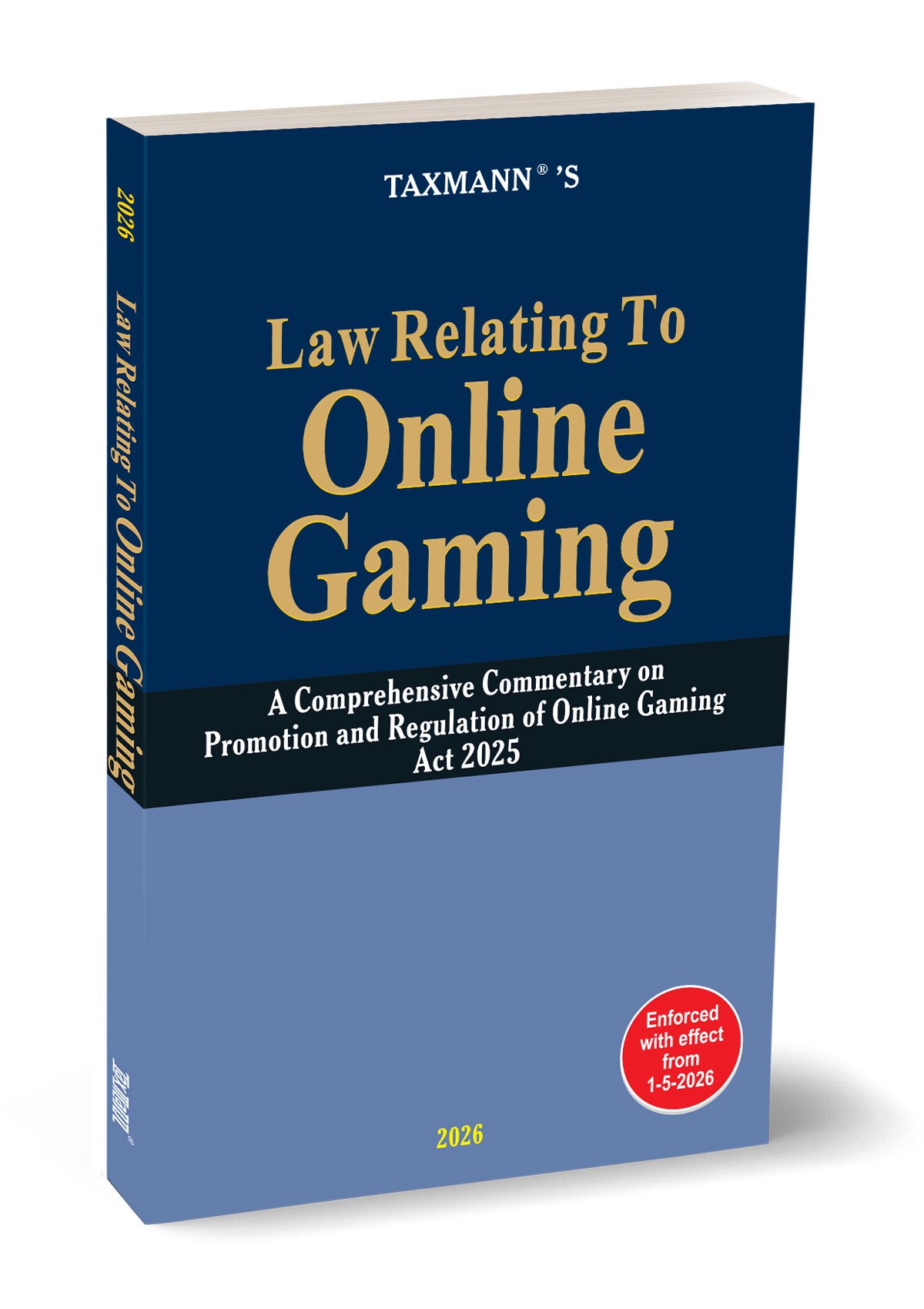
Law Relating to Online Gaming – A Comprehensive Commentary on Promotion and Regulation of Online Gaming Act 2025 By Taxmann – Edition 2026
₹295.00
Law Relating to Online Gaming – A Comprehensive Commentary on Promotion and Regulation of Online Gaming Act 2025 By Taxmann – Edition 2026
Description
Law Relating to Online Gaming is a section-wise commentary on the Promotion and Regulation of Online Gaming Act 2025, brought into force by Central Government notification with effect from 1-5-2026. The Act represents a structural break from the partial regime under the Information Technology (Intermediary Guidelines and Digital Media Ethics Code) Rules 2021 (as amended in 2023). It re-categorises online games into three mutually exclusive heads—e-Sports, Online Social Games, and Online Money Games—and imposes a complete ban on Online Money Games (also known as Online Real Money Games), irrespective of whether the game is one of skill, chance, or a combination of both. Simultaneously, the Act recognises, promotes, and provides a registration-based regulatory framework for e-Sports and Online Social Games through a newly constituted Online Gaming Authority of India.
The commentary explains every operative provision of the Act read with the Promotion and Regulation of Online Gaming Rules 2026 (notified 22-4-2026) and traces the transition from the 2021 Rules to the new statutory regime. It places the Act in its wider legal context, including its interaction with Section 112 of the Bharatiya Nyaya Sanhita 2023, the TDS/taxability provisions on winnings under Sections 115BBJ and 194BA of the Income-tax Act 1961 (and the corresponding provisions of the Income-tax Act 2025), and the recognition mechanism under the National Sports Governance Act 2025. It is positioned as a working reference for stakeholders who need to understand obligations, prohibitions, penalties, and transitional issues in a single, compact volume.
This book is intended for the following audience:
- Online Gaming Companies, Fantasy-Sports Platforms, Real-Money Gaming Operators winding down operations, and e-Sports organisers
- Online Social Game Publishers and Intermediaries—social media platforms, app stores, and aggregators
- In-House Counsel and Compliance Teams of gaming, fintech, and media companies
- Banks, Payment Aggregators, Payment Gateways, and other facilitators of funds transfer (in light of Section 7 prohibitions)
- Lawyers Practising in Technology, Criminal, and Constitutional Law
- Tax Practitioners advising on TDS, GST, and income characterisation for gaming winnings
- Venture Capital, Private Equity, and Public-Market Investors with exposure to listed and unlisted gaming entities
- Policy Professionals, Regulators, and Ministry Officials
- Law Schools, Academic Institutions, and Researchers in technology law and gaming policy
The Present Publication is the 2026 Edition, updated up to 1st May 2026. This book is authored by Taxmann’s Editorial Board, with the following noteworthy features:
- [60+ Thematically-Grouped FAQs at the Front] Covers the ban on Online Money Games, the redrawn definition of ‘online game’, e-Sports, Online Social Games, registration, the obligation of existing e-Sports and Online Social Games to apply for a Determination Order, and prosecution of providers, organisers, and facilitators—giving fast operational orientation before the chapter-wise treatment
- [Section-wise and Rule-wise Commentary] Covers all 20 sections of the Act and all 26 rules (organised into six Parts) of the 2026 PROG Rules, with each statutory provision broken down ingredient by ingredient
- [Comparative Tables Throughout] Side-by-side comparison of the new Section 2(1)(f) definition of ‘online game’ against Rule 2(1)(qa) of the 2021 IT Rules and Explanation (iii) of Section 115BBJ of the Income-tax Act 1961, with parallel comparators for Online Money Game, e-Sports, and Online Social Game
- [Defined-Term Analysis with Boundary Cases] ‘Online game’, ‘online money game’, ‘online money gaming service’, ‘online social game’, ‘e-sport’, ‘user’, ‘winning’, ‘other stakes’, and ‘advertisement’ each analysed, with boundary cases worked through—puzzles, virtual coins/tokens, intranet gaming, cashbacks, subscription fees, and freemium models
- [Displacement of the Predominance Test] Treatment of how the Act overrides the judicial ‘Game of Skill v. Game of Chance’ test through the express words ‘irrespective of whether such game is based on skill, chance, or both’ in Section 2(1)(g), engineered to displace State of Andhra Pradesh v. K Satyanarayana (AIR 1968 SC 825) and Gurdeep Singh Sachar v. UoI (Bombay HC; SLP dismissed by SC) on fantasy sports
- [Case-Law Support] Vivek Narayan Sharma v. UOI (SC) on the construction of ‘any’; Pleasantime Products v. CCE (SC) on the distinction between ‘game’ and ‘puzzle’; Madeva Upendra Sinai v. UOI (SC), Krishnadeo Misra v. State of Bihar (Patna HC), and Straw Products Ltd. v. ITO (SC) on the scope, jurisdictional fact, and limits of the Removal of Difficulties (Henry VIII) clause
- [Treatment of Transitional and Operational Issues] Includes the omission of Draft Rule 24 (180-day refund window) from the final 2026 Rules, and the practical position on user wallet balances, withdrawals versus fresh deposits, and orderly winding-up of operations under Section 13 directions
- [Identification of Drafting Issues] Absence of a penalty for breach of Section 13 directions (contrasted with the Section 12 penalty for Section 8(3) directions), and the awkward language of Rule 7(6) on the revisional power of the Appellate Authority
- [Policy Rationale Integrated into the Analysis] Reproduction of the Statement of Objects and Reasons, government press releases, and PIB notifications, with the policy drivers—financial fraud, money-laundering, tax evasion, financing of terrorism, gaming addiction, and WHO classification of gaming disorder—woven into the commentary
- [Composition of the Online Gaming Authority of India] As constituted by Notification S.O. 1992(E), dated 22-4-2026—chaired by the Additional Secretary, MeitY, with ex officio members from MHA, DFS (Finance), MIB, Youth Affairs and Sports, and Department of Legal Affairs
- [Authorised Investigators] Identified per Notification S.O. 1993(E)—police officers in charge of cyber cells in States/UTs and nodal cyber cell officers at police station, district, or commissionerate level
- [Industry Data and Policy Context] Market size (₹16,428 crore FY23 → ₹33,243 crore FY28E), 1,400 gaming startups, 42.5 crore gamers (second-largest after China), RMG 82.8% market share, projected GST and direct-tax contributions, and the response of major platforms (Dream11, MPL, PokerBaazi) to enforcement
- [Source Documents Reproduced in Full] The Act, the 2026 Rules, the underlying Bill, the 2021 IT Rules, the Statement of Objects and Reasons, MeitY/PIB press releases, the enforcement notification, and all relevant cross-statute provisions
The coverage of the book is as follows:
- Tri-Partite Categorisation of Online Games
- The new mutually exclusive heads—e-Sports, Online Social Games, and Online Money Games—and the principle that no game can fall into more than one head
- Total Prohibition of Online Money Games
- Ban irrespective of whether the game is predominantly skill-based, chance-based, or hybrid; abolition of the ‘permissible online real money game’ concept that survived under Rule 4A of the 2021 IT Rules
- Redrawn Definition of ‘Online Game’
- Omits the requirement that the game be offered ‘on the internet’ and instead covers any game played on an electronic or digital device managed and operated as software through the internet ‘or any other kind of technology facilitating electronic communication’, thereby extending the regime to intranet games in gaming zones, parlours, and offline electronic device-based games
- Three Operating Models of Online Games
- The winning prize pool format, the platform-fee/pay-to-play model, and the freemium model—each analysed for its treatment under the new framework
- e-Sports v. Fantasy Sports Distinction
- Why e-Sports are permitted (registration-based) and fantasy sports are treated as banned Online Money Games, including the eight conditions under Section 2(1)(c) for an online game to qualify as an e-Sport—multi-sports event participation, organised competitive format, multiplayer rules, recognition under the National Sports Governance Act 2025, registration with the Authority, outcome determined solely by skill, permissible registration/participation fees, and absence of bets, wagers, or other stakes
- Registration and Participation Fees in e-Sports
- When such fees amount to administrative cost recovery and when they cross over into wagering or staking; the open question of whether the Centre will fix percentage norms (5%/10%/20%) on participation-fee receipts as a safe harbour
- Stake Threshold in Online Social Games
- Treatment of subscription fees, one-time access fees, cashbacks, virtual coins/tokens, in-game assets, and crypto-purchased credits—and the threshold at which they become stakes or wagers
- Extra-Territorial Applicability
- Section 1(2) reach to online money gaming services offered in India and operated from outside the territory of India
- Three Operative Prohibitions on Online Money Games
- Offering and providing the service (Section 5), advertising in any medium including through celebrity and influencer endorsements (Section 6), and any facilitation or authorisation of funds by banks, financial institutions, or payment facilitators (Section 7)
- Determination Process by the Online Gaming Authority of India
- The three trigger situations (suo motu, application by a service provider intending to offer the game as an e-Sport, or notified categories of online social games), the five statutory factors under Rule 9, the 90-day timeline, the game-specific and provider-specific nature of determination orders, and the periodic-review and re-determination mechanisms
- Registration Architecture for e-Sports and Online Social Games
- The digital application form under Rule 23 (identity, registration/licence details, game description, target user age group, revenue model, user safety features, internal grievance redressal mechanism, undertaking of correctness), the digital Certificate of Registration with a unique registration number, the up-to-10-year validity, and the six grounds for suspension or cancellation
- Bar on Online Money Games Qualifying as e-Sports
- Online Money Games cannot be recognised or registered as an e-Sport under the National Sports Governance Act 2025
- Obligations of Online Game Service Providers
- Designation of a point of contact, data retention on computer resources located in India, prominent display of determination/registration details, prohibition on misrepresenting an unregistered game as registered, and operation of a functional grievance redressal mechanism
- Obligations of Banks, Financial Institutions, and Fund Facilitators
- Prior verification of the Certificate of Registration, suspension/restriction/discontinuance of facilitation upon Authority direction, and provision of information and assistance to the Authority
- User Safety Features Architecture
- Age verification, age-gating, time restrictions, parental controls, user reporting tools, counselling support, and fair-play and integrity monitoring—drawn from Rule 2(1)(i)
- Two-Tier Grievance Redressal
- Provider-level mechanism, escalation to the Authority within 30 days, second appeal to the Appellate Authority (Secretary, MeitY) within 30 days—with disposal endeavoured within 30 days at each stage
- Penalty Regime
- Section 9(1): up to 3 years imprisonment and fine up to ₹1 crore for offering OMG or OMG service; Section 9(2): up to 2 years and up to ₹50 lakh for advertisement violations; Section 9(3): up to 3 years and up to ₹1 crore for fund-transfer facilitation; mandatory minimums on repeat conviction (Sections 9(4) and 9(5)); and civil penalty up to ₹10 lakh under Section 12 with suspension/cancellation of registration for non-compliance with Section 8(3) directions
- Cognisability and Bailability
- Section 5 and Section 7 offences are cognisable and non-bailable under Section 10; Section 6 (advertisement) offence is non-cognisable and bailable
- Liability of Companies and Officers
- Vicarious liability of directors, managers, secretaries, and other officers, with the carve-out for independent and non-executive directors not involved in actual decision-making
- Compounding and Plea Bargaining
- The Act contains no compounding provisions; analysis of why plea bargaining under Chapter XXIII (Sections 289–300) of the BNSS 2023 is unlikely to apply, given that the Act addresses the ‘socio-economic condition of the country’
- Limitation Period for Cognisance
- Analysis of Section 514(2)(c) of the BNSS 2023, yielding a 3-year limitation for offences under Sections 9(1), 9(2), 9(3), and 9(5), and no limitation for repeat-offence offences under Section 9(4) carrying imprisonment beyond 3 years
- Investigation, Search, Arrest, and Seizure Powers
- Warrantless entry to ‘any place, whether physical or digital’, warrantless arrest, and the power to override access controls or security codes on computer resources, virtual digital spaces, electronic records, and electronic storage devices where the code is not available
- Blocking of Online Money Gaming Services
- Under Section 14, even where Section 69A of the IT Act 2000 might otherwise apply
- Punishability of Users
- Why those who play Online Money Games are not punished under the Act (treated as victims), and how they may nevertheless be exposed under Section 112 of the BNS 2023 (petty organised crime; 1 to 7 years imprisonment) where the act amounts to unauthorised betting or gambling within a group or gang
- Tax Treatment of Winnings
- Section 115BBJ (30% flat rate) and Section 194BA (TDS on net winnings; net-winnings computation; computation at year-end and at withdrawal; in-kind winnings) of the Income-tax Act 1961, and the equivalent Sections 194 and 393(3) (Sl. No. 5 and Sl. No. 2 of the respective Tables) of the Income-tax Act 2025
- Pre-Existing Deposits, Wallet Balances, and Refunds Post-Enforcement
- The position taken by Dream11, MPL, and PokerBaazi (continued withdrawals, no fresh deposits), the omission of Draft Rule 24’s 180-day window, and the analysis of refunds as winding-up rather than as Section 7 facilitation
- Continued Operation of the 2021 IT Rules
- To the extent not inconsistent with the Act, by virtue of Section 18, and the inoperability of the ‘permissible online real money game’ concept under Rule 4A
- Removal of Difficulties Power under Section 20
- The rationale for the Henry VIII clause, the two-year sunset, the jurisdictional fact of ‘difficulty arising’, and the limits placed by Madeva Upendra Sinai, Straw Products, and Krishnadeo Misra on its use as a substitute for rule-making
- Constitutional Architecture
- Inter-relationship with Entry 34, List II (‘Betting and gambling’) of the Seventh Schedule, the Centre’s basis for assuming legislative competence over the online gaming sector, the role of State police and public order, and the pre-existing 1,410 blocking directions issued by MeitY for offshore betting/gambling/gaming sites between 2022 and February 2025
The structure of the book is as follows:
- Operational FAQs (62 Questions, Thematically Grouped) — Covers the ban on Online Money Games; definition of “Online Game”; e-Sports; Online Social Games; registration of online games; obligations of existing e-Sports/Online Social Games to apply for a Determination Order; and prosecution of providers, offerors, organisers, and facilitators.
- Chapter-wise Commentary (Chapters 1 to 16) — Each chapter follows a consistent internal architecture:
- Introduction; Places the provision in its legislative context
- Statutory Text; Reproduced where appropriate
- Element-by-Element Break-Down of every defined term and condition
- Comparative Tables against the 2021 Rules and other related statutes
- Illustrative Discussion of borderline scenarios (puzzles, virtual coins, intranet gaming, cashbacks)
- Cross-References to the 2026 Rules, BNS 2023, Income-tax provisions, and case law
- Implications and Operational Guidance for service providers, intermediaries, and facilitators
- The chapters move sequentially from the architecture of the Act (Introduction, Effective Date, Existing Framework under IT Act 2000, Territorial Extent), to the substantive law (Online Game, Online Money Games, e-Sports, Online Social Games, Prohibitions, Determination, Registration, Obligations of Service Providers and Fund Facilitators), to enforcement (Punishments, Investigation and Search & Seizure, Consequences of Non-Compliance, Removal of Difficulties)
- Appendices (I to XII) — Reproduces the full text of the source documents
Additional information
| BINDING | PAPERBACK |
|---|---|
| AUTHOR | Taxmann's Editorial Board |
| EDITION | 2026 |
| ISBN | 9789371269261 |
| PUBLICATION | TAXMANN PUBLICATIONS |
Related products
-
- Sale!
- GENERAL READING, JURISPRUDENCE & MISCELLANEOUS, OTHERS
HUMAN BODY AS PROPERTY-LEGAL DIMESIONS
- Original price was: ₹1,000.00.₹850.00Current price is: ₹850.00.
- Add to cart
-
- Sale!
- ANTI-CORRUPTION, CORRUPTION, PREVENTION OF CORRUPTION, GENERAL READING, JURISPRUDENCE & MISCELLANEOUS, OTHERS
White-Collar Crime: The Abuse of Corporate and Government Power by Ronald J Berger
- Original price was: ₹595.00.₹536.00Current price is: ₹536.00.
- Add to cart
-
- Sale!
- GENERAL READING, JURISPRUDENCE & MISCELLANEOUS, OTHERS
THE PHILOSOPHY OF LAW : IMMANUEL KANT
- Original price was: ₹550.00.₹465.00Current price is: ₹465.00.
- Add to cart



Reviews
There are no reviews yet.