

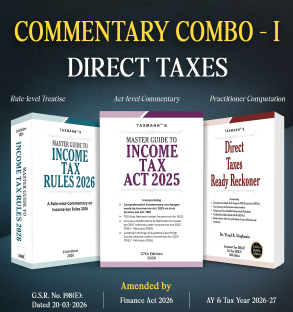
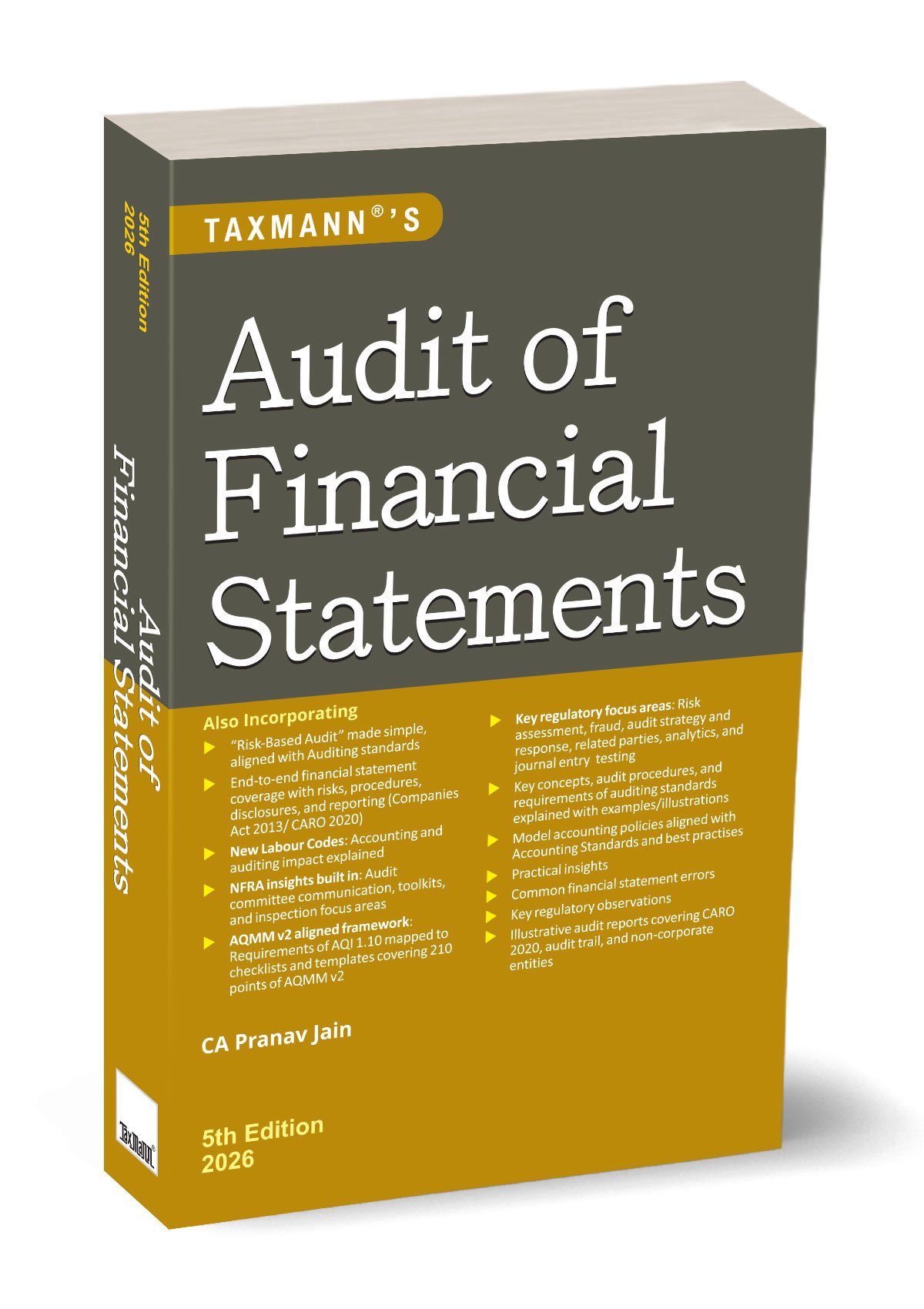
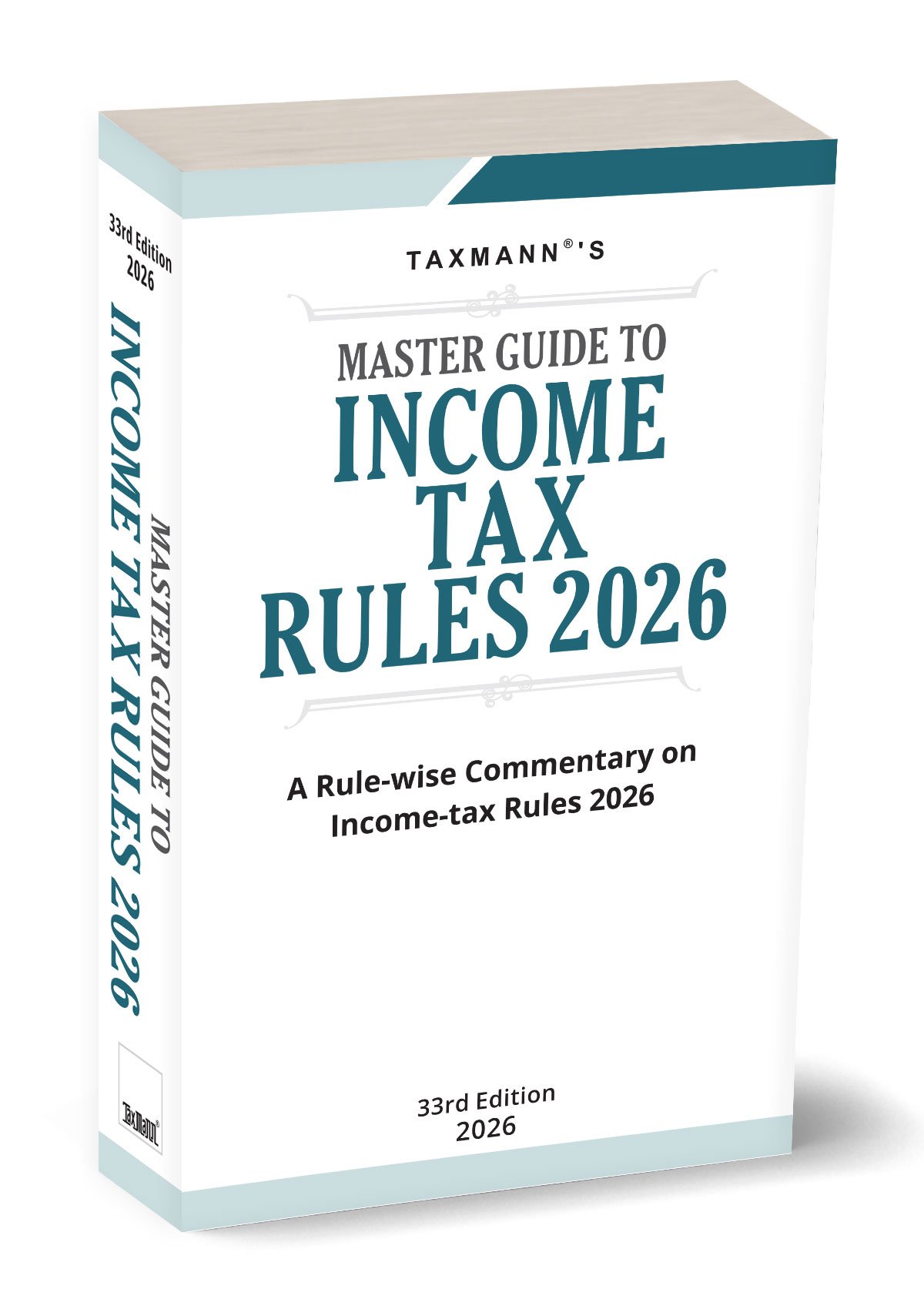
Master Guide to Income Tax Rules 2026 – A Rule wise Commentary on Income Tax Rules 2026 By M.K. Pithisaria, Abhishek Pithisaria – 33rd Edition 2026
Original price was: ₹3,195.00.₹2,395.00Current price is: ₹2,395.00.
Master Guide to Income Tax Rules 2026 – A Rule wise Commentary on Income Tax Rules 2026 By M.K. Pithisaria, Abhishek Pithisaria – 33rd Edition 2026
Description
Master Guide to Income Tax Rules 2026 is Taxmann’s flagship, rule-wise treatise on the Income-tax Rules 2026, notified vide G.S.R. No. 198(E), dated 20-03-2026, and brought into force as the subordinate legislative framework operationalising the Income-tax Act 2025. Spanning over 1,700 pages, the work undertakes a complete and systematic reconstruction of procedural income tax law in India under the new statutory regime. Every one of the 333 rules contained in the Income-tax Rules 2026 is addressed in a dedicated, self-contained commentary that maps the new rule to the following:
- Its parent provision in the Income-tax Act 2025
- The corresponding rule under the Income-tax Rules 1962
- The corresponding form (where applicable) under both the new and old frameworks
The treatise thus simultaneously functions as a rule-wise commentary, a comparative concordance and a transition manual for the change-over from the Income-tax Act 1961/Income-tax Rules 1962 regime to the Income-tax Act 2025/Income-tax Rules 2026 regime.
This book is intended for the following audience:
- Chartered Accountants, Tax Practitioners, Tax Consultants and Indirect Counsels engaged in direct tax advisory, compliance, opinion work and litigation
- Advocates and Counsels appearing before assessing officers, the Dispute Resolution Committee, the Joint Commissioner (Appeals), the Commissioner (Appeals), the Income Tax Appellate Tribunal, the Authority for Advance Rulings, High Courts and the Supreme Court
- In-House Tax Departments, CFOs, Finance Controllers, Tax Heads and Corporate Secretarial Teams of companies, banks, NBFCs, insurance companies, mutual funds, AIFs, REITs, InvITs, IFSC entities and multinational groups
- Departmental Officers, Faculty of the National Academy of Direct Taxes and Income-tax Department Staff requiring a working bench manual on the 2026 Rules
- Transfer Pricing Professionals, International Tax Specialists and TP Officers handling Arm’s Length Pricing, Safe Harbour, APA and MAP work
- GAAR, Faceless Assessment, Search & Seizure, Prosecution, Recovery and TDS/TCS Practitioners
- Trustees, Administrators and Auditors of recognised provident funds, approved superannuation funds, approved gratuity funds, charitable trusts, registered NPOs and electoral trusts
- Academicians, Researchers, Faculty and Students of National Law Universities, CA/CS/CMA programmes, LL.M. programmes in taxation, post-graduate diploma programmes in International Tax and Transfer Pricing, and ICAI/ICSI/ICMAI study circles
The Present Publication is the 33rd Edition | 2026, incorporating G.S.R. No. 198(E), dated 20-03-2026. This book is authored by Adv. M.K. Pithisaria and CA. Abhishek Pithisaria, with the following noteworthy features:
- [Independent Rule-wise Units] Every rule of the 2026 Rules is treated as an independent commentary unit, each opening with a footnoted statutory anchor identifying the relevant section of the 2025 Act and the corresponding rule of the 1962 Rules
- [Five-layer Treatment of Each Rule] Every rule is analysed across five layers, comprising:
- Statutory background tracing the parent provision in the 2025 Act
- Sub-rule-wise procedural commentary
- Tabulated lists of notified items, authorities and forms
- A dedicated ‘Analysis of changes in 2026 Rules vis-à-vis 1962 Rules’ comparison table identifying every divergence in language, threshold, timeline or procedure
- Author’s Notes flagging interpretational gaps, drafting inconsistencies and silent areas
- [Treatment of Omitted, Substituted & Re-numbered Rules] Express treatment of every omitted, substituted and re-numbered rule, with explicit cross-references where a 1962 rule has been merged into, split across, dropped from, or absorbed by a Schedule to the 2025 Act under the 2026 Rules
- [Judicial Precedent Coverage] Comprehensive integration of judicial precedent, with the body of each rule incorporating Supreme Court rulings, High Court decisions, ITAT orders, Special Bench rulings and dismissed Special Leave Petitions, each captured with full citation and tagged to the corresponding 1961 Act provisions and the 2025 Act provisions they now align with
- [CBDT Material Coverage] Extensive integration of CBDT material, including circulars, notifications, instructions, press releases and clarifications, organised rule-by-rule with the full notification number, date and contextual analysis
- [Dedicated Annexures] Extensive use of dedicated Annexures attached to individual rules reproducing the underlying CBDT circulars, departmental clarifications, statutory schemes, guideline-text and notification material referred to in the running commentary, so that the relevant source documents are accessible alongside the analysis
- [Four Concordance Tables] Four front-matter concordance tables enabling bi-directional navigation:
- Rules of 1962 to corresponding Rules of 2026
- Rules of 2026 to corresponding Rules of 1962
- Forms of 1962 to corresponding Forms of 2026
- Forms of 2026 to corresponding Forms of 1962
- Each table reproduces the heading of the rule/form on both sides for instant reconciliation
- [Footnoted Citation System] Inline footnoted citations to the precise section, sub-section, clause, sub-clause, proviso and explanation of the 2025 Act, the corresponding 1961 Act provision, and the corresponding 1962 Rule and Form
- [Worked Numerical Examples] Worked numerical examples illustrating shifts in counting of limitation periods (e.g., from ‘date of receipt of application’ under the 1962 Rules to ‘end of the month in which application was received’ under the 2026 Rules), changes in investment thresholds, timelines for capital deployment, valuation methodology and procedural deadlines
- [Transfer Pricing Treatment] OECD and UN-aligned treatment of transfer pricing rules, with detailed application notes on Comparable Uncontrolled Price method, Resale Price Method, Cost Plus Method, Profit Split Method and Transactional Net Margin Method, supplemented with case law on internal versus external comparables, cost basis determination, marketing intangibles and contract manufacturer benchmarking
- [Integrated Guideline Material] Statutory guideline material reproduced in full where required—including hospital approval guidelines (with floor area, manpower, equipment and bed-occupancy norms for ISM&H and other facilities), investment patterns for Recognised Provident Funds and Approved Superannuation Funds, electoral trust functioning norms, and infrastructure debt fund setup conditions
- [Electronic-filing Matrix] Dedicated electronic-filing matrix mapping every Form, return, statement, report, order and certificate to the relevant DGIT (Systems) notification specifying electronic furnishing under digital signature or EVC
The substantive coverage of this volume is exhaustive and includes:
- Preliminary, Residence & Source Provisions
- Definitions & Source Rules — Definitions, residence, source rules, SEP thresholds, attribution of income to Indian assets, and FMV computation for non-residents
- Dividends, Stock Exchanges & ZCBs — Declaration and payment of dividends, notification of recognised stock exchanges, notification of zero coupon bonds (complete digest from SIDBI 2006 to NABARD/REC/HUDCO/PFC/IRFC 2025 issuances) and pro-rata discount computation
- Salary, Perquisites & Allied Provisions
- Perquisites & Hospital Approval — Valuation of perquisites, annual accretion under section 17(1)(i), exemption of medical benefits, VRS compensation and hospital approval guidelines (including ISM&H speciality treatment centres)
- LTC, HRA & Special Allowances — Leave Travel Concession/Assistance (Rule 278), House Rent Allowance (Rule 279) and special allowances for armed forces, para-military forces and other employees (Rule 280, including the new Sundarbans Remote Locality Allowance)
- Family Pension & Salary Reliefs — Family pension to heirs of armed forces members killed in operational duties (Rule 281), reliefs on salary arrears/advance, gratuity and taxation of notified-country retirement benefit accounts
- Business Income, Disallowances & Deductions
- Rent, Bank Provisioning & Cash Disallowance — Unrealised rent, bank aggregate average advances for bad-debt provision, depreciation, cash payment disallowance under section 36(4)/36(7) with full jurisprudence, and preliminary expenses
- Scientific Research & Specified Projects — Mineral prospecting, scientific research (with approval framework for research associations, universities and companies), agricultural extension and skill development projects
- Specified Businesses & Cruise Ships — Affordable housing and semi-conductor wafer fabrication units, spectrum right expenditure, bad-debt interest of specified financial institutions, royalty and FTS, cruise-ship non-residents and section 61(2) resident companies
- Books, Audit & ULIP Gains — Books of account under section 62, audit reports under section 63, other electronic payment modes, ULIP capital gains and attribution of income to capital assets remaining with specified entities
- Feature Films & Composite Income — Composite agricultural-business income (Rule 270), rubber/coffee/tea manufacture (Rule 271), feature film production and distribution rights (Rules 272 and 273) and activities not constituting business connection in India (Rules 274 to 276)
- Capital Gains, Valuation & Reorganisation
- Holding Period & Currency Conversion — Period of holding, stay of crew of foreign-bound ships and rupee-foreign currency conversion for capital gains
- Original Funds, Slump Sale & FMV — Original fund conditions, FMV computation and accountant’s report on slump sale, Valuation Officer references, FMV determination for sections 26, 79 and 92, life insurance income under section 92(2)(l) and carry-forward of loss/depreciation in amalgamation
- Deductions & Reliefs
- Disability, Disease & Eminent Institutions — Disability deductions under sections 127 and 154, prescriptions for specified diseases, approval of universities of national eminence under section 133, donations and electoral trusts, rent paid deduction and audit reports for various deductions
- Double Taxation Relief & FTC — Certificates and documentation for double taxation relief under section 159 and the Foreign Tax Credit framework (Rule 76)
- International Tax & Transfer Pricing
- ALP Framework — Arm’s Length Pricing under Rules 77 to 81 (CUP, RPM, CPM, PSM, TNMM), multi-year ALP option, repatriation timeline and secondary adjustment interest under section 170
- TP Documentation & Safe Harbour — TP documentation under section 171, accountant’s report under Rule 85 and Safe Harbour Rules (Rules 86 to 102)
- APA, MAP & CbC Reporting — APA framework (Rules 103 to 120 and 122), section 206(1)(i) relief, MAP (Rule 121) and CbC reporting (Rule 124)
- Anti-Avoidance & Special Computations
- GAAR — GAAR consequences, carve-outs and reference to PCIT/CIT (Rules 127 to 132)
- Gaming, New Regime, MAT/AMT & Specified Funds — Online gaming net winnings (Rule 135), new tax regime option (Rule 136), MAT/AMT accountant’s reports (Rules 137 and 138), specified fund computation (Rules 139 to 144), securitisation trust/VCU/business trust/investment fund statements (Rule 145) and the Tonnage Tax Scheme (Rule 146)
- PF Interest Computation — Taxable interest on PF contributions exceeding specified limits (Rule 277)
- Assessment, Search & Procedural Provisions
- Search, Seizure & Distraint — Search and seizure (Rules 148, 149 and 150), requisition of books, release of assets under section 250, distraint and sale, and disclosure under section 258(2)
- PAN, Returns & Faceless Assessment — PAN allotment and quoting (Rules 157 to 162), return filing/verification, updated returns under section 263, defective returns, faceless assessment (Rule 175), modified returns on business reorganisation (Rule 177), TDS credit application (Rule 178), notice of demand under section 289 (Rule 179) and block assessment return (Rule 180)
- Charitable & Non-Profit Organisations
- NPO Registration & Compliance — Registration and approval of NPOs (Rule 181), commercial-activity gains, application to related persons, deemed application, accumulation, books, audit, accreted income and donation statements (Rules 182 to 191)
- Appellate, Dispute Resolution & Advance Rulings
- Appeals, DRC & BAR — Service of orders, additional evidence before JCIT(A)/CIT(A), Tribunal appeals and cross-objections, section 375 declarations, deferment applications, Dispute Resolution Committee (Rules 196 to 199) and Board for Advance Rulings (Rules 200 to 202)
- TDS, TCS, Recovery & Compliance Reporting
- TDS, TCS & Recovery — TDS and TCS under Rules 203 to 221, advance tax by AO order, TRO recovery, tax clearance certificates, section 434 refunds, service of notices, authentication of communications and annual statement by non-resident liaison offices
- SFT, Crypto & AIS — SFT and reportable accounts (Rules 237 to 240), Crypto-Asset reporting (Rules 241 to 244), AIS (Rule 245), registration of valuers (Rules 246 to 249), authorised representatives (Rules 250 to 268) and interest computation (Rule 269)
- Exempt Income & Fund-related Provisions
- Pension Funds & Schedule V — Pension funds (Rule 282) and minimum investment/exempt income computation under Schedule V (Rule 283)
- IFSC, Fund Relocation & Welfare Funds — IFSC offshore banking unit forward contracts/derivatives (Rule 284), fund relocation capital gains (Rule 285), employee welfare funds (Rule 286) and government grant threshold for substantially financed institutions (Rule 287)
- IDFs & Electoral Trusts — Infrastructure debt fund setup (Rule 288) and electoral trust functioning (Rule 289)
- Tea/Coffee/Rubber & Site Restoration — Audit reports under Schedules IX and X for tea/coffee/rubber development accounts and site restoration funds (Rules 290 and 291)
- Provident, Superannuation & Gratuity Funds
- Recognised Provident Funds — Rules 292 to 300
- Approved Superannuation Funds — Rules 301 to 315, with the prescribed investment pattern across Government securities, debt and short-term debt instruments, equities, and asset-backed/trust-structured investments (including derivatives, turnover ratio and fiduciary duty norms)
- Approved Gratuity Funds — Rules 316 to 329
- Insurance Reserves, Schedule XV Approvals & Electronic Compliance
- Insurance Reserves & Schedule XV — Reserves for unexpired risks (Rule 330) and approval under paragraph 1(z) of Schedule XV for infrastructure facilities and mutual funds (Rule 331)
- Electronic Furnishing & Payment — Electronic furnishing of forms, returns, statements, reports, orders and certificates (Rule 332, with the complete inventory of e-filing forms) and mandatory electronic payment of tax, interest, fee and penalty by companies and tax-audit assessees (Rule 333)
The volume opens with four cross-reference concordance tables, and then proceeds rule-by-rule from Rule 1 through Rule 333. Each rule-unit follows a uniform internal architecture:
- Statutory Anchor Header — A header identifying the rule of the 2026 Rules, the relevant section of the 2025 Act and the corresponding rule of the 1962 Rules, captured in a footnote anchor
- Statutory Background — Setting out the parent provision in the 2025 Act and the rationale for the procedural prescription
- Sub-rule wise Procedural Commentary — Paragraphs explaining procedural requirements, prescribed authorities, application formats, accompanying documents, timelines, disposal mechanics, conditions and consequences
- Tabulated Notified Items — Tabulated lists of items notified under the rule (ZCBs, pension funds, IDFs, affordable housing projects, semi-conductor units, agricultural extension projects, skill development projects, universities of national eminence, allowances, hospitals, etc.) with full citation of the underlying S.O./G.S.R./Notification number and date
- Comparative Table | 2026 Rules vis-à-vis 1962 Rules — A point-by-point comparison of every divergence between the old and new positions, accompanied by illustrative numerical examples and timeline calculations
- Author’s Notes & Footnotes — Author’s Notes flagging gaps, anomalies, drafting issues and silent areas, with footnotes anchoring the discussion to corresponding statutory provisions, rules and forms
The work is supported throughout by inline citations of judicial precedent at the level of each sub-paragraph, with case names, citations, court benches and dispositions clearly indicated, and by inline citations of CBDT circulars, notifications, instructions and clarifications, with their full reference numbers and dates.
Additional information
| BINDING | PAPERBACK |
|---|---|
| AUTHOR | Pithisaria & Pithisaria |
| EDITION | 2026 |
| ISBN | 9789375618560 |
| PUBLICATION | TAXMANN PUBLICATIONS |
Related products
-
- Out of StockSale!
- COMPANY LAW, CORPORATE LAWS, BUSINESS LAW, SEBI, SECURITIES, STOCK, FEMA, COMPETITION, MSMEs, START-UPs, INDUSTRIES, TAXATION LAW, INDIRECT TAX, DIRECT TAX, INCOME-TAX, GST, TDS, CA BOOKS
START-UPs & MSMEs (POLICIES, PROCEDURES & FINANCE)
- Original price was: ₹1,195.00.₹895.00Current price is: ₹895.00.
- Read more
-
-
- Out of StockSale!
- TAXATION LAW, INDIRECT TAX, DIRECT TAX, INCOME-TAX, GST, TDS, CA BOOKS
GST LAW & PROCEDURE ( SET OF 3 VOLUMES)
- Original price was: ₹6,995.00.₹5,245.00Current price is: ₹5,245.00.
- Read more
-
-
- Sale!
- TAXATION LAW, INDIRECT TAX, DIRECT TAX, INCOME-TAX, GST, TDS, CA BOOKS
INCOME TAX LAW, VOLS. 1-10 (SECTIONS 1-298 AND SCHEDULES ALONG WITH I T RULES, 1962 WITH APPENDED FORMS AND D T VIVAD SE VISHWAS ACT AND RULES, 2020 ALONGWITH ALLIED RULES, SCHEMES, ETC.), 7th EDITION
- Original price was: ₹29,500.00.₹19,175.00Current price is: ₹19,175.00.
- Add to cart

Reviews
There are no reviews yet.