

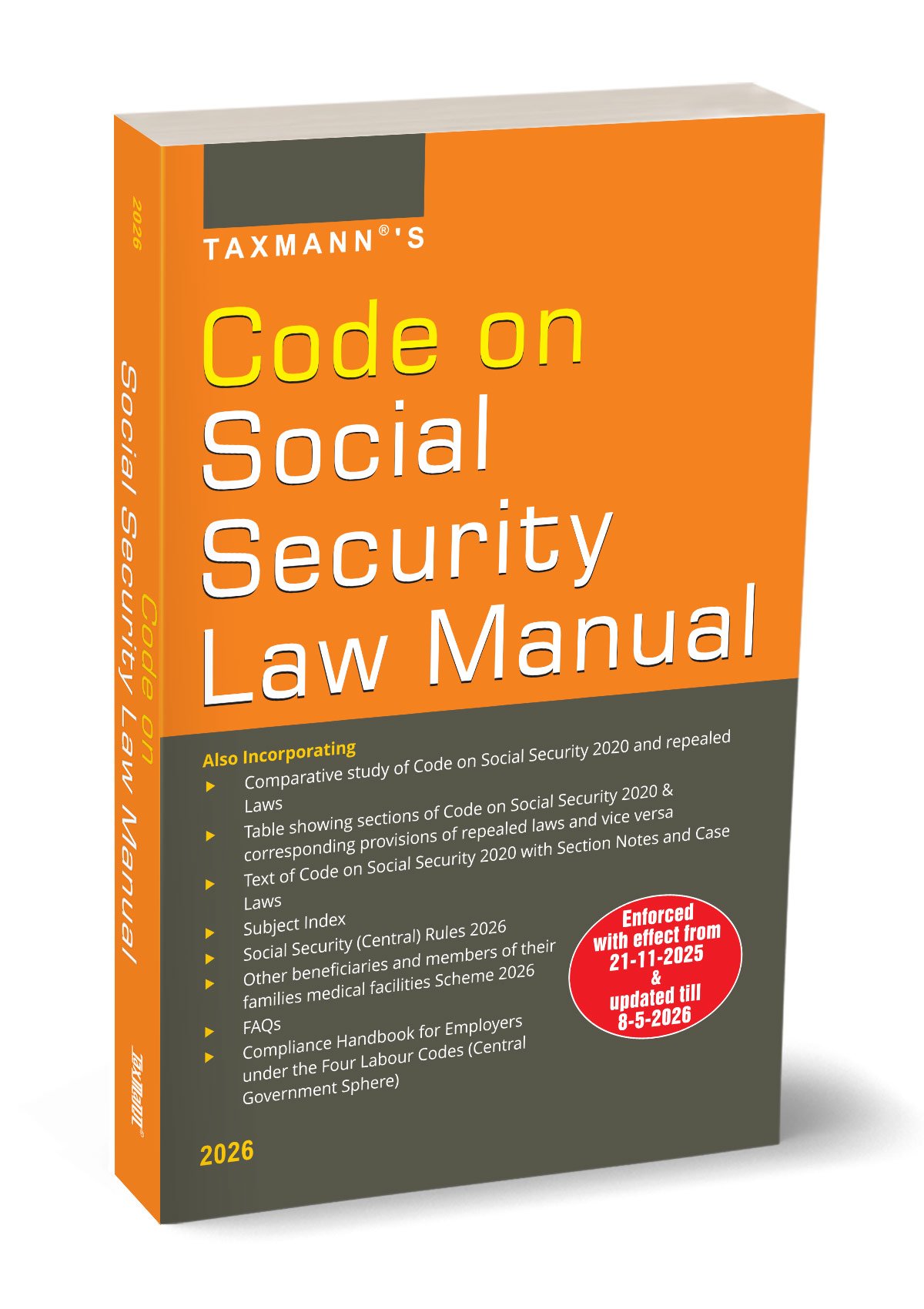
Code on Social Security Law Manual By Taxmann – 1st May Edition 2026
Original price was: ₹1,175.00.₹885.00Current price is: ₹885.00.
Code on Social Security Law Manual By Taxmann – 1st May Edition 2026
Description
Code on Social Security Law Manual is Taxmann’s authoritative single-volume working reference on India’s social security statute as it now operates in practice. The 2026 Edition is built around the editorial position that the Code on Social Security 2020 must be read as a system: the statute together with the rules made under it, the welfare scheme notified under it, the implementation cluster of notifications surrounding its commencement, and the cross-Code compliance machinery that frames it. The Manual brings all of these into one volume and arranges them so the reader can move between them in the order their work actually requires—concordance lookup, section text, editorial restatement, supporting case law, applicable rule, prescribed form, jurisdictional notification, FAQ, compliance checklist—without leaving the book.
The Manual also incorporates the Social Security (Central) Rules 2026, the Other Beneficiaries and Members of their Families Medical Facilities Scheme 2026 and a cluster of 24 commencement, designation, delegation and recovery notifications under the Code; this Edition is the first to carry the Code with that full implementation machinery in place.
The Manual is built for the reader who works with the Code on Social Security as operative law and needs the supporting apparatus alongside the statutory text:
- HR, Payroll, Benefits and Compliance Heads in factories, mines, plantations, building and other construction establishments, large-format service-sector enterprises and Central-Sphere PSUs who have to reconfigure their PF, ESI, gratuity, maternity, employee’s compensation and BOCW Cess workflows under the new regime
- In-House Counsel and Labour-Law Practitioners advising on contribution liability, PF and ESI applicability, gratuity entitlement and forfeiture, maternity benefit disputes, BOCW Cess assessment, the priority of contributions under the IBC, 2016 and the new gig and platform worker scheme architecture
- Compliance and Finance Officers at gig-platform aggregators, cinematograph production houses, contractor establishments and unorganised-sector enterprises navigating the new aggregator-funded contribution framework under Section 114 and the Section 113 registration regime
- Trustees, Plan Administrators and HR Benefits Teams managing exempted establishments, exempted trusts, and the conditions for grant, renewal and continuation of exemption under the new framework
- EPFO, ESIC, BOCW Welfare Board, State Unorganised Workers’ Board and Career Centre Officials; Inspectors-cum-Facilitators; Central and State Government officers in the Ministry of Labour & Employment and the State Labour Departments who need a single citation-safe source
- Employees’ Insurance Courts, Industrial Tribunals, Appellate Authorities under Sections 105 and 126, Competent Authorities under Chapter VII and other Adjudicating Authorities requiring an integrated working reference covering the Code, the Rules, the Notifications, the Scheme and the concordance with the nine repealed Acts
- Faculty, Researchers and Students of Labour Law across LL.B., LL.M., CS, the CA Industrial Law paper, MBA-HR and the AIBE Labour & Industrial Law module, who need the consolidated text along with comparative reference to the nine legacy Acts the Code replaces
The Present Publication is the 2026 Edition, updated till 8th May 2026. It is authored/edited by Taxmann’s Editorial Board with the following noteworthy features:
- [Four-Layer Per-Section Treatment] Each section in Division One opens with the statutory text and the Corresponding Provision flag tying it back to the legacy Acts, then carries a Section Notes block that restates the operative content in plain-language bulleted form for quick recall, a Comments block of editorial restatement keyed by section number (with a nutshell synopsis followed by sub-numbered notes on the points that practitioners will actually argue), and—where the section has been substantively litigated—a Relevant Case Laws block carrying the line of decisions that bears on its interpretation
- [Purpose-Built Concordance Tables] The preliminary part carries ten concordance tables: one forward table from the Code into all nine legacy Acts, and one reverse table from each legacy Act—the BOCW Welfare Cess Act 1996, the Cine-Workers Welfare Fund Act 1981, the Employee’s Compensation Act 1923, the Employees’ Provident Funds Act 1952, the Employees’ State Insurance Act 1948, the Employment Exchanges (CNV) Act 1959, the Maternity Benefit Act 1961, the Payment of Gratuity Act 1972 and the Unorganised Workers’ Social Security Act 2008—back into the Code. The tables sit before the statutory text rather than at the back of the volume, on the editorial grounds that the buyer transitioning from a long-established legacy practice will start there
- [Long-Form Comparative Study] Set as a free-text analytical chapter rather than as a table, the Comparative Study reads the Code provision-by-provision against the nine legacy Acts and flags every substantive change—the omission of Section 56(3) of the ESI Act on medical benefit during qualifying periods, the redrawn bar on duplication of benefits under Section 41(7), the revised compensation quantum framework under Section 76 vis-à-vis Section 4 of the EC Act, the new gig and platform worker scheme architecture under Section 45, and the narrowed Section 47 priority now keyed to the IBC 2016—meant to be read in sequence for transitional understanding rather than dipped into as a lookup
- [Social Security (Central) Rules 2026 in Full] The full text of the operative Central Rules notified on 8-5-2026 vide G.S.R. 344(E) is reproduced with all prescribed statutory Forms
- [Other Beneficiaries Medical Facilities Scheme 2026 in Full] The Other Beneficiaries and Members of their Families Medical Facilities Scheme 2026, notified on 8-5-2026 vide S.O. 2355(E), is reproduced in full alongside the Central Rules. Because the Scheme opens up the ESI hospital infrastructure to beneficiaries registered under any other Central Government scheme, the in-volume reproduction is what makes this Manual an end-to-end reference for both ESI-covered and Scheme-covered medical-benefit administration
- [Material for Purposive Interpretation] The Statement of Objects and Reasons and the Notes on Clauses for the originating Bill are reproduced as separate apparatus blocks, on the editorial reasoning that purposive interpretation arguments before Tribunals, ESI Courts and High Courts often turn on these materials
- [In-Volume Appendix of Cross-Referenced Statutes] Where the Code refers to a provision of another Act—the Aadhaar Act 2016, the BOCW (Regulation) Act 1996, the Companies Act 2013, the Civil and Criminal Procedure Codes, the Factories Act 1948, the General Clauses Act 1897, the Industrial Disputes Act 1947, the IRDA Act 1999, the Mines Act 1952, the Working Journalists Act 1955 and approximately fourteen others—the referenced provision is reproduced in an Appendix, so the reader does not have to leave the volume to locate it
- [Concept-Led Subject Index] The index is built around the way HR, payroll, benefits and IR professionals actually search—provident fund, contribution, exempted establishment, employees’ state insurance, sickness benefit, maternity benefit, gratuity entitlement, gratuity forfeiture, employee’s compensation, occupational disease, building worker, BOCW Cess, unorganised worker, gig worker, platform worker, Aadhaar, Inspector-cum-Facilitator, Social Security Fund, compounding of offences—rather than around the section list
- [Complete Notifications and Clarifications Module] Division Three reproduces 24 notifications in working order—each reproduced in full with the jurisdictional tables that allocate work across the Central Provident Fund Commissioner, the Director General of ESIC, the Social Security Officers, the Assistant Directors, the Deputy Directors and the Regional Directors
- [Cross-Code Frequently Asked Questions] A four-part FAQ module covers all four Labour Codes—twelve FAQs on the Code on Wages, nineteen on the Industrial Relations Code, nineteen on the OSH&WC Code, twenty-six on the Code on Social Security organised under seven sub-headings (General Framework & Registration; Schemes, Rule-Making & Social Security Funds; Maternity Benefit Provisions; Gratuity Rules; Building and Other Construction Workers’ Welfare; Gig and Platform Workers; Compliance, Inspection & Enforcement), and a separate Additional FAQs module dated as on 16-3-2026 covering all four Codes. The Social Security FAQs, in particular, address the most frequently asked operational questions on digital procedure under the Rules, merger of Social Security Funds, maternity certification, gratuity timing and forfeiture, BOCW Cess timing and instalments, inter-State portability for migrant construction workers, gig worker data updation, inspections, appeals, exempted-establishment oversight and records maintenance
- [Multi-Chapter Compliance Handbook for the Four Labour Codes] Division Three closes with a compliance reference for employers in the Central Government sphere, organised in chapters per Code—each anchored to specific section references and rendered as bullet-form obligation maps so the practitioner can move from a topic to a compliance action quickly. The Social Security chapter is broken down into seven sub-areas—EPF, ESI, Gratuity, Maternity Benefit, Employee’s Compensation, BOCW Welfare and Unorganised/Gig/Platform Workers—with supporting Annexures covering the Key Definitions under the Wages and IR Codes, the Third Schedule of the IR Code and the OSH&WC Code, and the First Schedule of the Code on Social Security
The structure is the editorial backbone of the Manual, organised as one preliminary part and three numbered Divisions, each one corresponding to a distinct working purpose—transitional reading, statutory and interpretive reference, operative rule-making and scheme machinery, and implementation and compliance.
- Preliminary Part | Transitional Anchor — The preliminary part anchors the transitional reading, carrying the ten concordance tables and the Comparative Study before the statutory text, so a reader coming in from legacy practice begins with the bridge between the old and the new
- Division One | The Code and its Interpretive Apparatus — Division One carries the Code on Social Security 2020 in full with its four-layer per-section apparatus—statutory text, Corresponding Provision flag, Section Notes, Comments and Relevant Case Laws—together with the First to Seventh Schedules and the supporting interpretive materials including the Subject Index, the Statement of Objects and Reasons, the Notes on Clauses and the Appendix of cross-referenced statutes
- Division Two | Operative Rule-Making and Welfare Scheme — Division Two carries the operative rule-making and welfare-scheme machinery: the Social Security (Central) Rules 2026 across fourteen chapters and sixty-nine Rules with the Schedule of statutory Forms, followed by the Other Beneficiaries and Members of their Families Medical Facilities Scheme 2026
- Division Three | Notifications, FAQs and Compliance — Division Three carries the implementation and compliance apparatus: the Notifications and Clarifications module of 24 notifications, the cross-Code FAQs covering all four Labour Codes and the Compliance Handbook for Employers under the Four Labour Codes in the Central Government sphere
Additional information
| BINDING | PAPERBACK |
|---|---|
| AUTHOR | Taxmann's Editorial Board |
| EDITION | 2026 |
| ISBN | 9789375612902 |
| PUBLICATION | TAXMANN PUBLICATIONS |
Related products
-
- Sale!
- LABOUR LAWS, DEPARTMENTAL ENQUIRIES, SERVICE LAWS, INDUSTRIAL LAW
COMMERCIAL’S LABOUR LAWS 2022 Edition
- Original price was: ₹995.00.₹795.00Current price is: ₹795.00.
- Add to cart
-
- Out of StockSale!
- LABOUR LAWS, DEPARTMENTAL ENQUIRIES, SERVICE LAWS, INDUSTRIAL LAW
Commentaries on Employees’ Provident Funds and Miscellaneous Provisions Act, 1952 by V.K. Kharbanda – Edition 2022
- Original price was: ₹1,800.00.₹1,440.00Current price is: ₹1,440.00.
- Read more
-
-
- Out of StockSale!
- LABOUR LAWS, DEPARTMENTAL ENQUIRIES, SERVICE LAWS, INDUSTRIAL LAW
NABHI’S HANDBOOK OF VIGILANCE -PROCEDURE & PRACTICE-REVISED BY GEETA RAM (4TH EDN )
- Original price was: ₹880.00.₹748.00Current price is: ₹748.00.
- Read more
-

Reviews
There are no reviews yet.