


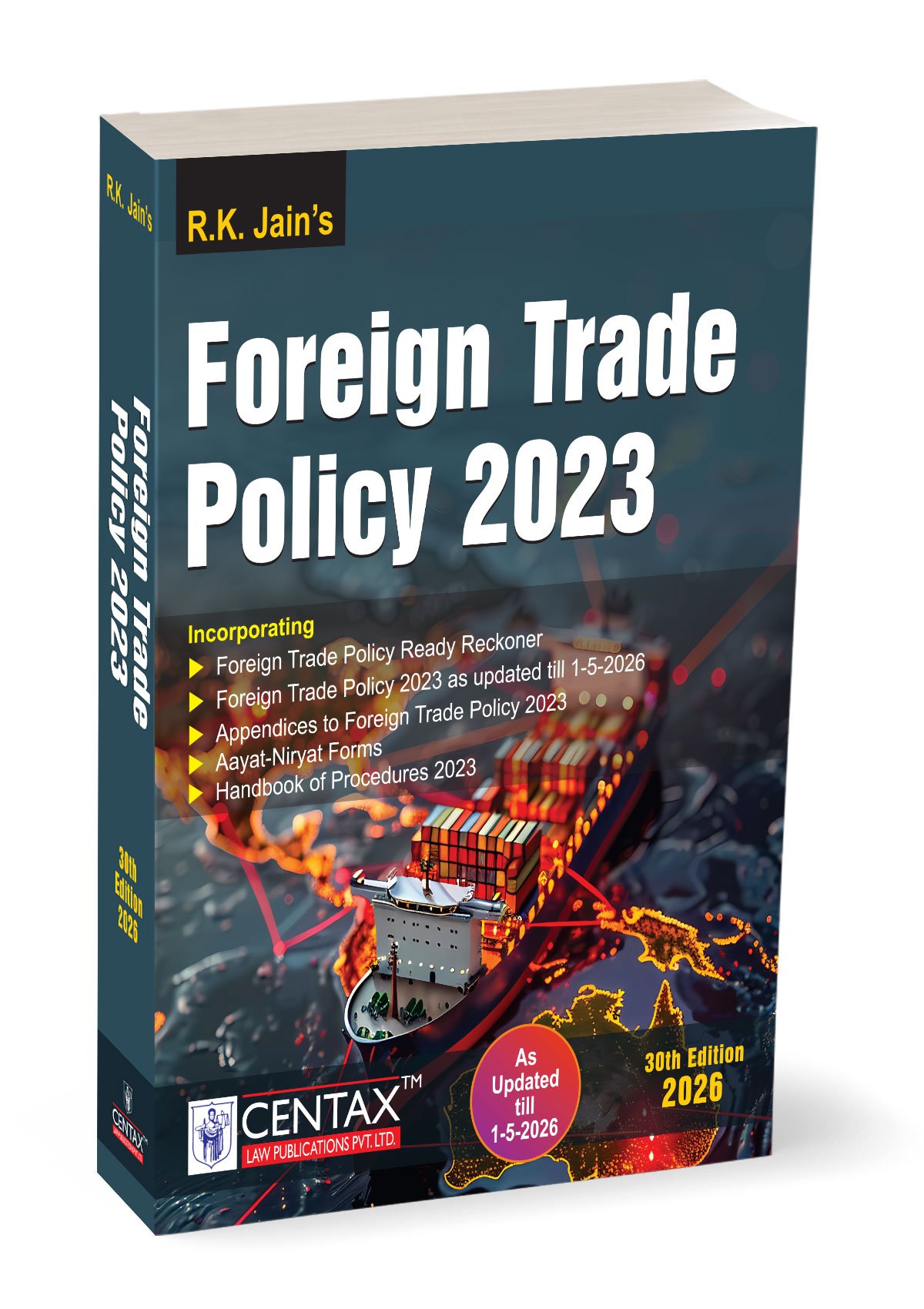
Foreign Trade Policy 2023 by R K Jain – 30th Edition 2026
Original price was: ₹2,695.00.₹2,150.00Current price is: ₹2,150.00.
Foreign Trade Policy 2023 by R K Jain – 30th Edition 2026
Description
R.K. Jain’s Foreign Trade Policy 2023, in its 30th Edition (2026), is the definitive single-volume working compendium of India’s foreign-trade legal regime, consolidating under one cover every operative instrument governing the cross-border movement of goods, services, and technology from India. This Edition presents the FTP 2023 framework—originally notified with effect from 1st April 2023—as it stands today, with every subsequent notification, public notice, trade notice and DGFT instruction integrated into the relevant clause without disturbing original paragraph numbering. The volume is architected as a complete EXIM reference shelf, opening with a practitioner-oriented Ready Reckoner of twenty chapters that translates the entire policy and procedural regime into navigable commentary, then reproducing the unabridged statutory text of the Foreign Trade Policy 2023, the Handbook of Procedures 2023 notified by DGFT, the full set of Appendices to the Handbook, the complete suite of Aayat-Niryat Forms (ANF) prescribed for application and reporting, a curated body of operative Customs notifications and DGFT Public Notices thematically organised by scheme, and the parent legislation and subordinate rules that constitute the legal foundation of the regime. The 30th Edition continuity—first published in 2000 and revised across thirty cycles spanning the Exim Policy 1997–2002 era through FTP 2004–09, 2009–14, 2015–20 and the present FTP 2023—establishes this title as the authoritative working reference of India’s EXIM community for over a quarter-century.
This book is intended for the following audience:
- Customs and Indirect-Tax Practitioners, Chartered Accountants, Company Secretaries, Cost Accountants and Tax Advocates handling EXIM advisory, authorisation work and litigation before adjudicating, appellate and judicial forums
- Exporters, Importers, Merchant Exporters, Supporting Manufacturers and Merchanting Traders across all sectors regulated by FTP, including engineering goods, pharmaceuticals, textiles, agriculture, gems and jewellery, marine products and project exports
- Special Economic Zone Units and developers, Export Oriented Units (EOUs), Electronic Hardware Technology Park (EHTP) units, Software Technology Park (STP) units, Bio-Technology Park (BTP) units and Free Trade and Warehousing Zone (FTWZ) operators
- Holders of Advance Authorisations, DFIA Scrips, EPCG Authorisations, Diamond Imprest Authorisations and other duty-exemption/remission instruments
- Status Holders (One-Star to Five-Star) and applicants seeking Status House certification
- Customs House Agents, Freight Forwarders, Logistics Service Providers, E-Commerce Export aggregators and trade-facilitation consultants
- Authorised Dealers, Banks and Financial Institutions handling export finance, e-BRC, EEFC accounts, Rupee Vostro arrangements and trade settlement
- DGFT Officers, Regional Authority officials, customs officers, Norms Committee members, Policy Interpretation Committee and Policy Relaxation Committee members, EXIM Facilitation Committee participants, adjudicating authorities, appellate forums and departmental trainees
- Export Promotion Councils, FIEO, commodity boards, industry chambers, MSME associations and trade-promotion bodies
- IFSC Market Participants and Entities regulated by IFSCA, including those engaged in finance, leasing, bullion, securities and education at GIFT IFSC
- Academic Institutions, Research Bodies, Doctoral Scholars and students of international trade law, foreign trade management, customs law and indirect taxation
- Government Ministries and Inter-Ministerial Committees engaged in trade negotiations, export-control policy under SCOMET and bilateral/multilateral trade agreements
The Present Publication is the 30th Edition | 2026, updated till 1st May 2026. This book is edited by Centax’s Editorial Board with the following noteworthy features:
- [Amended & Updated] Reflects the FTP 2023 regime as it operates today—fully updated through every notification, public notice, trade notice and DGFT instruction issued up to 1st May 2026
- [Twenty-Chapter Ready Reckoner] Translates the statutory policy into a scheme-by-scheme operating manual in commentary form, written in plain expository prose rather than bare reproduction of clauses, and equipped with worked tables, illustrative examples and procedural roadmaps
- [Verbatim Statutory Text] Unabridged text of FTP 2023 and HBP 2023 reproduced exactly as notified, with all consequential amendments incorporated at the relevant clause without disturbing original paragraph numbering—enabling reliable citation for adjudication and litigation
- [Cross-Referenced Architecture] Every policy paragraph is linked to its corresponding procedural provision in the Handbook, the prescribed Aayat-Niryat Form, the underlying Customs notification and the operative Public Notice—enabling lateral navigation across the entire regime from a single anchor point
- [Comprehensive Glossary of Acronyms] Runs to several pages and covers the entire spectrum of DGFT, Customs, FEMA, GST and trade-facilitation terminology—from AA, AANF, ACU and AEZ through SCOMET, SEZ, SION and STE to TRQ, WCO and WHO-GMP
- [Key Highlights Précis] A dedicated front-of-book section mapping the seven structural pillars introduced by FTP 2023—ease of doing business and e-initiatives, export-promotion initiatives and Status Holder threshold rationalisation, Districts as Export Hubs framework, e-commerce export facilitation, manufacturing impetus including PM MITRA additions, the special one-time Amnesty Scheme for export-obligation defaults, and SCOMET licensing streamlining
- [Complete Aayat-Niryat Forms Catalogue] All prescribed forms reproduced verbatim—from ANF-1A (Profile of Exporter/Importer) through application forms for IEC, Status Certificate, Duty Exemption schemes, EPCG, EOU/SEZ, Deemed Exports, Quality Complaints and the full SCOMET form suite—enabling direct filing reference at the practitioner’s desk
- [Curated Notifications Section] Consolidates the operative Customs notifications and DGFT Public Notices thematically organised—Advance Authorisation/DFIA/EPCG exemptions, Gem and Jewellery sector exemptions, SEZ and EOU exemptions, RoDTEP and RoSCTL notifications, and the running series of Public Notices issued from 1-4-2023 through April–May 2026
- [Allied Acts and Rules] A comprehensive part bringing together the Foreign Trade (Development and Regulation) Act 1992 and the Foreign Trade (Regulation) Rules 1993—the parent enactment and subordinate legislation that underpin the entire policy regime
- [List of Notifications Index] A detailed listing at the end of the volume serving as a chronological-cum-thematic index, enabling reverse navigation from a known notification number to the operative text or commentary
- [Tabular Treatment Throughout] Thresholds, fees, value-addition norms, time-limits, weightage factors, port-restriction tables and TRQ allocations presented in tabular form throughout the volume—designed for quick reference under time pressure
- [Dual-Use Design] Built for cover-to-cover study by new entrants and pinpoint reference by experienced practitioners, supported by chapter-and-paragraph numbered headings, internal cross-references and a glossary that anchors abbreviations the first time they appear
The coverage of the book is as follows:
- Statutory Framework of FT (D&R) Act 1992
- The FT (D&R) Act 1992 and the rules and orders made thereunder, including the legal basis of FTP, duration and amendment mechanism, overriding effect of FTP, interpretive jurisdiction of DGFT, transitional arrangements and proceedings against companies under the Insolvency and Bankruptcy Code 2016
- Trade Facilitation and Ease of Doing Business
- National Committee on Trade Facilitation, DGFT as facilitator, consultation with stakeholders, free passage of export consignments, no-seizure of export-related stock, perishable agricultural produce treatment, Niryat Bandhu hand-holding scheme, DGFT Online Customer Portal, e-IEC, e-RCMC, e-CoO, online QCTD filing, e-BRC and EDPMS, 24×7 helpdesk, Trade Data and Statistics, Authorised Economic Operator (AEO) programme and Trade Facilitation at Customs
- General Provisions on Imports and Exports
- Indian Trade Classification (Harmonised System), compliance with domestic laws and mandatory Quality Control Orders, Importer-Exporter Code, mandatory documents, principles of restrictions, Actual User condition, terms and conditions of authorisations, application fees, clearance against authorisation, Denied Entity List, firms under NCLT proceedings, prohibitions on trade (Iraq, ISIL/Al-Qaeda, DPRK, Iran, Somalia, Pakistan), Import/Export through State Trading Enterprises, transit facility, debt-repayment trade with Russia and trade with neighbouring countries
- Status Holder Certification
- Categories from One-Star to Five-Star, revised export-performance thresholds (3, 15, 50, 200 and 800 USD million), double-weightage for MSMEs and fruits/vegetables exporters, other conditions, privileges of status, skilling and mentorship obligations, Inter-Ministerial Committee for MSME grievances and Citizen’s Charter
- Districts as Export Hubs Initiative
- Objective and policy framework, District Export Promotion Committees, District Export Action Plans for each District, State/UT Export Promotion Committees, Nodal DGFT Regional Authority, online monitoring, export-promotion activities, capacity-building and implementation
- Duty Exemption and Remission Schemes
- Advance Authorisation (regular and for Annual Requirement), Advance Authorisation for Spices, Special Advance Authorisation Scheme for export of Articles of Apparel and Clothing Accessories, eligible applicants and export/supply categories, Self-Ratification Scheme, value addition formula and minimum value-addition norms (15% generally, 50% for tea, 25% for spices), import of mandatory spares, ineligible categories on self-declaration, accounting of input, pre-import condition, drawback admissibility, Actual User condition, validity period, free-of-cost supply, domestic sourcing, currency of realisation, export-obligation period and extension, re-import of exported goods, Duty Free Import Authorisation (DFIA) scheme—eligibility, minimum value addition, validity and transferability, sensitive items
- Gem and Jewellery Sector Schemes
- Nominated agencies, advance procurement and replenishment of precious metals, replenishment authorisation for gems and consumables, value-addition norms for the sector, wastage norms, diamond imprest, certification and grading, export of cut and polished diamonds with re-import facility at zero duty, export against supply by foreign buyer, branded jewellery, special notified zones, Diamond and Jewellery Dollar Accounts, treatment and re-import of precious and semi-precious stones, re-import of rejected jewellery and consignment-basis exports
- RoDTEP and RoSCTL
- Scheme objective and operating principles, ineligible supplies/items/categories, nature of rebate, monitoring, audit and risk management, output-outcome framework, Appendix 4R notified rates and per-unit value caps, RoDTEP restoration for AA holders, EOUs and SEZ units (Appendix 4RE), Diamond Imprest Authorisation eligibility, export obligation and details of duties exempted, RoSCTL for textiles administered by the Ministry of Textiles
- EPCG Scheme and Project Imports
- Objective and overview, EOU/relocated SEZ unit conversion to DTA, indigenous sourcing benefits to domestic suppliers, calculation of export obligation, incentive for early EO fulfilment, reduced EO for Green Technology products, reduced EO for North East Region and UTs of Jammu & Kashmir and Ladakh, exemption from average export-obligation maintenance, transitional arrangements, EODC, clubbing of authorisations, re-export, repair and replacement of capital goods, PM MITRA scheme inclusion under CSP, penal action and Project Imports
- EOU/EHTP/STP/BTP Framework
- Introduction and objective, export and import of goods, leasing of capital goods, Net Foreign Exchange Earnings, applications and approvals via Letter of Permission and Letter of Intent, Legal Undertaking, investment criteria, DTA sale of finished products, rejects, waste, scrap, remnants and by-products, other supplies counted for NFE fulfilment, export through others, entitlements for supplies from DTA, inter-unit transfer, sub-contracting, sale of unutilised material and capital goods, reconditioning/repair and re-engineering, replacement/repair of imported or indigenous goods, exit from the scheme, conversion of DTA unit, NFE monitoring, export through exhibitions and showrooms abroad, personal carriage and export/import by post/courier, fast-track clearance for status-holder EOUs and routine procedures
- Deemed Exports
- Objective, categories of supply, deemed export by main and sub-contractors, benefits to supplier and recipient, conditions for refund of Terminal Excise Duty and Deemed Export drawback, common conditions, benefits on specified supplies, liability of interest on delayed refund, Risk Management and Internal Audit mechanism and penal action for mis-declaration
- Quality Complaints and Trade Disputes
- Objective and scope, obligations of importer/exporter, provisions in FT (D&R) Act and Rules, Committee on Quality Complaints and Trade Disputes (CQCTD) constitution and proceedings, procedures, corrective measures, Case Officer and Nodal Officer designations
- Cross-Border Trade in Digital Economy (e-Commerce)
- Objective, e-Commerce exports of goods and services, e-Commerce platforms, Export Logistics Provider, export and import through Courier Service and Post, promotion of e-Commerce exports through hand-holding and outreach, e-Commerce Export Hubs (ECEHs)—creation, nature of operations and entitlements, Dak Niryat Kendras and value-limit enhancement for courier exports to ₹10,00,000 per consignment
- SCOMET Framework
- Background, SCOMET List, classification of categories and licensing jurisdiction, export of SCOMET items, catch-all controls on dual-use non-SCOMET items, supply from DTA to SEZ/EOU and outside the country, export of imported SCOMET items, types of export authorisations, issue, amendment and revalidation of authorisations, outreach programmes, voluntary self-disclosure of dual-use exports and alignment with India’s commitments under the Wassenaar Arrangement, Australia Group and Missile Technology Control Regime
- Miscellaneous Policy Provisions
- Transitional arrangements, trade facilitation, online initiatives, ease of doing business, time-bound DGFT services, grievance redressal, Free Trade Agreements (FTAs) and Preferential Trade Agreements (PTAs), Generalised System of Preferences (GSP), Duty Free Tariff Preference (DFTP) Scheme for LDCs, Certificates of Origin (Preferential and Non-Preferential), TRQ under FTA/CECA, Rules of Origin (Preferential and Non-Preferential) and Approved Exporter Scheme (AES) for self-certification of Certificate of Origin
- Duty Drawback
- Scheme of customs-duty drawback, types of drawback rates (All Industry Rate and Brand Rate), drawback rate fixation, claim procedure, drawback on re-export and ancillary provisions
- Special Economic Zones
- SEZ policy to encourage exports, setting up of SEZs, routine operations of SEZ units, supply by DTA unit to SEZ, sale to DTA from SEZ, miscellaneous SEZ provisions, States’ policies towards SEZs, applicability of labour laws, exemption from cesses, customs and excise duties, stamp duty exemption, GST provisions applicable to SEZ, supply from Free Trade Warehousing Zone (FTWZ) to DTA
- FT (D&R) Act and Rules
- Scheme of the Act, role and powers of the Director General of Foreign Trade, penalty and adjudication, penalties and punishments for violation of FTP, institution and continuation of proceedings against companies under the Insolvency Code
- International Financial Services Centre (IFSC)
- Background of IFSC and regulation of financial services, IFSCA initiatives in the financial sector, regulations relating to insurance, leasing business, bullion, securities market and the education sector at GIFT IFSC, including International Branch Campuses and Offshore Education Centres
- Aayat-Niryat Forms (ANF)
- The prescribed application, declaration and reporting forms supporting every operative scheme under FTP and HBP
- Operative Customs Notifications and DGFT Public Notices
- The running notification series implementing exemptions under each scheme and the procedural and trade-facilitation directions issued by DGFT
- Allied Legislation
- The Foreign Trade (Development and Regulation) Act 1992 with all amendments through the Foreign Trade (Development and Regulation) Amendment Act 2010, and the Foreign Trade (Regulation) Rules 1993, together with consolidated definitions of services, technology, specified goods, conveyances and adjudicating and appellate authorities
The book is architected into seven Parts presented as three logical blocks.
- Block I — Commentary and Statutory Text
- Part 1 — Foreign Trade Policy Ready Reckoner
- Part 2 — Foreign Trade Policy 2023
- Block II — Procedures, Appendices and Forms
- Part 3 — Handbook of Procedures 2023
- Part 4 — Appendices to Handbook of Procedures
- Part 5 — Aayat-Niryat Forms
- Block III — Notifications and Allied Legislation
- Part 6 — Notifications
- Part 7 — Allied Act & Rules
- Each chapter in the Ready Reckoner follows a uniform internal architecture:
- A definitional and objective paragraph that anchors the scheme in its statutory source under the FT (D&R) Act and the relevant FTP/HBP paragraph
- A scheme-mechanics walkthrough covering eligibility, entitlements, value-addition norms, fees, validity periods and conditions
- A procedural pathway linking the policy provision to the corresponding HBP paragraph, the prescribed Aayat-Niryat Form and the operative Customs notification
- Tabular treatment of thresholds, fees, value-addition norms, time-limits, weightage factors and category-wise schedules where applicable
- Treatment of consequential matters—Bank Guarantee and LUT execution, port of registration, EODC, clubbing, transitional arrangements, regularisation of bona fide default, penal action and judicial precedents (cited inline) that shape the working interpretation of key provisions
Additional information
| BINDING | PAPERBACK |
|---|---|
| AUTHOR | R K Jain |
| EDITION | 2026 |
| ISBN | 9789349247031 |
| PUBLICATION | CENTAX PUBLICATION |
Related products
-
- Out of StockSale!
- TAXATION LAW, INDIRECT TAX, DIRECT TAX, INCOME-TAX, GST, TDS, CA BOOKS
ONE STOP REFERENCER FOR ASSESSMENT & APPEALS
- Original price was: ₹1,495.00.₹1,120.00Current price is: ₹1,120.00.
- Read more
-
-
- Out of StockSale!
- TAXATION LAW, INDIRECT TAX, DIRECT TAX, INCOME-TAX, GST, TDS, CA BOOKS
DECODING TRANSFER PRICING FOR SELLING (DISTRIBUTION AND AGENCY) FUNCTIONS-PRACTICAL SOLUTIONS FOR MARKETING INTANGIBLES AND PROFIT ATTRIBUTION TO AGENCY PERMANENT ESTABLISHMENTS
- Original price was: ₹1,000.00.₹850.00Current price is: ₹850.00.
- Read more
-
-
- Sale!
- TAXATION LAW, INDIRECT TAX, DIRECT TAX, INCOME-TAX, GST, TDS, CA BOOKS
ATAL KUMAR-TAXATION LAWS
- Original price was: ₹390.00.₹332.00Current price is: ₹332.00.
- Add to cart

Reviews
There are no reviews yet.