

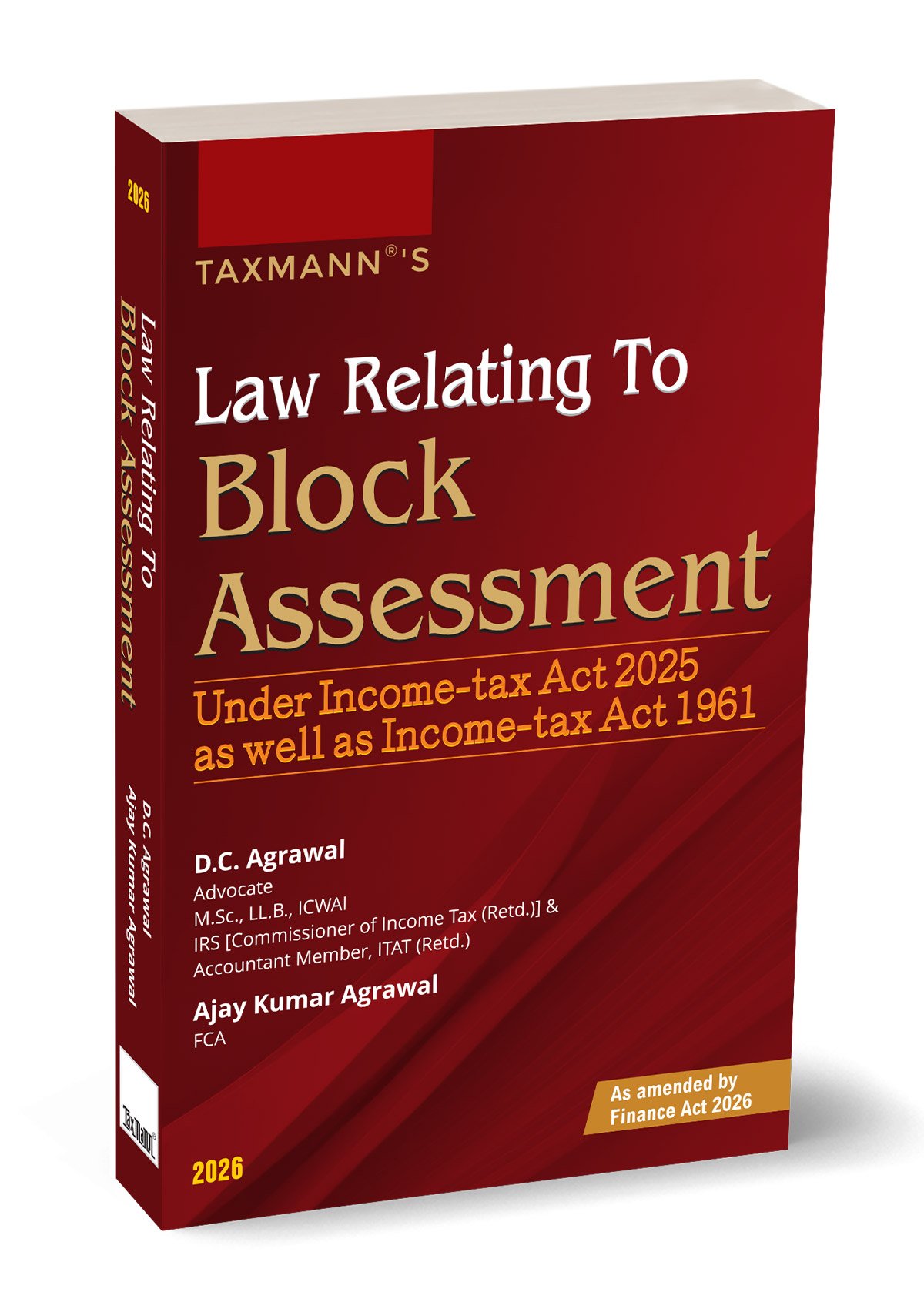
Law Relating To Block Assessment by D.C. Agrawal and Ajay Kumar Agrawal – Edition 2026
Original price was: ₹3,295.00.₹2,475.00Current price is: ₹2,475.00.
Law Relating To Block Assessment by D.C. Agrawal and Ajay Kumar Agrawal – Edition 2026
Description
Law Relating To Block Assessment is the leading contemporary work on India’s revived block assessment regime. The reintroduction of block assessment through the Finance (No. 2) Act 2024, its refinement by the Finance Act 2025, its consolidation under the Income-tax Act 2025 (operative from 1st April 2026) and its further amendment by the Finance Act 2026 has fundamentally reshaped the architecture of search-driven taxation in India. After two decades of search assessments under Sections 153A to 153C, the legislature has returned to a consolidated block mechanism—but in a modernised form that incorporates digital assets, quarter-based limitation, mandatory supervisory approvals, and harmonised integration with the deemed income regime.
The book’s distinguishing position is that it does not treat block assessment under the 2025 Code as a stand-alone subject. Instead, it reads the new framework against the entire body of Chapter XIV-B jurisprudence developed between 1995 and 2003 and refined through litigation thereafter, and asks, provision by provision, which doctrines survive, which evolve, and which are displaced. The result is the only block assessment treatise that simultaneously serves as a working manual under the 2025 Code and as a continuing reference to the 1961 Act for ongoing litigation, appellate proceedings and pre-2026 search cycles.
The volume is intended as a definitive working reference for:
- Tax Litigators and Senior Advocates appearing in search and block assessment matters before the Tribunal, High Courts and the Supreme Court
- Chartered Accountants and Tax Consultants advising taxpayers on search defence, statement retraction strategy, cash credit explanations, peak credit and telescoping computations, and undisclosed income exposure under Sections 102 to 105
- Assessing Officers, Investigation Wing Officers, Departmental Representatives and Commissioners (Appeals) drafting or adjudicating block assessment orders, satisfaction notes under Section 295, panchnamas, and supervisory approvals under Section 299
- Corporate Heads of Tax, CFOs and In-house Counsel of Business Groups facing or anticipating search and seizure action, particularly those holding digital assets, cross-border positions, or layered investment structures
- Members of the Income Tax Appellate Tribunal and Judicial Officers seeking a consolidated reference on the interplay between the 1961 and 2025 frameworks
- Forensic Accountants, Certified Fraud Examiners, and Investigation Wing Analysts working on the detection side of accommodation entries, shell companies, derivative misclassification, and digitally stored evidence
- Academicians, Post-graduate Law and Accountancy Researchers studying anti-evasion architecture and the transition from Chapter XIV-B to Chapter XVI-B
The Present Publication is the 2026 Edition, amended by the Finance Act 2026. It reflects the Income-tax Act 2025 framework, effective from 1st April 2026, alongside the corresponding jurisprudence under the 1961 Act. It is authored by D.C. Agrawal and Ajay Kumar Agrawal, with the following noteworthy features:
- [Statutory Text-and-Analysis Format] Every key provision is reproduced verbatim, followed by a clause-by-clause ‘Key Features’ exposition covering purpose, scheme placement, sub-section mechanics, evidentiary basis, exclusions, charging linkage, procedural safeguards, taxpayer implications and administrative implications
- [Comprehensive 1961 ↔ 2025 Section Mapping] Explicit cross-walks across the entire Code in tabular and narrative form, allowing the reader to navigate seamlessly between corresponding provisions of the two statutes
- [Over 2,500 Judicial Precedents] Supreme Court, High Court and Tribunal decisions integrated by ratio under each sub-issue, with explicit testing of pre-2025 Chapter XIV-B authorities for continued applicability under the new Code
- [Three-Part Manner-of-Operation/Example/Defence Treatment] For each manipulation pattern in the forensic and financial transactions chapters, the reader is provided the modus operandi, a worked rupee-denominated example, and the documentary defence package
- [Dual-Lens Drafting] Every chapter reflects both the assessing-authority view (how to draft, defend and adjudicate) and the taxpayer-defence view (what paperwork discharges the shifting onus), driven by the authors’ combined Tribunal-bench and litigation-practice experience
- [Comparative Tables and Illustrative Situations] Embedded throughout for rapid navigation across the two statutory regimes
- [Case-by-Case Digital Evidence Taxonomy] Separate compilations of decisions where Section 65B/Bharatiya Sakshya Adhiniyam certification was correctly invoked and admitted, where it was improperly invoked or absent and the evidence was rejected, and where the certificate was held not to be required
- [Practitioner-Ready Apparatus] Each chapter concludes with a ‘Guidelines’ section synthesising actionable principles, followed by a ‘Conclusion’ crystallising the doctrinal position; rebuttal templates and CBDT instruction summaries are embedded where relevant
- [Consolidated List of Cases and Subject Index] Over 80 pages of case citations and a granular subject index keyed to paragraph numbers, enabling targeted retrieval
This section sets out the substantive themes addressed by the book.
- Historical Evolution of Block Assessment
- The original 1995 regime, its abolition in 2003, the 2024 reintroduction, and the legislative rationale for each transition
- Concept of Block Period and Undisclosed Income
- Definitional contours, foundational conditions, distinctions between disclosed, undisclosed, escaped and unaccounted income, sequential and simultaneous searches, and treatment of part-period income in the year of search
- Charging and Computation of Total Undisclosed Income
- Non-obstante effect, two-part aggregation, statutory exclusions to prevent double counting, treatment of properly recorded book entries, the Assessing Officer’s recomputation power, transfer pricing and Specified Domestic Transactions carve-out, partner-related rules for firms, special tax rate linkage, prohibition on set-off of brought-forward losses and unabsorbed depreciation, and carry-forward beyond the block period
- Procedural Architecture for Block Assessment
- Notice mechanics, filing windows and audit-driven extensions, deeming of the block return as a regular return, scrutiny notice machinery, bar on revised returns, inapplicability of summary processing, mandatory supervisory pre-approval, and integration with seized-asset adjustment
- Other-Person Assessments
- The ‘belongs to/pertains to/relates to’ trichotomy, satisfaction note doctrine, prima-facie versus conclusive proof, jurisdictional competence, hand-over of seized material, dual-capacity Assessing Officer scenarios, block period alignment, and curative effect of substantive compliance
- Limitation Framework
- Quarter-based formula, statutory exclusions, safeguards, impact of stay orders, special audit references, interim court orders, fresh authorisations, remand-driven recomputations, void-ab-initio doctrine, and the assessee’s right to challenge limitation
- Interest, Penalty and Immunity
- Penalty discretion under the Hindustan Steel and Anantharam Veerasinghaiah line, mens rea requirements, conscious non-disclosure threshold, computation principles, extension of penalty limitation, immunity conditions, and revival after final appellate adjudication
- Supervisory Approval and Competent Authority
- Administrative versus quasi-judicial nature of approval, hearing and reasons requirements, revisional jurisdiction over approvals, and consequences of approval from the wrong authority
- Search and Seizure Law
- Authorisation conditions, ‘reason to believe’ versus ‘reason to suspect,’ ‘information in possession’ doctrine, satisfaction notes, warrant validity (joint names, multiple premises, several occupants), prohibitory and restraint orders, retention limits, evidentiary value of illegally obtained material, distinction between illegality and irregularity, application of the Bharatiya Nagarik Suraksha Sanhita 2023, and the rights and duties of the searched person
- Requisition Proceedings
- Conditions for issuance, ‘reasonable belief’ standard, requisition from criminal courts and banks, counting of block period, and writ jurisdiction
- Statements, Cross-Examination and Retraction
- Recording mechanics, evidentiary value with and without oath, retraction across distinguishable circumstances (mid-night recording, stress, coercion, vagueness, delay, voluntariness, specificity, supporting affidavits, subsequent conduct), the Andaman Timber Industries doctrine, the Bharatiya Sakshya Adhiniyam framework for examination and cross-examination, and CBDT guidance to first appellate authorities
- Presumption Doctrine
- Possession, control and beneficial ownership distinguished from formal title; presumptions in shared households; affidavit-based rebuttal; presumptions for criminal prosecution; the handwriting-on-document importance; and the rebuttable nature of statutory presumptions
- Taxability of Cash
- Family claims, locker contents, third-party premises, recovery from debtors, gifts, inheritance, agricultural savings, NBFC and chit fund collections, political party exemption requirements, educational institution claims, partner’s capital claims, imprest money, and on-money receipts
- Taxability of Stock
- Profit-element doctrine for excess stock, judicially-accepted explanations for shortage, business income versus undisclosed income characterisation, set-off between deficit and surplus, consignment stock defence, accumulated profit theory, and the limits of pre-search valuation reports
- Taxability of Jewellery
- Non-seizure thresholds, ancestral and customary gifts, weighment methods, valuation disputes, customs-imported jewellery, and family savings explanations
- Taxability of Virtual Digital Assets
- Definitional scope, special charging rate, no-deduction rule, loss restriction, TDS allocation across different transaction structures (over-the-counter, exchange-paid, broker-paid, exchange-as-seller, in-kind and crypto-to-crypto exchange, payment-gateway-routed), threshold limits and specified persons, the new crypto-asset clause, the proposed reporting framework, valuation, and forensic detection in searches
- Burden of Proof
- The Bharatiya Sakshya Adhiniyam architecture in tax proceedings, source-of-source doctrine, identity-creditworthiness-genuineness triad, shifting onus on detection of bogus transactions, ownership presumptions for locker contents, and comparative discharge thresholds
- Documentary and Digital Evidence
- ‘Dumb documents,’ loose papers, diaries, third-party documents, criteria for additions on unsigned and undated material, decoding of figures, digital evidence certification, the Anvar P.V. and Arjun Panditrao line, and the original-device exception
- Forensic Accounting in Search Defence
- Manipulation patterns across trading account, profit and loss account, manufacturing account and balance sheet, including sales suppression, revenue deferral, related-party routing, fictitious credit notes, accommodation purchases, undervalued scrap, under-invoicing, split invoicing, inflated and personal expenses, capital-versus-revenue misclassification, fictitious salaries, excessive related-party payments, ghost vendors, false provisions, and fake debit notes
- Securities, Commodities and Derivatives Manipulations
- Client Code Modification, business-to-capital loss conversion, speculative loss reclassification, circular options trading, illiquid options for artificial loss, F&O turnover non-reporting, hedging misclassification, name-lender accounts, fake counterparties, warehouse stock non-reconciliation, and cash margin practices
- Accommodation Entries and Shell Companies
- Modus operandi, characteristics of paper companies, identification methodology, deletion-justified versus addition-justified case taxonomies, the entry-operator-statement-only rule, and the duty of independent inquiry beyond Investigation Wing reports
- Telescoping and Peak Credit
- Circumstances where peak credit theory is inapplicable, the maximum-bank-balance versus peak-credit distinction, double addition prevention, and the percentage-on-grey-market-purchases alternative
- Bogus Sales and Purchases
- Limited addition principle, accommodation purchase patterns, GST and e-way bill cross-verification, transporter logs, and book rejection consequences
- Deemed Income
- Unexplained cash credits, unexplained investments, unexplained money and valuable articles, and unexplained expenditure, including the source-of-source amendment, the investment-versus-deposit distinction, possession-versus-ownership analysis, joint ownership treatment, role of affidavits, applicability under presumptive taxation, and the principle that cash deposited in a bank account is not money for the purpose of the unexplained-money provision
The chapters are arranged in five progressive analytical blocks:
- Block I | Statutory Architecture and Definitional Core (Chapters 1 to 12) — Covers the historical evolution and the entire substantive and procedural backbone of Chapter XVI-B in the order in which the provisions appear in the statute, from definitional sections through computation, procedure, other-person assessment, limitation, penalty and interest, supervisory approval and residual application
- Block II | Search, Requisition and Examination Machinery (Chapters 13 to 15) — Covers the operational procedures of search and seizure, requisition, and the recording, evidentiary weight, cross-examination and retraction of statements
- Block III | Presumptions, Assets and Documentary Evidence (Chapters 16 to 22) — Covers the presumption regime, asset-specific taxability across cash, stock, jewellery and virtual digital assets, the burden of proof framework, and the evidentiary treatment of dumb documents, loose papers, diaries and digital records
- Block IV | Accounting Integrity and Transactional Detection (Chapters 23 to 27) — Covers the practical detection-and-defence layer: forensic accounting in financial statements, securities and commodity-derivatives transactions, accommodation entries with shell company analysis, telescoping and peak credit, and bogus sales and purchases
- Block V | Deemed Income (Chapters 28 to 31) — Closes with a dedicated, section-wise treatment of the four deemed-income limbs of the 2025 Code, each integrated with its 1961 antecedent
- Each chapter follows a consistent internal architecture:
- An Introduction establishing context and statutory location
- Reproduction of the relevant statutory provision in full
- A clause-by-clause ‘Key Features’ or ‘Ingredients’ exposition
- Comparative mapping between the corresponding 1961 and 2025 provisions
- Granular sub-issue treatment with judicial precedents arranged by ratio
- Illustrative situations of acceptance and rejection of taxpayer explanations
- Burden of proof and procedural safeguards relevant to that issue
- For forensic chapters, a Manner-of-Operation/Example/Defence triad for each pattern
- A ‘Guidelines’ section consolidating actionable principles
- A ‘Conclusion’ crystallising the prevailing doctrinal position
Additional information
| BINDING | PAPERBACK |
|---|---|
| AUTHOR | D.C. Agrawal and Ajay Kumar Agrawal |
| EDITION | 2026 |
| ISBN | 9789375617990 |
| PUBLICATION | TAXMANN PUBLICATIONS |
Related products
-
- Sale!
- TAXATION LAW, INDIRECT TAX, DIRECT TAX, INCOME-TAX, GST, TDS, CA BOOKS
INCOME TAX LAW, VOLS. 1-10 (SECTIONS 1-298 AND SCHEDULES ALONG WITH I T RULES, 1962 WITH APPENDED FORMS AND D T VIVAD SE VISHWAS ACT AND RULES, 2020 ALONGWITH ALLIED RULES, SCHEMES, ETC.), 7th EDITION
- Original price was: ₹29,500.00.₹19,175.00Current price is: ₹19,175.00.
- Add to cart
-
- Out of StockSale!
- INTERPRETATION OF STATUTES, TAXATION LAW, INDIRECT TAX, DIRECT TAX, INCOME-TAX, GST, TDS, CA BOOKS
INTERPRETATION OF INDIRECT TAX STATUTES INCLUDING GST
- Original price was: ₹3,399.00.₹2,550.00Current price is: ₹2,550.00.
- Read more
-
-
- Out of StockSale!
- TAXATION LAW, INDIRECT TAX, DIRECT TAX, INCOME-TAX, GST, TDS, CA BOOKS
GST PLEADING AND PRACTICE
- Original price was: ₹5,995.00.₹4,800.00Current price is: ₹4,800.00.
- Read more
-

Reviews
There are no reviews yet.