

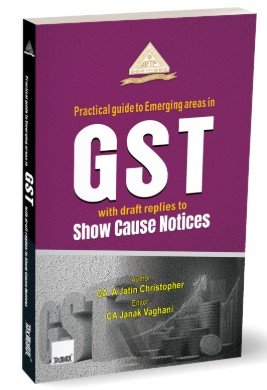
Practical Guide to Emerging Areas in GST with Draft Replies to Show Cause Notices by All India Federation of Tax Practitioners and A Jatin Christopher – Edition 2026
Original price was: ₹745.00.₹670.00Current price is: ₹670.00.
Practical Guide to Emerging Areas in GST with Draft Replies to Show Cause Notices by All India Federation of Tax Practitioners and A Jatin Christopher – Edition 2026
Description
Practical Guide to Emerging Areas in GST with Draft Replies to Show Cause Notices is one of the most strategic, litigation-ready, and conceptually advanced GST publications. It is not a routine commentary on the Act. Instead, it identifies the precise areas where GST disputes are intensifying nationwide, in audits, scrutiny, investigations, and adjudications. It provides a principled, evidence-backed, draft-ready framework to defend taxpayers. The book is organised in two integrated parts:
- Part I decodes the law through first principles, case law, inter-statute comparison, and administrative law doctrines. It explains not only what the law is, but why certain departmental approaches are erroneous or ultra vires
- Part II operationalises these principles by meticulously drafting replies to the very SCNs that taxpayers are currently receiving, making this the first book to bridge high-level legal analysis with practical drafting templates.
The result is a publication that redefines how GST disputes are understood and handled, equipping readers to respond with clarity, authority, and procedural precision.
This book is intended for the following audience:
- GST & Indirect Tax Practitioners – Professionals who advise, represent, or defend clients in audits, investigations, adjudications, and appeals, including those appearing before GSTAT
- Corporate Tax, Finance & Compliance Leaders – CFOs, tax heads, controllers, and compliance teams dealing with complex valuation, ITC, cross-charge, contract interpretation, and credit distribution issues
- Litigators & Dispute-resolution Specialists – Advocates needing a statute-backed, case-law-supported, and ready-to-adapt drafting resource
- GST Officers & Administrators – Officers (Central and State) seeking doctrinal clarity on jurisdiction, proper officer roles, audit vs investigation boundaries, confiscation prerequisites, and due-process limitations
- Scholars & Advanced Students of Taxation – Researchers studying GST’s structural architecture, interplay with allied laws, and modern principles of tax administration
The Present Publication is the Latest Edition, commissioned by the All-India Federation of Tax Practitioners (AIFTP) and published exclusively by Taxmann. It is authored by CA. A Jatin Christopher and edited by CA. Janak Vaghani, with the following noteworthy features:
- [Advanced Treatment of GST’s Most Litigated Areas] The book identifies and analyses the ‘pressure-point issues’ that consistently appear in SCNs, audit objections, and adjudication orders. These include:
- Deemed supplies and free-issue material
- Discounts & pricing structures
- Cross-charge vs ISD (post-2025 amendments)
- Corporate guarantees (post Rule 28(2))
- ESOPs & cross-border employee cost allocations
- Section 194R perquisites & barter structures
- Non-genuine suppliers & ‘fake ITC’ disputes
- Section 16(4) time-barred credits
- Confiscation vs seizure, interest computation, and jurisdictional lapses
- The author provides not only the statutory interpretation but also the logical, contractual, and evidentiary framework that determines the GST consequence
- [Most Complete Exposition of Departmental Powers & Limitations] It thoroughly explains:
- What scrutiny can and cannot examine
- How audit differs from investigation
- Why Section 67 powers cannot be used for routine verification
- What constitutes ‘reasons to believe’
- How the jurisdiction of the ‘Proper Officer’ is established
- Why linear comparisons (GSTR-1 vs 3B; 2A/2B vs 3B; EWB vs 3B) are jurisprudentially unsound
- How to challenge invalid authorisations, defective SCNs, incorrect service, and overreach
- Each chapter functions as a practical defence manual for disputes
- [Draft Replies that Practitioners can Deploy Immediately] Every reply is:
- Richly reasoned
- Statutorily anchored
- Supported by CBIC circulars, instructions, and press releases
- Aligned with evidence, law and administrative law doctrines
- Structured exactly as adjudicating authorities expect replies to be structured
- Templates cover 15+ scenarios, including mismatches, ITC objections, e-way bill disputes, late fee/penalty, interest-only demands, RCM alleged short payments, ‘other income’ disputes, SPL-1 to SPL-4 amnesty replies, and non-genuine supplier allegations
- [Litigation Strategy Woven into Every Chapter] The book explains to the reader:
- When not to reveal facts prematurely
- How ‘without prejudice’ is misused and how to avoid self-damage
- How to shift the burden of proof back to the department
- Why SCN defects are fatal and cannot be cured in adjudication (Section 75(7))
- How to prepare strategically for Tribunal, keeping in mind the limitations, interest cost, and probability analysis
- Why remand, revision, and enhancement require strict statutory compliance
- [Robust Case-law Integration] Includes an extensive catalogue of landmark decisions such as:
- Govind Saran, Oryx Fisheries, Nazir Ahmad, Brindavan Beverages, Binapani, Menaka Gandhi, Mafatlal, Ramlal, KM Cheria Abdulla, Gannon Dunkerley, Bhayana Builders, NM Goel, etc.
- These are embedded in reasoning and drafting
The coverage of the book is as follows:
- Part I – Essential Aspects of GST Law | A doctrinal, example-rich, litigation-oriented analysis covering:
- Contractual Architecture of GST Liability
- Why GST disputes must begin by reading the commercial contract; how to detect sham contracts; interaction with RERA, NHAI, Stamp Act, Legal Metrology rules, and accounting disclosures
- Classification of Supplies, Fiction & Non-fiction
- Clarifies misunderstood concepts of ‘deemed supply’, ‘deeming fiction’, ‘distinct persons’, and the limits of Schedule I
- Valuation Challenges – Discounts, FIM, Guarantees, ESOPs
- Each area is analysed with illustrations, court precedents, and statutory logic, resolving common misconceptions that lead to flawed SCNs
- Powers of the State vs. Rights of the Taxpayer
- A tour of Sections 59, 61, 62, 63, 65, 67, 69, meticulously explaining their boundaries, preconditions, procedural safeguards, and consequences of breach
- Interest, Confiscation, Remand & Revision
- Demystifies interest computation under Rule 88B, establishes the ‘seizure → custody → confiscation’ chain, clarifies when remand is appropriate, and warns against revision being misused as a second adjudication
- GSTAT Procedures & Future of GST Litigation
- A deep review of the new GSTAT Procedure Rules 2025, hybrid hearings, registry powers, filing defects, and how litigation strategy must evolve
- Death of the Taxpayer
- A sophisticated discussion on abatement of proceedings when a taxpayer (individual or company via merger) ‘dies,’ and the limits of recovery from legal heirs or successors
- Contractual Architecture of GST Liability
- Part II – Draft Replies to Emerging Issues | A complete ready-to-use drafting suite covering:
- GSTR-1 vs 3B
- GSTR-2A vs 3B
- GSTR-2B vs 3B
- GSTR-7 (TDS) mismatches
- Section 16(4) denial of ITC
- Fake ITC/non-genuine supplier allegations
- Free-of-cost supplies, expenditure-based supply allegations
- E-way bill mismatches
- RCM disputes
- Interest-only demands
- Late fee & general penalty
- Mandatory CGST-SGST issues (Section 77)
- SPL-1, SPL-2, SPL-3, SPL-4 replies under Amnesty Scheme
- Each draft contains robust statutory argumentation, procedural objections, and a legally sound ‘Relief Sought’ section
The structure of the book is intentionally problem-solution oriented:
- Problem – What kinds of SCNs are being issued?
- Principles – Which legal doctrines apply (contract law, evidence law, administrative law, allied laws)?
- Process – Which statutory procedures must Revenue follow, and where is overreach occurring?
- Protection – Which rights, safeguards and jurisprudential tools does the taxpayer have?
- Practice – A ready-to-deploy reply draft structured as per real adjudication expectations
Additional information
| BINDING | PAPERBACK |
|---|---|
| AUTHOR | A JATIN CHRISTOPHER, AIFTP |
| EDITION | 2026 |
| ISBN | 9789375618492 |
| PUBLICATION | TAXMANN PUBLICATIONS |
Related products
-
- Out of StockSale!
- TAXATION LAW, INDIRECT TAX, DIRECT TAX, INCOME-TAX, GST, TDS, CA BOOKS
COMPENDIUM OF TOP 100 RULINGS UNDER GOODS & SERVICES TAX
- Original price was: ₹1,095.00.₹825.00Current price is: ₹825.00.
- Read more
-
-
- Sale!
- TAXATION LAW, INDIRECT TAX, DIRECT TAX, INCOME-TAX, GST, TDS, CA BOOKS
INCOME TAX LAW, VOLS. 1-10 (SECTIONS 1-298 AND SCHEDULES ALONG WITH I T RULES, 1962 WITH APPENDED FORMS AND D T VIVAD SE VISHWAS ACT AND RULES, 2020 ALONGWITH ALLIED RULES, SCHEMES, ETC.), 7th EDITION
- Original price was: ₹29,500.00.₹19,175.00Current price is: ₹19,175.00.
- Add to cart
-
- Out of StockSale!
- TAXATION LAW, INDIRECT TAX, DIRECT TAX, INCOME-TAX, GST, TDS, CA BOOKS
TAXMANN’S DIRECT TAXES READY RECKONER (AY 2022-23 & 2023-24)
- Original price was: ₹1,850.00.₹1,388.00Current price is: ₹1,388.00.
- Read more
-

Reviews
There are no reviews yet.